

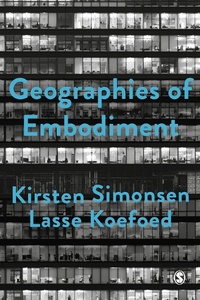
Geographies of Embodiment
Critical Phenomenology and the World of Strangers
1st Edition
Published on 13. January 2020
168 pages
978-1-5297-0214-9 (ISBN)
Description

Geographies of Embodiment provides a critical discussion of the literatures on the body and embodiment, and humanism and post-humanism, and develops arguments about "otherness" and "encounter" which have become key ideas in urban studies, and studies of the city. It situates these arguments in a wider political context, looking at power-relations through case studies at urban, national and transnational scales.
These arguments are situated across disciplinary boundaries, at the borderline between between philosophy and social science that is associated to critical phenomenology, and reaches across Human Geography, Sociology, Philosophy, Anthropology, Cultural Studies and Urban Studies.
These arguments are situated across disciplinary boundaries, at the borderline between between philosophy and social science that is associated to critical phenomenology, and reaches across Human Geography, Sociology, Philosophy, Anthropology, Cultural Studies and Urban Studies.
Reviews / Votes
Geographies of Embodiment by Koefoed and Simonsen presents articulate and sophisticated insights into issues about encounters, space and bodies through a practice-orientated reading of phenomenology. The book draws upon four projects over the last fifteen years about cities, encounters and nationalism to offer critical and engaging readings of encounters, embodiment, and the politics of urban life. This is an important text for critical and engaged scholars working in human geography, urban studies and racial and ethnic studies.Peter Hopkins, Professor of Social Geography, Newcastle University -- Peter Hopkins Rarely do I think that any book is a 'must-read', but that is surely the case with Geographies of Embodiment: Phenomenology and Strangers. Located on the border between philosophy and social science, this is a deeply theoretical book that is anchored by significant empirical research. Koefoed and Simonsen have written a powerful argument for a new humanism, one that is rooted in complex critical theories and phenomenological philosophies, yet is supported by important empirical work on the geographies of embodiment, practice and difference. The result is a book that makes us rethink present understandings of humanism, especially as the 'human' in humanism is (re)made in embodied spatial practice.
Lawrence D. Berg is Professor in Critical Geography at the University of British Columbia -- Lawrence D. Berg
More details
Series
Edition
1. Auflage
Language
English
Place of publication
London
United Kingdom
Publishing group
Sage Publications Ltd (Digital)
Target group
College/higher education
Professional and scholarly
Product notice
Reflowable
ISBN-13
978-1-5297-0214-9 (9781529702149)
Copyright in bibliographic data and cover images is held by Nielsen Book Services Limited or by the publishers or by their respective licensors: all rights reserved.
Schweitzer Classification
Other editions
Additional editions
Kirsten Simonsen | Lasse Koefoed
Geographies of Embodiment
Critical Phenomenology and the World of Strangers
Book
01/2020
1st Edition
SAGE Publications Ltd
€79.50
Shipment within 15-20 days
Kirsten Simonsen | Lasse Koefoed
Geographies of Embodiment
Critical Phenomenology and the World of Strangers
Book
01/2020
1st Edition
SAGE Publications Ltd
€136.10
Shipment within 15-20 days
Persons
Kirsten Simonsen is Professor in Social and Cultural Geography at Department of People and Technology, Roskilde University, Denmark. Her research concerns issues of philosophy of geography, Nordic geography, spatial conceptualizations, urban theory and everyday practices, and the living of racialized Others in contemporary European Cities.
Lasse Koefoed is Associate Professor at the Department of People and Technology, Roskilde University, Denmark, and is well known within Critical Geography. His research interests relate to urban geographies, cities and ethnic minorities, nation and nationalism, postcolonialism, cross-cultural encounters and everyday life.
Lasse Koefoed is Associate Professor at the Department of People and Technology, Roskilde University, Denmark, and is well known within Critical Geography. His research interests relate to urban geographies, cities and ethnic minorities, nation and nationalism, postcolonialism, cross-cultural encounters and everyday life.
Content
Introduction
Chapter 1. Figuring the ground
a. What is critical phenomenology
b. Critical phenomenology as a 'New Humanism'
Chapter 2. Bodies and embodiment
a. Thinking the body
b. Embodied Identities
c. The temporality and spatiality of the body (including case '(re)scaling identities)
d. Affectivity and emotions
Chapter 3. Encountering the Other
a. The concept of encounter
b. Different modes of encounter
c. Collective planned encounters
d. Encounters with authorities
e. Banal everyday encounters
Chapter 4. Urban Perspectives
a. The Flesh of the urban
b. The urban as a world of strangers
c. From invisibility to visibility: Opening of a purpose-built mosque in Copenhagen
Chapter 5: Political Perspectives
a. Everyday politics
b. Everyday nationalism
e. Politics of hospitality
Chapter 1. Figuring the ground
a. What is critical phenomenology
b. Critical phenomenology as a 'New Humanism'
Chapter 2. Bodies and embodiment
a. Thinking the body
b. Embodied Identities
c. The temporality and spatiality of the body (including case '(re)scaling identities)
d. Affectivity and emotions
Chapter 3. Encountering the Other
a. The concept of encounter
b. Different modes of encounter
c. Collective planned encounters
d. Encounters with authorities
e. Banal everyday encounters
Chapter 4. Urban Perspectives
a. The Flesh of the urban
b. The urban as a world of strangers
c. From invisibility to visibility: Opening of a purpose-built mosque in Copenhagen
Chapter 5: Political Perspectives
a. Everyday politics
b. Everyday nationalism
e. Politics of hospitality
