

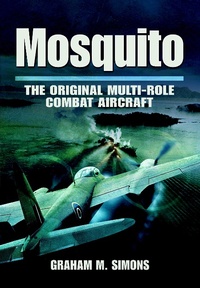
Mosquito
The Original Multi-Role Combat Aircraft
Published on 31. January 2020
256 pages
978-1-78383-128-9 (ISBN)
Description

A history of the high-speed wooden aircraft-from bomber to fighter, to photographic and weather reconnaissance-from the author of
B-17 Memphis Belle.
During the history of aviation there have been very few aircraft that have achieved immediate success when entering front-line service. The de Havilland Mosquito was one such aircraft. It was not designed to an RAF requirement, but was the result of an initiative of the designers and builders to utilize the skills of woodworkers and the relative abundance of wood in the crisis years of World War II. The result was an airplane that could be built quickly, was extremely fast and extremely versatile. The pilots loved it.
This book describes how it was built and utilizes many hitherto unpublished photographs from the design studio and production lines. It illustrates and explains the many different roles that the aircraft took as the war progressed. Fighter, bomber, reconnaissance, night fighter there were few tasks that this brilliant design could not adopt.
"To most Britain at War readers, the de Havilland Mosquito needs little introduction. Dramatic as such low-level attacks were, there is, as Graham Simons reveals in this latest insight into a remarkable aircraft, far more to the wartime service of the 'mossy.'"-Britain at War
During the history of aviation there have been very few aircraft that have achieved immediate success when entering front-line service. The de Havilland Mosquito was one such aircraft. It was not designed to an RAF requirement, but was the result of an initiative of the designers and builders to utilize the skills of woodworkers and the relative abundance of wood in the crisis years of World War II. The result was an airplane that could be built quickly, was extremely fast and extremely versatile. The pilots loved it.
This book describes how it was built and utilizes many hitherto unpublished photographs from the design studio and production lines. It illustrates and explains the many different roles that the aircraft took as the war progressed. Fighter, bomber, reconnaissance, night fighter there were few tasks that this brilliant design could not adopt.
"To most Britain at War readers, the de Havilland Mosquito needs little introduction. Dramatic as such low-level attacks were, there is, as Graham Simons reveals in this latest insight into a remarkable aircraft, far more to the wartime service of the 'mossy.'"-Britain at War
More details
Other editions
Additional editions
Graham M. Simons
Mosquito: The Original Multi-Role Combat Aircraft
Book
10/2015
Pen & Sword Aviation
€20.00
Shipment within 10-20 days
Graham M. Simons
Mosquito: the Original Multi-role Combat Aircraft
Book
05/2011
Pen & Sword Aviation
€44.75
Article exhausted; check different version
Person
English professional aviation writer, publisher and historian Graham M Simons is one of the founders of the world famous aviation museum at Duxford near Cambridge where his interest was piqued watching the making of the 'Battle of Britain film there in the late 1960s and from the days when you could go 'aircraft spotting at London Heathrow and other airports.
From this, and with an engineering background, he progressed to membership of a number of aviation societies, including sitting on the British Aviation Preservation Council, eventually taking the position of Engineering Director with one group. Here he was responsible for overseeing the restoration of a De Havilland DH89 Dragon Rapide airliner to flying condition and placing this aircraft - with official approval - in the colours and markings of the first aircraft of what was then the Kings Flight. It was during this period that he was contacted by Ian Allen Ltd to write the first ever history of this classic De Havilland type.
Other titles rapidly followed and with a growing number of contacts in both the military and airliners, Graham turned professional in 1987, combining his love of writing with his skills in production to create and publish aviation histories focussed on a variety of subjects.
He is the author of Howard Hughes and the Spruce Goose, Comet! The Worlds First Jet Airliner, The Airbus A380: A History, and De Havilland Enterprises: A History, amongst many others published by Pen & Sword Books.
From this, and with an engineering background, he progressed to membership of a number of aviation societies, including sitting on the British Aviation Preservation Council, eventually taking the position of Engineering Director with one group. Here he was responsible for overseeing the restoration of a De Havilland DH89 Dragon Rapide airliner to flying condition and placing this aircraft - with official approval - in the colours and markings of the first aircraft of what was then the Kings Flight. It was during this period that he was contacted by Ian Allen Ltd to write the first ever history of this classic De Havilland type.
Other titles rapidly followed and with a growing number of contacts in both the military and airliners, Graham turned professional in 1987, combining his love of writing with his skills in production to create and publish aviation histories focussed on a variety of subjects.
He is the author of Howard Hughes and the Spruce Goose, Comet! The Worlds First Jet Airliner, The Airbus A380: A History, and De Havilland Enterprises: A History, amongst many others published by Pen & Sword Books.
Content
- Cover
- Title Page
- Copyright Page
- Contents
- Acknowledgements
- Introduction
- Project
- Prototypes
- Construction and Build
- Photographic Reconnaissance
- Fighters
- Fighter-Bombers
- Bombers
- An infinitely Adaptable Aircraft
- From the Cockpit
- Mosquito variants
- Test Aircraft
- Conclusion
- Index
- Bibliography
