

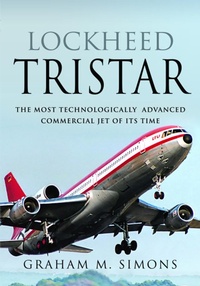
Lockheed TriStar
The Most Technologically Advanced Commercial Jet of Its Time
Published on 4. April 2023
320 pages
978-1-5267-5883-5 (ISBN)
Description

"A thoughtful, well-organized overview from the beginning to the twilight days of this iconic airliner" by the highly regarded aviation historian (
Large Scale Planes
).
In April 1972, after six grueling years of design and development, the then Lockheed California Company (now Lockheed Martin) delivered the most technologically advanced commercial jet of its era, the L-1011 TriStar, to its first client, Eastern Airlines.
To mark the moment, Lockheed decided to make an impressive statement about the capabilities of its new medium-to-long-range, wide-body trijet airliner. It did so in spectacular fashion. Overseen by two test pilots, a total of 115 crew members, VIPs, Lockheed employees, and selected reporters boarded a TriStar at Lockheed's Palmdale plant in California. The subsequent 4-hour, 13-minute flight to Washington Dulles Airport was achieved with virtually no input from the two pilots in the cockpit, the TriStar's Automatic Flight Control System being "engaged from takeoff roll to landing." It was, Lockheed proudly claimed, "the first cross-country flight without the need for human hands on the controls."
On the way to the L-1011's inaugural flight, Lockheed battled through design challenges, financial difficulties, and even international allegations of bribery, with the result that the TriStar, famed for its large, curved nose, low-set wings, and graceful swept tail, remained in production until 1984, by when 250 examples had been built. The toll on Lockheed, however, was too great and after the TriStar it withdrew from the commercial aircraft business.
In this revealing insight into the L-1011, the renowned aviation historian Graham M. Simons reveals the full story of this airliner's design, development and service over the decades since 1970.
In April 1972, after six grueling years of design and development, the then Lockheed California Company (now Lockheed Martin) delivered the most technologically advanced commercial jet of its era, the L-1011 TriStar, to its first client, Eastern Airlines.
To mark the moment, Lockheed decided to make an impressive statement about the capabilities of its new medium-to-long-range, wide-body trijet airliner. It did so in spectacular fashion. Overseen by two test pilots, a total of 115 crew members, VIPs, Lockheed employees, and selected reporters boarded a TriStar at Lockheed's Palmdale plant in California. The subsequent 4-hour, 13-minute flight to Washington Dulles Airport was achieved with virtually no input from the two pilots in the cockpit, the TriStar's Automatic Flight Control System being "engaged from takeoff roll to landing." It was, Lockheed proudly claimed, "the first cross-country flight without the need for human hands on the controls."
On the way to the L-1011's inaugural flight, Lockheed battled through design challenges, financial difficulties, and even international allegations of bribery, with the result that the TriStar, famed for its large, curved nose, low-set wings, and graceful swept tail, remained in production until 1984, by when 250 examples had been built. The toll on Lockheed, however, was too great and after the TriStar it withdrew from the commercial aircraft business.
In this revealing insight into the L-1011, the renowned aviation historian Graham M. Simons reveals the full story of this airliner's design, development and service over the decades since 1970.
More details
Other editions
Additional editions
Book
10/2021
Air World
€37.50
Shipment within 10-20 days
Content
- Cover
- Book Title
- Copyright
- Contents
- Acknowledgements
- Introduction
- Chapter One. What came before
- Chapter Two. Genesis of a Giant
- Chapter Three. Choice of Powerplant
- Chapter Four. Finance - and Problems
- Chapter Five. Build
- Chapter Six. Rollout and Flight Test
- Chapter Seven. TriStars on Tour!
- Chapter Eight. On Board the L-1011
- Chapter Nine. Into Service!
- Chapter Ten. Later Models and 'Active Control'
- Chapter Eleven. The RAF and Marshall Aerospace
- Chapter Twelve. Accidents and Incidents
- Chapter Thirteen. TwiLight of the TriStar
- Bibliography
- Index
