

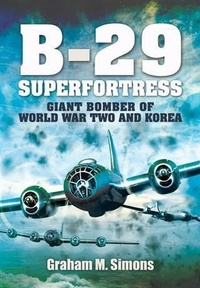
B-29
Superfortress
Published on 19. September 2012
256 pages
978-1-78337-619-3 (ISBN)
Description

"A well written history of a history-changing aircraft," the bomber that carried the two atomic bombs that destroyed Hiroshima and Nagasaki in WWII (
Aeromilitaria).
The Boeing B-29 Superfortress was a four-engined heavy bomber flown primarily by the United States in World War Two and the Korean War. The name "Superfortress" was derived from that of its well-known predecessor, the B-17 Flying Fortress. The B-29 was the progenitor of a series of Boeing-built bombers, reconnaissance aircraft, trainers and tankers including the variant, B-50 Superfortress.
The B-29 was one of the largest aircraft to see service during World War Two. A very advanced bomber for its time, it included features such as pressurized cabins, an electronic fire-control system and remote-controlled machine-gun turrets. Though it was designed as a high-altitude daytime bomber, in practice it actually flew more low-altitude nighttime incendiary bombing missions. It was the primary aircraft in the American firebombing campaign against Japan in the final months of World War Two. Unlike many other World War Two-era bombers, the B-29 remained in service long after the war ended, with a few even being employed as flying television transmitters. The type was finally retired in the early 1960s, with 3,960 aircraft in all built.
Without doubt there is a clear, strong requirement to "put the record straight" using primary source documentation to record the undoubted achievements alongside and in context with the shortcomings to the type's design and operation that have otherwise received scant attention. The book covers all variants and is profusely illustrated.
The Boeing B-29 Superfortress was a four-engined heavy bomber flown primarily by the United States in World War Two and the Korean War. The name "Superfortress" was derived from that of its well-known predecessor, the B-17 Flying Fortress. The B-29 was the progenitor of a series of Boeing-built bombers, reconnaissance aircraft, trainers and tankers including the variant, B-50 Superfortress.
The B-29 was one of the largest aircraft to see service during World War Two. A very advanced bomber for its time, it included features such as pressurized cabins, an electronic fire-control system and remote-controlled machine-gun turrets. Though it was designed as a high-altitude daytime bomber, in practice it actually flew more low-altitude nighttime incendiary bombing missions. It was the primary aircraft in the American firebombing campaign against Japan in the final months of World War Two. Unlike many other World War Two-era bombers, the B-29 remained in service long after the war ended, with a few even being employed as flying television transmitters. The type was finally retired in the early 1960s, with 3,960 aircraft in all built.
Without doubt there is a clear, strong requirement to "put the record straight" using primary source documentation to record the undoubted achievements alongside and in context with the shortcomings to the type's design and operation that have otherwise received scant attention. The book covers all variants and is profusely illustrated.
More details
Other editions
Additional editions
Graham M. Simons
B-29: Superfortress
Book
10/2012
Pen & Sword Aviation
€44.75
Shipment within 10-20 days
Person
English professional aviation writer, publisher and historian Graham M Simons is one of the founders of the world famous aviation museum at Duxford near Cambridge where his interest was piqued watching the making of the 'Battle of Britain' film there in the late 1960's and from the days when you could go 'aircraft spotting' at London Heathrow and other airports.
From this, and with an engineering background, he progressed to membership of a number of aviation societies, including sitting on the British Aviation Preservation Council, eventually taking the position of Engineering Director with one group. Here he was responsible for overseeing the restoration of a De Havilland DH89 Dragon Rapide airliner to flying condition and placing this aircraft - with official approval - in the colours and markings of the first aircraft of what was then the Kings Flight. It was during this period that he was contacted by Ian Allen Ltd to write the first ever history of this classic De Havilland type.
Other titles rapidly followed and with a growing number of contacts in both the military and airliners, Graham turned professional in 1987, combining his love of writing with his skills in production to create and publish aviation histories focussed on a variety of subjects.
He is the author of Howard Hughes and the Spruce Goose, Comet! The World's First Jet Airliner, The Airbus A380: A History, and De Havilland Enterprises: A History, amongst many others published by Pen and Sword Books.
From this, and with an engineering background, he progressed to membership of a number of aviation societies, including sitting on the British Aviation Preservation Council, eventually taking the position of Engineering Director with one group. Here he was responsible for overseeing the restoration of a De Havilland DH89 Dragon Rapide airliner to flying condition and placing this aircraft - with official approval - in the colours and markings of the first aircraft of what was then the Kings Flight. It was during this period that he was contacted by Ian Allen Ltd to write the first ever history of this classic De Havilland type.
Other titles rapidly followed and with a growing number of contacts in both the military and airliners, Graham turned professional in 1987, combining his love of writing with his skills in production to create and publish aviation histories focussed on a variety of subjects.
He is the author of Howard Hughes and the Spruce Goose, Comet! The World's First Jet Airliner, The Airbus A380: A History, and De Havilland Enterprises: A History, amongst many others published by Pen and Sword Books.
Content
- Intro
- Table of contents
- Introduction
- Origins
- Birth Pains
- Early Aircraft
- China
- Into the Pacific!
- Operation Centreboard
- Peace - and a 'Police Action'
- Washingtons and Tankers
- The B-50
- The Tu-4 'Bull'
- Specials
- Operating the B-29
- Bibliography
- Index
