

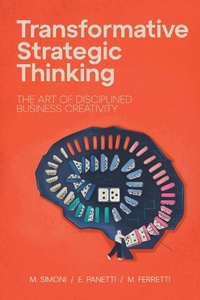
Transformative Strategic Thinking
Description

In an era marked by rapid innovation and disruptive technologies like AI, unforeseen global challenges like the recent pandemic, and pressing sustainability challenges, businesses' survival and success hinge on their ability to transform continuously.
The success stories of industry giants like Amazon, Uber, and Airbnb reveal a crucial insight: Thriving in today's market isn't just about innovative products or cutting-edge technology-it's about pioneering business models.
This book introduces the Transformative Strategic Thinking (TST) toolkit, a creative thinking methodology designed for businesses eager to embrace change and explore new business model scenarios. The TST toolkit combines analytical tools for evaluating current business models with five transformational practices for experimenting with new ones.
Concluding with real-life success stories of three entrepreneurs who navigated disruptive innovations and black swan events through the TST approach, this book provides a hands-on perspective on transforming business models. Different from traditional strategy literature, this book doesn't offer off-the-shelf formulas but empowers you to think creatively. With step-by-step guidance, visual collaboration tools, real-world case examples, exercises, and design tips, you will learn to dissect your current business model, identify areas for improvement, and foster a creative approach to developing new models.
Targeted at forward-thinking managers, daring entrepreneurs, aspiring business leaders, and ambitious startup founders, the TST toolkit equips them to challenge conventional business models and design innovative ones. It is equally valuable for students and enthusiasts of business design, design thinking, and entrepreneurship.
More details
Other editions
Additional editions
Persons
Content
- Front cover
- Half title
- Title
- Copyright
- Description
- Contents
- Acknowledgments
- Introduction
- The TST tool
- The TST Elements
- The TST Practices
- The TST Challenge
- Who Should Read This Book?
- CHAPTER 1 Shaping the Meaning
- What Will You Learn?
- Element #1 the Meaning: A Product Love Story
- Wrap-Up Questions
- Warm-Up Task
- Understanding the Meaning
- Step 1. Defne the End-Use
- Design Tips
- Step 2. Delimit the Usage Context
- Design Tips
- Step 3. Unveil the Symbolic Signifcance
- Design Tips
- So What?
- TST Challenge
- TST Practice #1 Transforming the Business Model Logic by Shaping the Meaning
- Shaping by Repurposing the Meaning End-Use
- Shaping by Moving the Meaning Usage Context
- Shaping by Changing the Meaning Symbolic Signifcance
- Key Takeaways
- Business Case Example
- Chapter Overview
- CHAPTER 2 Stretching the Experiential Performance
- What Will You Learn?
- Element #2 the Experiential Performance: Creating a Memorable Customer Experience
- Wrap-Up Questions
- Warm-Up Task
- Understanding the Experiential Performance
- Step 1. List the Experiential Building Blocks
- Design Tips
- Step 2. Find the Experiential Benchmark
- Design Tips
- Step 3. Qualify the Experiential Building Block
- Design Tips
- So What?
- TST Challenge
- TST Practice #2 Transforming the Business Model Logic by Stretching the Experiential Performance
- Stretching by Introducing or Removing Experiential Building Blocks
- Stretching by Altering the Experiential Quality
- Stretching by Shifting the Experiential Benchmark
- Key Takeaways
- Business Case Example
- Chapter Overview
- CHAPTER 3 Sharing the Resources
- What Will You Learn?
- Element #3 the Resources: Learning How to Win
- Wrap-Up Questions
- Warm-Up Task
- Understanding the Resources
- Step 1. Identify the Key Resources
- Step 2. Identify the Resource Regime
- So What?
- TST Challenge
- TST Practice #3 Transforming the Business Model Logic by Sharing the Resources
- Insharing the Resources
- Outsharing the Resources
- Key Takeaways
- Business Case Example
- Chapter Overview
- CHAPTER 4 Switching the Roles
- What Will You Learn?
- Element #4 the Roles: A Matter of Responsibilities
- Wrap-Up Questions
- Warm-Up Task
- Understanding the Roles
- Step 1. Identify the Flow of Key Activities
- Design Tips
- Step 2. Map the Flow of Key Activities
- Step 3. Identify the Key Roles
- So What?
- The TST Challenge
- TST Practice #4 Transforming the Business Model Logic by Switching the Roles
- Switching by Changing the Flow of Activities
- From Backstage to Onstage activities (KBA &KOA)
- From Onstage to Backstage (KOA &KBA)
- From Support to Backstage (KSA &KBA)
- From Backstage to Support (KBA &KSA)
- Switching by Changing the Key Actors
- Company to Customers and Vice Versa
- Company to Partners and Vice Versa
- Key Takeaways
- Business Case Example
- Chapter Overview
- CHAPTER 5 Swapping the Value Equation
- What Will You Learn?
- Element #5 Value Equation: No Pain, No Gain
- Wrap-Up Questions
- Warm-Up Task
- Understanding the Value Equation
- Step 1 . Assess the Benefts Provided
- Customer-Related Benefts
- Society-Related Benefts
- Environment-Related Benefts
- Step 2. Assess Required Effort
- Customer-Related Efforts
- Society-Related Efforts
- Environment-Related Efforts
- Step 3. Evaluate the Value Delivered
- So What?
- TST Challenge
- Design Tips
- Step 1. Assess the Benefts Provided
- Step 2. Assess the Required Efort
- Step 3. Evaluate the Value Delivered
- TST Practice #5 Transforming the Business Model Logic by Swapping the Value Equation
- Remove and Add Benefts/Efforts
- Reverse Benefts and Efforts
- Key Takeaways
- Business Case Example
- Chapter Overview
- CHAPTER 6 Disruptive Innovations
- What Will You Learn in This Chapter?
- Challenge #1 Disruptive Innovation: From the Fringe to the Mainstream
- Key Takeaways
- Understanding How Disruptive Innovation Affects Business Model Logics
- Step 1. Analyze the Current Business Model Logic
- Step 2. Pinpoint the Vulnerable Element
- Step 3. Experiment With a New Business Model Logic
- Applying TST to Deal With Disruptive Innovation: The Case of Hyper Crunch
- Hyper Crunch Before Being Disrupted
- Hyper Crunch Meaning-Before Disruptive Innovation
- Hyper Crunch Experiential Performance-Before Disruptive Innovation
- Hyper Crunch Resources-Before Disruptive Innovation
- Hyper Crunch Roles-Before Disruptive Innovation
- Hyper Crunch Value Equation-Before Disruptive Innovation
- Hyper Crunch Faces the Disruption
- Hyper Crunch After the Disruption
- Hyper Crunch Roles-After Disruptive Innovation
- Hyper Crunch Experiential Performance-After Disruptive Innovation
- Hyper Crunch Resources-After Disruptive Innovation
- Hyper Crunch Value Equation-After Disruptive Innovation
- Hyper Crunch Meaning-After Disruptive Innovation
- So What?
- Chapter Overview
- CHAPTER 7 Black Swan Events
- What Will You Learn in This Chapter?
- Challenge #2 Black Swan Events: Decoding the Unexpected
- Key Takeaways
- Understanding How Black Swan Events Affect Business Model Logics
- Step 1 . Understanding the Impact of the Black Swan Event
- Step 2. Analyze the Business Model Logic and Identify Vulnerable Element(s)
- Step 3. Experiment With a New Business Model Logic
- Applying TST to Deal With Black Swan Events Technology: The Case of MoreNFT
- MoreNFT Before the Black Swan
- MoreNFT Meaning-Before Black Swan
- MoreNFT Experiential Performance-Before Black Swan
- MoreNFT Resources-Before Black Swan
- MoreNFT Roles-Before Black Swan
- MoreNFT Value Equation-Before Black Swan
- MoreNFT Faces the Black Swan
- MoreNFT After the Black Swan
- MoreNFT Resources After the Black Swan
- MoreNFT Roles After the Black Swan
- MoreNFT Experiential Performance After Black Swan
- MoreNFT Value Equation After the Black Swan
- MoreNFT Meaning After the Black Swan
- So What?
- Chapter Overview
- CHAPTER 8 Paradox Management
- What Will You Learn in This Chapter?
- Challenge #3 Paradox Management: Bridging Contradictions for Business Success
- Key Takeaways
- Understanding How Paradox Management Affects Business Model Logics
- Step 1. Analyze the Current Business Model Logic
- Step 2. Pinpoint the Polarized Elements
- Step 3. Experiment With a New Business Model Logic
- Applying TST to Managing Paradoxes: The Case of Congo Clothing Company (CCC)
- CCC Before Managing the Paradoxes
- CCC Meaning Before Managing the Paradoxes
- CCC Experiential Performance Before Managing the Paradoxes
- CCC Resources Before Managing the Paradoxes
- CCC Roles Before Managing the Paradoxes
- CCC Value Equation Before Managing the Paradoxes
- CCC Deals With the Paradoxes
- CCC After Managing the Paradoxes
- CCC Meaning After Managing the Paradoxes
- CCC Experiential Performance After Managing the Paradoxes
- CCC Resources After Managing the Paradoxes
- CCC Roles After Managing the Paradoxes
- CCC Value Equation After Managing the Paradoxes
- So What?
- Chapter Overview
- Conclusions
- Competitiveness Beyond Products
- Thriving Through Transformation
- Understanding Assumptions for Change
- Elemental Transformation
- Goal 1: Understanding Assumptions Behind a Business Model
- Goal 2: Experiment with Alternative Business Model Logic Transformations
- When Should You Use the TST Tool?
- Business Model Diagnosis
- Generation and Selection of Alternative Business Model Scenarios
- Business Model Validation
- Bibliography
- Chapter 1
- Chapter 2
- Chapter 3
- Chapter 4
- Chapter 5
- Chapter 6
- Chapter 7
- Chapter 8
- About the Authors
- Index
- OTHER TITLES IN THE SERVICE SYSTEMS AND INNOVATION FOR BUSINESS AND SOCIETY COLLECTION
- Concise and Applied Business Books
- Back cover
