

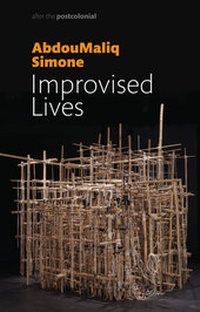
Improvised Lives
Description

More details
Other editions
Additional editions
Content
2
Ensemble Work
The air of the thing that escapes enframing is what I'm interested in - an often unattended movement that accompanies largely unthought positions and appositions. What if the thing whose meaning or value has never been found finds things, founds things? What if the thing will have founded something against the very possibility of foundation and against all anti- or post-foundational impossibilities? What if the thing sustains itself in the absence or eclipse of meaning that withholds from the thing the horrific honorific of "object"? At the same time, what if the value of that absence or excess is given to us only in and by way of a kind of failure or inadequacy - or, perhaps more precisely, by way of a history of exclusion, serial expulsion, presence's ongoing taking of leave - the non-attainment of meaning or ontology, of source or origin. (Moten 2008: 182)
The notion of ensemble work, its strange "thing-ness," takes its cue from the concept of harmolodics that Ornette Coleman applied to his music. This is a way of playing where melody is not superseded by harmony, where the democracy of the ensemble was such that each player could deliver the melody in its own configuration of rhythm and chord changes. Harmolodic modulation is the method of moving the same notes-as-written from one clef to another in order to yield various names accompanied by a parallel modulation where the same notes are played on different instruments in order to realize various sounds.
So, the following vignettes operate as an ensemble. The ensemble will play out some of the variety of rhythms of endurance. The vignettes take up some of the notions applied in the discussion of the uninhabitable as method, notions such as "strange alliances," "spirals," "scenes of the crime," and "detachment." For now, the "players" in these vignettes will stay close to home, close to the places they come from, even if these places have been left behind a long time ago, to their own devices, without the players.
Strange Alliances
Ambassador and Kuningan ITC are attached 30-year-old malls set in the midst of the accelerated expansion of the central business district in Jakarta. Mega-towers now spread across decomposed working-class districts. The mall is full of small stores and is known for its supply of cheap electronics and software. It is always crowded with consumers actually shopping rather than simply soaking up the ambiance of a newer generation of malls. With the exception of the Carrefour supermarket, none of the outlets are parts of brand stores. The operation is largely managed by a collection of brokers orchestrating oscillating supply chains, managing intricate subcontracting arrangements over commercial space and use, and sculpting layers of complementarity among sellers, providers, and customers in ways that generate interacting specializations and piece together different scales of deals.
The Ambassador continues to thrive in ways that enfold many different sources of goods, types of knowledge, and networks of contact that keep prices affordable and customers engaged. But those who have worked the mall for a long time also point to a much more opaque and intricate space of operation that is situated in the dense strip of a popular neighborhood in Karbela that endures just outside the northern circumference of the mall's parking area. This densely packed old neighborhood, one of the few left in the area, is a repository of a different sort. Several of the brokers who actually manage the comings and goings of the Ambassador have their small houses here and help oversee an "archive" of stories presented by passers-by in search of family and friends gone missing, or conversely, in search of interventions for their inability to distance themselves from kin, lovers, and affiliations that always manage to know exactly where they can be found at any given time.
Passers-by also crowd small street-side eating places or the makeshift "foyers" of makeshift associations presenting projects they want to pursue and are searching for partners whose identity they would prefer not to know. This is a neighborhood that is party to stitchedtogether deals of all kinds, a place where strangers are put in touch with other strangers, where individuals with no clear purpose in mind can simply get a "take" on things, garner a sense of what is going on in places beyond their immediate experience. The neighborhood hosts all-night gambling games where police, politicians, businesspeople, and thugs all show up at the table. It is a place where special prayers are offered, curses exorcised, and secrets can be both widely shared or safely stored, depending on whom you talk to.
Whatever transpires here has no direct connection to the mall next door outside a scattering of "shared personnel," who insist that the components of their "multi-tasking" have nothing to do with each other. But when a piece of knowledge is gained, an inquiry proffered or a connection made in this Karbela neighborhood, the individual involved usually says that it took place at the Ambassador. So, while it is possible to tell all kinds of stories about how each domain relates to and possibly protects the other, it is never going to be clear which does what to whom. This is not interoperable data. Trying to pin down the details of all the interventions involved is a constantly frustrating task, although it is widely known that these interventions, whatever they consist of on a point-by-point basis, travel far and wide. Perhaps it is all an urban myth. But if so, it is a myth capable of engendering weird relationships of all kinds, strange alliances seemingly impervious to contradiction.
It is precisely these "strange alliances" on which increasing numbers of residents in Jakarta come to rely. These are strange alliances that almost operate as a version of exotic financial instruments in their capacity to meld relationships among divergent experiences and materials. These are strange alliances that do not so much connote an instrumentality among defined interests so as to maximize their respective maneuverability or self-aggrandizement. Rather they are alliances undertaken often without a clear sense of what the resultant dispositions might be. For example, while the tremulous endurance of "popular" districts such as Karbela, which run like fossilized layers across the growing "rock formations" of Jakarta's expanding central business district (CBD), generates income from providing cheap accommodation, food, and services to thousands upon thousands of workers, this complementarity, while important, is not the primary reason that these neighborhoods endure.
Rather, it is the pursuit by the popular - in its particular mixtures of political clientelism, authority claims, and tactical wisdom - of some of the very logics of the CBD that consolidates an "immunity" of these territories, at least for now. In other words, constellations of actors/residents in Karbela operate as "holding companies," develop local forms of "securitization" playing with varying statuses and ambiguities of land, design "ownership," and "tenancy" systems that are then concretized laterally over a patchwork of "properties" and "residencies." Trying to identify the clear, outright ownership of a particular plot of land and the building implanted on it takes you into a nebulous web of expanding lateral connections that stymie many conventional land acquisition maneuvers undertaken by the major developers. What is particularly ironic is that some of these developers, unbeknownst to them, are part of these intricate cross-ownership structures.
Nevertheless, for an increasing number of Jakarta's residents, popular districts are being unraveled, and their residents individuated into more accountable "citizens." These are districts that historically melded different ways of life, built environments, resources, and livelihoods in a process both reflective and constitutive of intensely heterogeneous urban sensibilities and practices. The proliferation of mega-housing complexes across the region becomes a device for materializing and staging this individuation. Attention shifts from the labor-intensive management of local, interior districtlevel relationships to managing more diffuse circulations across the urban context. Consolidating a place of belonging, of home, shifts in favor of better anticipating and positioning oneself to be "in the right place at the right time." Such sensibilities usually produce impatience with efforts to cultivate long-term connections and, instead, generate more provisional affiliations with workplaces. Here, even the notion of the salary partially dissolves into a thicket of other amenities, rewards, and access to opportunities.
But whether this individuation plays out in terms of increased atomization, precarity, and the diminution of any form of collective life remains a question. Rather, such individuation, as well as the experiences of Karbela, suggests the potential importance of the notion of "compression" as a mode of visibility (invisibility) for how seemingly divergent components of something - a collective or a housing development, for example - might operate in conjunction with each other without necessarily showing that any such mutuality...
