

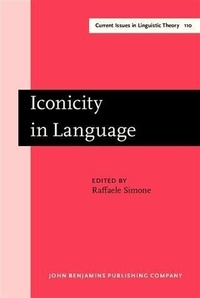
Iconicity in Language
1st Edition
Published on 10. February 1995
XII, 315 pages
978-90-272-8570-6 (ISBN)
Description

Several current linguistic approaches converge in rejecting the wide-spread idea that language is an autonomous system, i.e. that it is structured independently from the outside world and the natural equipment of language users. Around the world, semiotically biased linguistics (functionalism, naturalism, etc.) takes this position, which differentiates it very clearly from generative linguistics. One of the basic assumptions of such approaches is that language structure includes some non-arbitrary aspects, from the phonological through the textual level, and a great amount of research has occurred in the last decade regarding the "iconic aspects" of language(s). This volume focuses on generally neglected dimensions of language and semiotic activity, featuring contributions by philosophers, linguists, semioticians, and psychologists. After tracing the tradition of iconicity in the history of linguistic thought, the central section is devoted to specific analyses emphasizing the role of non-arbitrary phenomena in language foundation and linguistic structure. Specifically discussed are numeration systems, the gestural systems of communication among deaf people, the genesis of writing in children, and inter-ethnic communication.
More details
Other editions
Additional editions
Raffaele Simone
Iconicity in Language
Book
02/1995
John Benjamins Publishing Co
€127.20
Shipment within 10-15 days
Person
Content
- ICONICITY IN LANGUAGE
- Editorial page
- Title page
- Copyright page
- Table of contents
- Foreword Under the Sign of Cratylus
- Notes
- References
- I. History of Linguistics
- Criticisms of the Arbitrariness of Languagein Leibniz and Vico and the 'Natural'Philosophy of Language
- Appendix
- Notes
- References
- II. Semiotic Theory
- Interactions between Iconicity and Other Semiotic Parameters in Language
- Notes
- References
- Iconicity and/or Arbitrariness
- Appendix
- Notes
- References
- Isomorphism in the Grammatical Code Cognitive and Biological Considerations
- 1. Isomorphic vs. arbitrary coding
- 2. Principles of iconic coding
- 3. Combining iconic and conventional elements
- 4. The biological basis of iconic codes
- 5. Closure
- 6. Markedness as meta-iconicity
- NOTES
- REFERENCES
- The Icon as an Abductive Process towards Identity
- Notes
- III. Language Description and Linguistic Theory
- The Iconic Index: from Sound Change to Rhyming Slang
- 1. Introduction
- 2. Iconicity and Change
- 3. Drastic Changes
- 4. Conclusion
- Notes
- References
- Iconicity in Grammaticalization Processes
- 1. Introduction
- 2. Iconicity vs. Transparency
- 3. Evidence from Acquisition and from Pidgins and Creoles
- 4. Language Change and Analogy
- 5. Exploring Parallel Developments: the Acquisition of Tense-Mood-Aspect morphology
- 6. Some Concluding Remarks
- Notes
- References
- Iconicity between Indicativity and Predicativity
- 1. Introduction
- 2. Iconicity between Indicativity and Predicativity in Numeration
- 3. Conclusion
- Note
- References
- Iconic Aspects of Syntax: A Pragmatic Approach
- 1. Preliminaries
- 2. A Paradigm Theory of Iconic Syntax
- 3. 'Iconic' and 'Diagrammatic' Syntax
- 4. Pragmatic Considerations: Utterances as Tools for Actions
- 5. Conclusion: Limitations of the Arbitrariness Paradigm
- Notes
- References
- Figure and Ground in Second Language Narratives: Traces of Iconicity
- 1. Introduction
- 2. The Figure/Ground Distinction: Formal and Substantive Criteria
- 3. The Linguistic Mechanisms and Communicative Strategies of Grounding: Hypotheses
- 4. Corpus Characteristics
- 5. Analysis of Narratives
- 6. Surface Signals of Figure/Ground and Iconicity
- 7. Conclusions
- Transcript notation
- Notes
- References
- Morphological Markedness in L2 Acquisition
- 1. Introduction: Theoretical Background
- 2. Morphological Development in a Notional Perspective
- 3. A Formal Perspective
- 4. Conclusions
- Notes
- References
- IV. Sign Systems Other than Verbal Language
- Terms for Spatio-Temporal Relations in Italian Sign Language
- 1. Introduction
- 2. Methodology and Data
- 3. Spatio-Temporal Terms for Priority and Antecedence in LIS
- 4. Iconic Features of the LIS Spatio-Temporal Terms Compared with Spoken Language Terms
- 5. Conclusion
- Notes
- References
- Creative Iconic Gestures: Some Evidence from Aphasics
- 1. Codified and Creative Gestures
- 2. Nouns by Words and Nouns by Gestures
- 3. Iconic Creative Gestures in Aphasics
- 4. Method
- 5. Results and Discussion
- Notes
- References
- Iconicity in Children's First Written Texts
- 1. Introduction
- 2. Trends in the Development of Children's Theories on Writing
- 3. Formal Versus Meaning Differentiation: The Cases of the Diminutive and the Plural Forms in the Italian System
- 4. The Syllabic Evolution: Toward a Stable and Conventional Sound Value
- 5. Interpreting Words with and without Letter Duplication with Related Meanings
- 6. Writing Different Types of Text: What Changes?
- 7. Final comments
- References
- Index
- The series Current Issues in Linguistic Theory
