

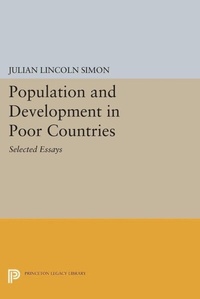
Population and Development in Poor Countries
Selected Essays
1st Edition
Published on 14. July 2014
484 pages
978-1-4008-6217-7 (ISBN)
Description

Making the case that population growth does not hinder economic progress and that it eventually raises standards of living, Julian Simon became one of the most controversial figures in economics during the past decade. This book gathers a set of articles--theoretical, empirical, and policy analyses--written over the past twenty years, which examine the effects of population increase on various aspects of economic development in less-developed economies. The studies show that within a century, or even a quarter of a century, the positive benefits of additional people counterbalance the short-run costs. The process is as follows: increased numbers of consumers, and the resultant increase of total income, expand the demand for raw materials and finished products. The resulting actual and expected shortages force up prices of the natural resources. The increased prices trigger the search for new ways to satisfy the demand, and sooner or later new sources and innovative substitutes are found. These new discoveries lead to cheaper natural resources than existed before this process began, leaving humanity better off than if the shortages had not appeared.
Originally published in 1992.
The Princeton Legacy Library uses the latest print-on-demand technology to again make available previously out-of-print books from the distinguished backlist of Princeton University Press. These editions preserve the original texts of these important books while presenting them in durable paperback and hardcover editions. The goal of the Princeton Legacy Library is to vastly increase access to the rich scholarly heritage found in the thousands of books published by Princeton University Press since its founding in 1905.
Originally published in 1992.
The Princeton Legacy Library uses the latest print-on-demand technology to again make available previously out-of-print books from the distinguished backlist of Princeton University Press. These editions preserve the original texts of these important books while presenting them in durable paperback and hardcover editions. The goal of the Princeton Legacy Library is to vastly increase access to the rich scholarly heritage found in the thousands of books published by Princeton University Press since its founding in 1905.
More details
Other editions
Additional editions
Book
04/2016
Princeton University Press
€158.30
Article not available at the moment
Book
07/2014
Princeton University Press
€61.10
Article not available at the moment

Book
06/1992
Princeton University Press
€80.47
Article exhausted; check different version
Person
Julian Lincoln Simon
Content
FrontMatter, pg. i
Contents, pg. vii
Acknowledgments, pg. ix
Introduction, pg. xi
1.The Effects of Population on Nutrition and Economic Well-Being, pg. 3
2. Demographic Causes and Consequences of the Industrial Revolution, pg. 24
3. An Integration of the Invention-Pull and Population- Push Theories of Economic-Demographic History, pg. 43
4. Some Theory of Population Growth's Effect on Technical Change in an Industrial Context, pg. 78
5. Population, Natural Resources, and the Long-Run Standard of Living, pg. 89
6. Robinson Crusoe Was Not Mainly a Resource Allocator, pg. 122
7. There Is No Low-Level Fertility-and-Development Trap, pg. 127
8. Population Growth May Be Good for LDCs in the Long Run: A Richer Simulation Model, pg. 143
9a. The Relationship between Population and Economic Growth in LDCs, pg. 180
9b. On Aggregate Empirical Studies Relating Population Variables with Economic Development, pg. 199
10. The Positive Effect of Population Growth on Agricultural Saving in Irrigation Systems, pg. 209
11. "Population Pressure" on the Land: Analysis of Trends Past and Future, pg. 223
12. The Effect of Population Density on Infrastructure: The Case of Road Building, pg. 242
13a. The Effect of Population Growth on the Quantity of Education Children Receive, pg. 259
13b. The Effect of Population Growth on the Quantity of Education Children Receive: A Reply, pg. 284
14. Does Population Growth Cause Unemployment, or Economic Development, or Both?, pg. 289
15. The Effects of Population Size, Growth, and Concentration on Scientific Productivity, pg. 317
16. Population Size, Knowledge Stock, and Other Determinants of Agricultural Publication and Patenting: England, 1541-1850, pg. 334
17. Population Growth, Economic Growth, and Foreign Aid, pg. 363
18. The Welfare Effect of an Additional Child Cannot Be Stated Simply and Unequivocally, pg. 389
19. On the Evaluation of Progress and Technological Advance, Past and Future, pg. 411
20. Lebensraum: An Essay on Peace in the Future; or, Population Growth May Eventually End Wars, pg. 423
Epilogue: Some History and Reflections on Population Economics, pg. 435
Index, pg. 455
Contents, pg. vii
Acknowledgments, pg. ix
Introduction, pg. xi
1.The Effects of Population on Nutrition and Economic Well-Being, pg. 3
2. Demographic Causes and Consequences of the Industrial Revolution, pg. 24
3. An Integration of the Invention-Pull and Population- Push Theories of Economic-Demographic History, pg. 43
4. Some Theory of Population Growth's Effect on Technical Change in an Industrial Context, pg. 78
5. Population, Natural Resources, and the Long-Run Standard of Living, pg. 89
6. Robinson Crusoe Was Not Mainly a Resource Allocator, pg. 122
7. There Is No Low-Level Fertility-and-Development Trap, pg. 127
8. Population Growth May Be Good for LDCs in the Long Run: A Richer Simulation Model, pg. 143
9a. The Relationship between Population and Economic Growth in LDCs, pg. 180
9b. On Aggregate Empirical Studies Relating Population Variables with Economic Development, pg. 199
10. The Positive Effect of Population Growth on Agricultural Saving in Irrigation Systems, pg. 209
11. "Population Pressure" on the Land: Analysis of Trends Past and Future, pg. 223
12. The Effect of Population Density on Infrastructure: The Case of Road Building, pg. 242
13a. The Effect of Population Growth on the Quantity of Education Children Receive, pg. 259
13b. The Effect of Population Growth on the Quantity of Education Children Receive: A Reply, pg. 284
14. Does Population Growth Cause Unemployment, or Economic Development, or Both?, pg. 289
15. The Effects of Population Size, Growth, and Concentration on Scientific Productivity, pg. 317
16. Population Size, Knowledge Stock, and Other Determinants of Agricultural Publication and Patenting: England, 1541-1850, pg. 334
17. Population Growth, Economic Growth, and Foreign Aid, pg. 363
18. The Welfare Effect of an Additional Child Cannot Be Stated Simply and Unequivocally, pg. 389
19. On the Evaluation of Progress and Technological Advance, Past and Future, pg. 411
20. Lebensraum: An Essay on Peace in the Future; or, Population Growth May Eventually End Wars, pg. 423
Epilogue: Some History and Reflections on Population Economics, pg. 435
Index, pg. 455
