

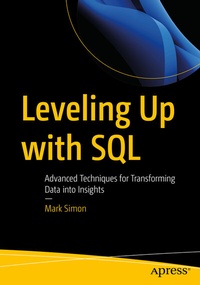
Leveling Up with SQL
Description

Learn to write SQL queries to select and analyze data, and improve your ability to manipulate data. This book will help you take your existing skills to the next level.
Author Mark Simon kicks things off with a quick review of basic SQL knowledge, followed by a demonstration of how efficient SQL databases are designed and how to extract just the right data from them. You'll then learn about each individual table's structure and how to work with the relationships between tables. As you progress through the book, you will learn more sophisticated techniques such as using common table expressions and subqueries, analyzing your data using aggregate and windowing functions, and how to save queries in the form of views and other methods. This book employs an accessible approach to work through a realistic sample, enabling you to learn concepts as they arise to improve parts of the database or to work with the data itself.
After completing this book, you will have a more thorough understanding of database structure and how to use advanced techniques to extract, manage, and analyze data.
What Will You Learn
- Gain a stronger understanding of database design principles, especially individual tables
- Understand the relationships between tables
- Utilize techniques such as views, subqueries, common table expressions, and windowing functions
Who Is This Book For:
SQL Databases users who want to improve their knowledge and techniques.
More details
Other editions
Additional editions
Person
Content
Chapter 1: Getting Ready.- Chapter 2: Working with Table Design.- Chapter 3: Table Relationships and Working With Joins.- Chapter 4: Working with Calculated Data.- Chapter 5: Aggregating Data.- Chapter 6: Creating and Using Views and Friends.- Chapter 7: Working With Subqueries and Common Table Expressions.- Chapter 8: Working With Window Functions.-Chapter 9: More on Common Table Expressions.- Chapter 10: More Techniques with SQL: Triggers, Pivot Tables, and Variables.- Appendix A.
