

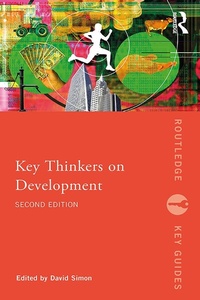
Key Thinkers on Development
2nd Edition
Published on 2. April 2019
528 pages
978-1-351-02629-1 (ISBN)
Description

Since its publication in 2006 as Fifty Key Thinkers on Development, this invaluable reference has established itself as the leading biographical handbook in its field, providing a concise and accessible introduction to the lives and key contributions of development thinkers from across the ideological and disciplinary spectrum. This substantially expanded and fully updated second edition in the relaunched series without the numerical constraint includes an additional 24 essays, filling in many gaps in the original selection, greatly improving the gender balance and diversifying coverage to reflect the evolving landscape of development in theory, policy and practice.
It presents a unique guide to the lives, ideas and practices of leading contributors to the contested terrain of development studies and development policy and practice. Its thoughtful essays reflect the diversity of development in theory, policy and practice across time, space, disciplines and communities of practice. Accordingly, it challenges Western-centrism, Orientalism and the like, while also demonstrating the enduring appeal of "development" in different guises. David Simon has assembled a highly authoritative team of contributors from different backgrounds, regional settings and disciplines to reflect on the lives and contributions of leading authorities on development from around the world. These include:
Modernisers like Kindleberger, Perroux and Rostow
Dependencistas such as Frank, Furtado, Cardoso and Amin
Progressives and critical modernists like Hirschman, Prebisch, Helleiner Sen, Streeten and Wang
Political leaders enunciating radical alternative visions of development, such as Mao, Nkrumah and Nyerere
Progenitors of religiously or spiritually inspired development, such as Gandhi, Ariyaratne and Vivekananda
Development-environment thinkers like Agarwal, Blaikie, Brookfield, Ostrom and Sachs
International institution builders like Singer, Hammarskoeld, Kaul and Ul Haq
Anti- and post-development thinkers and activists like Escobar, Ghosh, Quijano and Roy
Key Thinkers on Development is therefore the essential handbook on the world's most influential development thinkers and an invaluable guide for students of development and sustainability, policy-makers and practitioners seeking an accessible overview of this diverse field and its leading voices.
It presents a unique guide to the lives, ideas and practices of leading contributors to the contested terrain of development studies and development policy and practice. Its thoughtful essays reflect the diversity of development in theory, policy and practice across time, space, disciplines and communities of practice. Accordingly, it challenges Western-centrism, Orientalism and the like, while also demonstrating the enduring appeal of "development" in different guises. David Simon has assembled a highly authoritative team of contributors from different backgrounds, regional settings and disciplines to reflect on the lives and contributions of leading authorities on development from around the world. These include:
Modernisers like Kindleberger, Perroux and Rostow
Dependencistas such as Frank, Furtado, Cardoso and Amin
Progressives and critical modernists like Hirschman, Prebisch, Helleiner Sen, Streeten and Wang
Political leaders enunciating radical alternative visions of development, such as Mao, Nkrumah and Nyerere
Progenitors of religiously or spiritually inspired development, such as Gandhi, Ariyaratne and Vivekananda
Development-environment thinkers like Agarwal, Blaikie, Brookfield, Ostrom and Sachs
International institution builders like Singer, Hammarskoeld, Kaul and Ul Haq
Anti- and post-development thinkers and activists like Escobar, Ghosh, Quijano and Roy
Key Thinkers on Development is therefore the essential handbook on the world's most influential development thinkers and an invaluable guide for students of development and sustainability, policy-makers and practitioners seeking an accessible overview of this diverse field and its leading voices.
More details
Series
Edition
2nd edition
Language
English
Place of publication
London
United Kingdom
Publishing group
Taylor & Francis Ltd
Target group
College/higher education
File size
4,32 MB
ISBN-13
978-1-351-02629-1 (9781351026291)
Copyright in bibliographic data and cover images is held by Nielsen Book Services Limited or by the publishers or by their respective licensors: all rights reserved.
Schweitzer Classification
Other editions
Additional editions
David Simon
Key Thinkers on Development
Book
04/2019
2nd Edition
Routledge
€45.40
Shipment within 10-20 days
David Simon
Key Thinkers on Development
Book
04/2019
2nd Edition
Routledge
€146.40
Shipment within 10-20 days
Person
David Simon is Professor of Development Geography at Royal Holloway, University of London, UK, and Director of Mistra Urban Futures, Chalmers University of Technology, Gothenburg, Sweden. He is author, editor and co-editor of many books and journal special issues on cities, development-environment challenges and climate change adaptation, most recently Rethinking Sustainable Cities: Accessible, Green and Fair (2016), Urban Planet (2018) and Holocaust Escapees and Global Development: Hidden Histories (2019).
Content
Adebayo Adedeji (1930-2018) Irma Adelman (1930-2017) Anil Agarwal (1947-2002) Elmar Altvater (1938-2018) Samir Amin (1931-2018) Alice Amsden (1943-2012) A.T. Ariyaratne (1931-) Jagdish Bhagwati (1934-) Piers Blaikie (1942-) James M. (Jim) Blaut (1927-2000) Norman Borlaug (1914-2009) Ester Boserup (1910-1999) Harold Brookfield (1926-) Fernando Henrique Cardoso (1931-) Michael Cernea (1934-) Robert Chambers (1932-) Hollis B. Chenery (1918-1994) Diane Elson (1946-) Arturo Escobar (1952-) Frantz Fanon (1925-1961) Fei Xiaotong (1919-2005) Andre Gunder Frank (1929-2005) Paolo Freire (1921-1997) John Friedmann (1926-2017) Celso Furtado (1920-2004) Mohandas (Mahatma) Gandhi (1869-1948) Susan George (1934-) Alexander Gerschenkron (1904-1978) Jayati Ghosh (1955-) Eduardo Gudynas (1960-) Dag Hammarskjoeld (1905-1961) Gerald K. Helleiner (1936-) Albert O. Hirschman (1915-2012) Philippe Hugon (1939-2018) Richard Jolly (1934-) Naila Kabeer (1950-) Michal Kalecki (1899-1970) Inge Kaul (1944-) Akhtar Hameed Khan (1914-1999) Charles Poor Kindleberger (1910-2003) Sir William Arthur Lewis (1915-1991) Michael Lipton (1937-) Reverend Thomas Robert Malthus (1766-1834) Mao Zedong (1893-1976) Karl Marx (1818-1883) Manfred Max-Neef (1932-) Terence Gary McGee (1936-) Gunnar Myrdal (1898-1987) Kwame Francis Nkrumah (1909-1972) Ragnar Nurkse (1907-1957) Julius Kambaragwe Nyerere (1922-1999) Elinor Ostrom (1933-2012) Francois Perroux (1903-1987) Karl Polanyi (1886-1964) Raul Prebisch (1901-1986) Anibal Quijano (1928-2018) Joan Robinson (1903-1983) Walter Rodney (1942-1980) Paul Rosenstein-Rodan (1902-1985) Walt Whitman Rostow (1916-2003) Aruna Roy (1946-) Ignacy Sachs (1927-) E.F. (Fritz) Schumacher (1911-1977) Dudley Seers (1920-1983) Amartya Kumar Sen (1933-) Hans Wolfgang Singer (1910-2006) Frances Stewart (1940-) Joseph Stiglitz (1943-) Paul Patrick Streeten (1917-2019) James Tobin (1918-2002) Mahbub Ul Haq (1934-1998) Swami Vivekananda (1863-1902) Wang Hui (1959-) Eric R. Wolf (1923-1999) Peter Worsley (1924-2013)
