

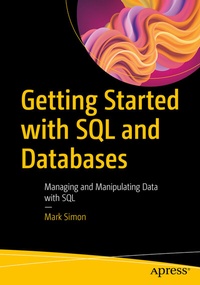
Getting Started with SQL and Databases
Description

Learn the basics of writing SQL scripts. Using Standard SQL as the starting point, this book teaches writing SQL in various popular dialects, including PostgreSQL, MySQL/MariaDB, Microsoft SQL Server, Oracle, and SQLite.
The book starts with a general introduction to writing SQL and covers the basic concepts. Author Mark Simon then covers database principles, and how database tables are designed. He teaches you how to filter data using the WHERE clause, and you will work with NULL, numbers, dates, and strings. You will also understand sorting results using the ORDER BY clause, sorting by calculated columns, and limiting the number of results. By the end of the book, you will know how to insert and update data, and summarize data with aggregate functions and groups. Three appendices cover differences between SQL dialects, working with tables, and a crash course in PDO.
What You Will Learn
- Filter, sort, andcalculate data
- Summarize data with aggregate functions
- Modify data with insert, update, and delete statements
- Study design principles in developing a database
Who This Book Is For
Developers and analysts working with SQL, as well as web developers who want a stronger understanding of working with databases
More details
Other editions
Additional editions
Person
Mark Simon has been involved in training and education since the beginning of his career. He started as a teacher of mathematics but soon moved into IT consultancy and training because computers are much easier to work with than high school students! He has worked with and trained in several programming and coding languages, and currently focuses on web development and database languages. When not involved in work, you will generally find Mark listening to or playing music, reading, or just wandering about.
Content
Chapter 1: SQL Sampler.- Chapter 2: Database.- Chapter 3: Filtering Data.- Chapter 4: Ordering Results.- Chapter 5: Calculating Column Values.- Chapter 6: Selecting from Multiple Tables.- Chapter 7: Aggregating Data.- Chapter 8: Working with Tables.- Chapter 9: SQL Techniques.- Appendix 1: Differences Between SQL Dialects.- Appendix 2: Working with Tables.- Appendix 3: A Crash Course in PDO.
