

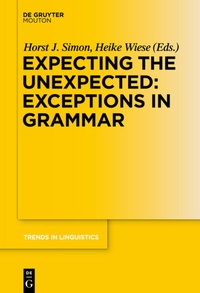
Expecting the Unexpected: Exceptions in Grammar
Description

Every linguistic theory has to come to grips with a fundamental property of human language: the existence of exceptions, i.e. phenomena that do not follow the standard patterns one observes otherwise. The contributions to this volume discuss and exemplify a variety of approaches to exceptionality within different formal and non-formal frameworks.
Topics include criteria for exceptionality, the diachronic rise of exceptions, the relevance of different grammatical subsystems and their interaction in the explanation of exceptions, and the crucial characteristics of grammatical models that can accommodate exceptions. A special feature of the book is that the articles are accompanied by peer-commentaries and responses thereupon, thus opening up the papers to further discussion.
More details
Other editions
Additional editions
Persons
Content
- Intro
- Contents
- Preface
- Introductory overview
- What are exceptions? And what can be done about them?
- Coming to grips with exceptions
- Classical loci for exceptions: morphology and the lexicon
- Exceptions to stress and harmony in Turkish: co-phonologies or prespecification?
- Lexical exceptions as prespecification: some critical remarks
- Feature spreading, lexical specification and truncation
- Higher order exceptionality in inflectional morphology
- An I-language view of morphological 'exceptionality': Comments on Corbett's paper
- Exceptions and what they tell us: reflections on Anderson's comments
- How do exceptions arise? On different paths to morphological irregularity
- On the role of subregularities in the rise of exceptions
- Statement on the commentary by Wolfgang U. Dressler
- Taking into account interactions of grammatical sub-systems
- Lexical variation in relativizer frequency
- Corpus evidence and the role of probability estimates in processing decisions
- Response to Kempson's comments
- Structured exceptions and case selection in Insular Scandinavian
- Remarks on two kinds of exceptions: arbitrary vs. structured exceptions
- Response to Susann Fischer
- Loosening the strictness of grammar
- Three approaches to exceptionality in syntactic typology
- Remarks on three approaches to exceptionality in syntactic typology
- A reply to the commentary by Artemis Alexiadou
- Three types of exceptions - and all of them rule-based
- Anomalies and exceptions
- Distinguishing lexical and syntactic exceptions
- Disagreement, variation, markedness, and other apparent exceptions
- What is an exception to what? - Some comments on Ralf Vogel's contribution
- Response to van Riemsdijk
- Describing exceptions in a formal grammar framework
- Explanation and constraint relaxation
- Unexpected loci for exceptions: languages and language families
- Quantitative explorations of the worldwide distribution of rare characteristics, or: the exceptionality of northwestern European languages
- Remarks on rarity
- Some more details about the definition of rarity
- Subject index
- Language index
