

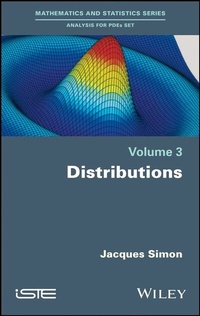
Distributions
Description

This operation produces properties similar to those of convolution for distributions defined in any open space. Emphasis is placed on the extraction of convergent sub-sequences, the existence and study of primitives and the representation by gradient or by derivatives of continuous functions. Constructive methods are used to make these tools accessible to students and engineers.
Jacques Simon is Emeritus Research Director at CNRS, France. His research focuses on the Navier–Stokes equations, particularly in shape optimization and in the functional spaces they use.
More details
Other editions
Additional editions

Person
Content
Introduction ix
Notations xv
Chapter 1 Semi-Normed Spaces and Function Spaces 1
1.1. Semi-normed spaces 1
1.2. Comparison of semi-normed spaces 4
1.3. Continuous mappings 6
1.4. Differentiable functions 8
1.5. Spaces Cm (O; E), Cmb (O; E) and Cmb (¿; E) 11
1.6. Integral of a uniformly continuous function 14
Chapter 2 Space of Test Functions 17
2.1. Functions with compact support 17
2.2. Compactness in their whole of support of functions 19
2.3. The space D(O) 21
2.4. Sequential completeness of D(O) 24
2.5. Comparison of D(O) to various spaces 26
2.6. Convergent sequences in D(O) 28
2.7. Covering by crown-shaped sets and partitions of unity 33
2.8. Control of the CK m (O)-norms by the semi-norms of D(O) 35
2.9. Semi-norms that are continuous on all the CK 8 (O) 38
Chapter 3 Space of Distributions 41
3.1. The space D ' (O; E) 41
3.2. Characterization of distributions 46
3.3. Inclusion of C(O; E) into D ' (O; E) 48
3.4. The case where E is not a Neumann space 53
3.5. Measures 57
3.6. Continuous functions and measures 63
Chapter 4 Extraction of Convergent Subsequences 65
4.1. Bounded subsets of D ' (O; E) 65
4.2. Convergence in D ' (O; E) 67
4.3. Sequential completeness of D ' (O; E) 69
4.4. Sequential compactness in D ' (O; E) 71
4.5. Change of the space E of values 74
4.6. The space E-weak 76
4.7. The space D ' (O; E-weak) and extractability 78
Chapter 5 Operations on Distributions 81
5.1. Distributions fields 81
5.2. Derivatives of a distribution 84
5.3. Image under a linear mapping 91
5.4. Product with a regular function 94
5.5. Change of variables 100
5.6. Some particular changes of variables 107
5.7. Positive distributions 109
5.8. Distributions with values in a product space 113
Chapter 6 Restriction, Gluing and Support 117
6.1. Restriction 117
6.2. Additivity with respect to the domain 121
6.3. Local character 122
6.4. Localization-extension 125
6.5. Gluing 128
6.6. Annihilation domain and support 130
6.7. Properties of the annihilation domain and support 133
6.8. The space DK ' (O; E) 137
Chapter 7 Weighting 141
7.1. Weighting by a regular function 141
7.2. Regularizing character of the weighting by a regular function 144
7.3. Derivatives and support of distributions weighted by a regular weight 148
7.4. Continuity of the weighting by a regular function 150
7.5. Weighting by a distribution 153
7.6. Comparison of the definitions of weighting 156
7.7. Continuity of the weighting by a distribution 159
7.8. Derivatives and support of a weighted distribution 161
7.9. Miscellanous properties of weighting 165
Chapter 8 Regularization and Applications 169
8.1. Local regularization 169
8.2. Properties of local approximations 174
8.3. Global regularization 175
8.4. Convergence of global approximations 178
8.5. Properties of global approximations 180
8.6. Commutativity and associativity of weighting 183
8.7. Uniform convergence of sequences of distributions 188
Chapter 9 Potentials and Singular Functions 191
9.1. Surface integral over a sphere 191
9.2. Distribution associated with a singular function 193
9.3. Derivatives of a distribution associated with a singular function 196
9.4. Elementary Newtonian potential 197
9.5. Newtonian potential of order n 201
9.6. Localized potential 208
9.7. Dirac mass as derivatives of continuous functions 210
9.8. Heaviside potential 214
9.9. Weighting by a singular weight 217
Chapter 10 Line Integral of a Continuous Field 221
10.1. Line integral along a C1 path 221
10.2. Change of variable in a path 225
10.3. Line integral along a piecewise C1 path 228
10.4. The homotopy invariance theorem 231
10.5. Connectedness and simply connectedness 235
Chapter 11 Primitives of Functions 237
11.1. Primitive of a function field with a zero line integral 237
11.2. Tubular flows and concentration theorem 239
11.3. The orthogonality theorem for functions 243
11.4. Poincaré's theorem 244
Chapter 12 Properties of Primitives of Distributions 247
12.1. Representation by derivatives 247
12.2. Distribution whose derivatives are zero or continuous 251
12.3. Uniqueness of a primitive 253
12.4. Locally explicit primitive 254
12.5. Continuous primitive mapping 256
12.6. Harmonic distributions, distributions with a continuous Laplacian 261
Chapter 13 Existence of Primitives 265
13.1. Peripheral gluing 266
13.2. Reduction to the function case 268
13.3. The orthogonality theorem 270
13.4. Poincaré's generalized theorem 274
13.5. Current of an incompressible two dimensional field 277
13.6. Global versus local primitives 279
13.7. Comparison of the existence conditions of a primitive 282
13.8. Limits of gradients 283
Chapter 14 Distributions of Distributions 285
14.1. Characterization 285
14.2. Bounded sets 288
14.3. Convergent sequences 289
14.4. Extraction of convergent subsequences 293
14.5. Change of the space of values 294
14.6. Distributions of distributions with values in E-weak 295
Chapter 15 Separation of Variables 297
15.1. Tensor products of test functions 297
15.2. Decomposition of test functions on a product of sets 301
15.3. The tensorial control theorem 303
15.4. Separation of variables 309
15.5. The kernel theorem 311
15.6. Regrouping of variables 317
15.7. Permutation of variables 318
Chapter 16 Banach Space Valued Distributions 323
16.1. Finite order distributions 323
16.2. Weighting of a finite order distribution 326
16.3. Finite order distribution as derivatives of continuous functions 328
16.4. Finite order distribution as derivative of a single function 333
16.5. Distributions in a Banach space as derivatives of functions 335
16.6. Non-representability of distributions with values in a Fréchet space 339
16.7. Extendability of distributions with values in a Banach space 342
16.8. Cancellation of distributions with values in a Banach space 347
Appendix 349
Bibliography 367
Index 371
Introduction
Objective. This book is the third of seven volumes dedicated to solving partial differential equations in physics:
Volume 1: Banach, Frechet, Hilbert and Neumann Spaces
Volume 2: Continuous Functions
Volume 3: Distributions
Volume 4: Integration
Volume 5: Sobolev Spaces
Volume 6: Traces
Volume 7: Partial Differential equations
This third volume aims to construct the space of distributions with real or vectorial values and to provide the main properties that are useful in studying partial differential equations.
Intended audience. We1 have looked for simple methods that require a minimal level of knowledge to make this tool accessible to as wide an audience as possible - doctoral students, university students, engineers - without loosing generality and even generalizing certain results, which may be of interest to some researchers.
This has led us to choose an unconventional approach that prioritizes semi-norms and sequential properties, whether related to completeness, compactness or continuity.
Utility of distributions. The main advantage of distributions is that they provide derivatives of all continuous or integrable functions, even those which are not differentiable, and thus broaden the scope of application of differential calculus. This is especially useful for solving partial differential equations.
To this end, a family of objects, the distributions, is defined, with the following properties.
-
- Any continuous function is a distribution.
-
- Any distribution has partial derivatives, which are distributions.
-
- For a differentiable function, we find the conventional derivatives.
-
- Any limit of distributions is a distribution.
-
- Any Cauchy sequence of distributions has a limit.
These properties may be roughly summarized by saying that the space ´ of distributions is the completion with respect to derivation of the space of continuous functions. This construction, due to Laurent SCHWARTZ, [69] and [72], is completed here for distributions on an open subset O of d with values in a Neumann space E, i.e. a sequentially complete separable semi-normed space. This includes values in a Banach or Fréchet space.
Originality. The quest for simple methods2 giving general properties led us to proceed as follows.
-
- Directly consider vectorial values, i.e. constructing ´(O; E) without any prior study of real distributions.
-
- Assume that E is sequentially complete, i.e. a Neumann space.
-
- Use semi-norms to construct the topologies of E, (O), ´(O; E), etc.
-
- Equip ´(O; E) with the simple topology.
-
- Introduce weighting to generalize the convolution to open domains.
-
- Explicitly construct the primitives.
-
- Separate the variables using a "basic" method.
-
- Only use integration for continuous functions.
Let us take a closer look at these points that lie off the beaten track.
Vector values. We consider distributions with values in a general Neumann space E even though the partial differential equations in physics generally have real values. This is useful in evolution equations to separate the time t from the variable of space x. A distribution over t, x with real values is then identified with a distribution over t with values in a space E of distributions on x, for example, with an element of ´((0, T); E) where E = ´(O), which is itself a Neumann space. This identification is made possible by the fundamental kernel theorem, p. 312.
A list of the most useful Neumann spaces is given on page 43.
For stationary equations, the real distributions (that is, the case where E = ) are sufficient. We will directly work on the case where E is a Neumann space in order to avoid repetitions, the generalization often consisting of replacing with E and the absolute value | | with a semi-norm of E in the statements and proofs, when using appropriate methods.
Particular features in the case of vector values. The main differences as compared to distributions with real values are as follows, for a general space E.
-
- The space ´(O; E) is not reflexive and its topology of pointwise convergence on (O) does not coincide with its weak topology.
-
- The bounded subsets of ´(O; E) are not relatively compact.
-
- The distributions over O are not of a finite order over its compact parts: they cannot always be expressed as finite order derivatives of continuous functions.
-
- Variables may be separated by constructing a bijection from ´(O1 × O2; E) onto ´(O1; ´(O2; E)) (even for a real distribution, i.e. for E = , this brings in vector values, in this case in ´(O2)).
Sequential completeness. We assume that E is a Neumann space, i.e. that all its Cauchy series converge, since this is an essential condition for continuous functions to be distributions. That is, for (O; E) ? ´(O; E), see section 3.4, The case where E is not a Neumann space, p. 53.
This property is simpler than the completeness, i.e. the convergence of all the Cauchy filters, and is especially more general: for example, if H is a Hilbert space with infinite dimensions, H-weak is sequentially complete but is not complete [Vol. 1, Property (4.11), p. 63].
It is also simpler and more general than quasi-completeness, i.e. the completeness of bounded subsets, used by Laurent SCHWARTZ [72, p. 2, 50 and 52].
Semi-norms. We use families of semi-norms rather than locally convex topologies, which are equivalent, in order to be able to define Lp(O; E) in Volume 4. Indeed, it is possible to raise a semi-norm to a power p, but not a convex neighborhood!
The handling of semi-normed spaces is simple, although it is less familiar than that of topological spaces: it follows the handling of normed spaces, the main difference being that there are several semi-norms or norms instead of a single norm. For example, we bring in the topology of (O) through the family of semi-norms indexed by p ? + (O), which is much simpler than its (equivalent) construction as the inductive limit of the K(O).
Simply topology. We equip the space ´(O; E) with the family of semi-norms indexed by f ? (O) and ? ? E (set indexing the semi-norms of E), i.e. with the topology of simple convergence on (O), as it is well-suited to our study . . . and is simple. This simplicity is achieved without restricting ourselves to a pseudo-topology as is done in several texts.
In addition, this topology has the same convergent sequences and the same bounded sets as the topology of uniform convergence on the bounded subsets of (O) used by Laurent SCHWARTZ. The reasons for our choices are detailed on p. 45.
Open domain and weighting. We consider distributions defined on an open subset O of d. As these do not necessarily have an extension to all of d, we introduce an operation, we call it weighting, which plays a role for O that is similar to the role played by convolution for d and which we constantly use.
The weighted distribution f µ of a distribution f, defined on an open set O, by a weight µ, which is a real distribution on d with a compact support D, is a distribution defined on the open set OD ?= {x ? d : x + D ? O}. When f and µ are functions, it is given by When O = d, the convolution is recovered up to a symmetry on µ, and all its properties are recovered up to a possible sign.
Primitives. We show that a field of distributions q = (q1, . . . , qd) has a primitive f, that is ?f = q, if and only if it satisfies <q, ?> = 0E for all the test fields ? = (?1, . . . , ?d) such that ? . ? = 0. It is the orthogonality theorem. We explicitly determine all the primitives and among these determine one which depends continuously on q.
We also demonstrate that when O is simply connected it is necessary and sufficient that ?iqj = ?jqi for all i and j. It is the Poincaré's generalized theorem.
Separation of variables. We show that the separation of variables is bijective from ´(O1 O2; E) onto ´(O1; ´(O2; E)) by means of inequalities. These are certainly laborious to establish, but they avoid the difficult topological properties used by Laurent SCHWARTZ in...
