

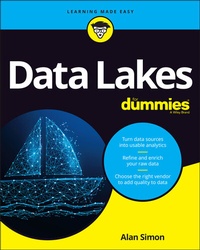
Data Lakes For Dummies
Description

"Data lakes" is the latest buzz word in the world of data storage, management, and analysis. Data Lakes For Dummies decodes and demystifies the concept and helps you get a straightforward answer the question: "What exactly is a data lake and do I need one for my business?" Written for an audience of technology decision makers tasked with keeping up with the latest and greatest data options, this book provides the perfect introductory survey of these novel and growing features of the information landscape. It explains how they can help your business, what they can (and can't) achieve, and what you need to do to create the lake that best suits your particular needs.
With a minimum of jargon, prolific tech author and business intelligence consultant Alan Simon explains how data lakes differ from other data storage paradigms. Once you've got the background picture, he maps out ways you can add a data lake to your business systems; migrate existing information and switch on the fresh data supply; clean up the product; and open channels to the best intelligence software for to interpreting what you've stored.
* Understand and build data lake architecture
* Store, clean, and synchronize new and existing data
* Compare the best data lake vendors
* Structure raw data and produce usable analytics
Whatever your business, data lakes are going to form ever more prominent parts of the information universe every business should have access to. Dive into this book to start exploring the deep competitive advantage they make possible--and make sure your business isn't left standing on the shore.
More details
Other editions
Additional editions
Person
Content
Part 1: Getting Started with Data Lakes 5
Chapter 1: Jumping into the Data Lake 7
Chapter 2: Planning Your Day (and the Next Decade) at the Data Lake 25
Chapter 3: Break Out the Life Vests: Tackling Data Lake Challenges 49
Part 2: Building the Docks, Avoiding the Rocks 65
Chapter 4: Imprinting Your Data Lake on a Reference Architecture 67
Chapter 5: Anybody Hungry? Ingesting and Storing Raw Data in Your Bronze Zone 97
Chapter 6: Your Data Lake's Water Treatment Plant: The Silver Zone 121
Chapter 7: Bottling Your Data Lake Water in the Gold Zone 139
Chapter 8: Playing in the Sandbox 151
Chapter 9: Fishing in the Data Lake 159
Chapter 10: Rowing End-to-End across the Data Lake 169
Part 3: Evaporating the Data Lake into the Cloud 187
Chapter 11: A Cloudy Day at the Data Lake 189
Chapter 12: Building Data Lakes in Amazon Web Services 199
Chapter 13: Building Data Lakes in Microsoft Azure 217
Part 4: Cleaning Up the Polluted Data Lake 243
Chapter 14: Figuring Out If You Have a Data Swamp Instead of a Data Lake 245
Chapter 15: Defining Your Data Lake Remediation Strategy 259
Chapter 16: Refilling Your Data Lake 283
Part 5: Making Trips to the Data Lake a Tradition 297
Chapter 17: Checking Your GPS: The Data Lake Road Map 299
Chapter 18: Booking Future Trips to the Data Lake 325
Part 6: The Part of Tens 333
Chapter 19: Top Ten Reasons to Invest in Building a Data Lake 335
Chapter 20: Ten Places to Get Help for Your Data Lake 341
Chapter 21: Ten Differences between a Data Warehouse and a Data Lake 345
Index 351
Chapter 1
Jumping into the Data Lake
IN THIS CHAPTER
Defining and scoping the data lake
Diving underwater in the data lake
Dividing up the data lake
Making sense of conflicting terminology
The lake is the place to be this season - the data lake, that is!
Just like the newest and hottest vacation destination, everyone is booking reservations for a trip to the data lake. Unlike a vacation, though, you won't just be spending a long weekend or a week or even the entire summer at the data lake. If you and your work colleagues do a good job, your data lake will be your go-to place for a whole decade or even longer.
What Is a Data Lake?
Ask a friend this question: "What's a lake?" Your friend thinks for a moment, and then gives you this answer: "Well, it's a big hole in the ground that's filled with water."
Technically, your friend is correct, but that answer also is far from detailed enough to really tell you what a lake actually is. You need more specifics, such as:
- How big, dimension-wise (how long and how wide)
- How deep that "big hole in the ground" goes
- How much variability there is from one lake to another in terms of those length, width, and depth dimensions (the Great Lakes, anyone?)
- How much water you'll find in the lake and how much that amount of water may vary among different lakes
- Whether a lake contains freshwater or saltwater
Some follow-up questions may pop into your mind as well:
- A pond is also a big hole in the ground that's filled with water, so is a lake the same as a pond?
- What distinguishes a lake from an ocean or a sea?
- Can a lake be physically connected to another lake?
- Can the dividing line between two states or two countries be in the middle of a lake?
- If a lake is empty, is it still considered a lake?
- If one lake leaves Chicago, heading east and travels at 100 miles per hour, and another lake heads west from New York . oh wait, wrong kind of word problem, never mind. .
So many missing pieces of the puzzle, all arising from one simple question!
You'll find the exact same situation if you ask someone this question: "What's a data lake?" In fact, go ahead and ask your favorite search engine that question. You'll find dozens of high-level definitions that will almost certainly spur plenty of follow-up questions as you try to get your arms around the idea of a data lake.
Here's a better idea: Instead of filtering through all that varying - and even conflicting - terminology and then trying to consolidate all of it into a single comprehensive definition, just think of a data lake as the following:
A solidly architected, logically centralized, highly scalable environment filled with different types of analytic data that are sourced from both inside and outside your enterprise with varying latency, and which will be the primary go-to destination for your organization's data-driven insights
Wow, that's a mouthful! No worries: Just as if you were eating a gourmet fireside meal while camping at your favorite lake, you can break up that definition into bite-size pieces.
Rock-solid water
A data lake should remain viable and useful for a long time after it becomes operational. Also, you'll be continually expanding and enhancing your data lake with new types and forms of data, new underlying technologies, and support for new analytical uses.
Building a data lake is more than just loading massive amounts of data into some storage location.
To support this near-constant expansion and growth, you need to ensure that your data lake is well architected and solidly engineered, which means that the data lake
- Enforces standards and best practices for data ingestion, data storage, data transmission, and interchange among its components and data delivery to end users
- Minimizes workarounds and temporary interfaces that have a tendency to stick around longer than planned and weaken your overall environment
- Continues to meet your predetermined metrics and thresholds for overall technical performance, such as data loading and interchange, as well as user response time
Think about a resort that builds docks, a couple of lakeside restaurants, and other structures at various locations alongside a large lake. You wouldn't just hand out lumber, hammers, and nails to a bunch of visitors and tell them to start building without detailed blueprints and engineering diagrams. The same is true with a data lake. From the first piece of data that arrives, you need as solid a foundation as possible to help keep your data lake viable for a long time.
A really great lake
You'll come across definitions and descriptions that tell you a data lake is a centralized store of data, but that definition is only partially correct.
A data lake is logically centralized. You can certainly think of a data lake as a single place for your data, instead of having your data scattered among different databases. But in reality, even though your data lake is logically centralized, its data is physically decentralized and distributed among many different underlying servers.
The data services that you use for your data lake, such as the Amazon Simple Storage Service (S3), the Microsoft Azure Data Lake Storage (ADLS), or the Hadoop Distributed File System (HDFS) manage the distribution of data among potentially numerous servers where your data is actually stored. These services hide the physical distribution from almost everyone other than those who need to manage the data at the server storage level. Instead, they present the data as being logically part of a single data lake. Figure 1-1 illustrates how logical centralization accompanies physical decentralization.
FIGURE 1-1: A logically centralized data lake with underlying physical decentralization.
Expanding the data lake
How big can your data lake get? To quote the old saying (and to answer a question with a question), how many angels can dance on the head of a pin?
Scalability is best thought of as "the ability to expand capacity, workload, and missions without having to go back to the drawing board and start all over." Your data lake will almost always be a cloud-based solution (see Figure 1-2). Cloud-based platforms give you, in theory, infinite scalability for your data lake. New servers and storage devices (discs, solid state devices, and so on) can be incorporated into your data lake on demand, and the software services manage and control these new resources along with those that you're already using. Your data lake contents can then expand from hundreds of terabytes to petabytes, and then to exabytes, and then zettabytes, and even into the ginormousbyte range. (Just kidding about that last one.)
FIGURE 1-2: Cloud-based data lake solutions.
Cloud providers give you pricing for data storage and access that increases as your needs grow or decreases if you cut back on your functionality. Basically, your data lake will be priced on a pay-as-you-go basis.
Some of the very first data lakes that were built in the Hadoop environment may reside in your corporate data center and be categorized as on-prem (short for on-premises, meaning "on your premises") solutions. But most of today's data lakes are built in the Amazon Web Services (AWS) or Microsoft Azure cloud environments. Given the ever-increasing popularity of cloud computing, it's highly unlikely that this trend of cloud-based data lakes will reverse for a long time, if ever.
As long as Amazon, Microsoft, and other cloud platform providers can keep expanding their existing data centers and building new ones, as well as enhancing the capabilities of their data management services, then your data lake should be able to avoid scalability issues.
A multiple-component data lake architecture (see Chapter 4) further helps overcome performance and capacity constraints as your data lake grows in size and complexity, providing even greater scalability.
More than just the water
Think of a data lake as being closer to a lake resort rather than just the lake - the body of water - in its natural state. If you were a real estate developer, you might buy the property that includes the lake itself, along with plenty of acreage surrounding the lake. You'd then develop the overall property by building cabins, restaurants, boat docks, and other facilities. The lake might be the centerpiece of the overall resort, but its value is dramatically enhanced by all the additional assets that you've built surrounding the lake.
A data lake is an entire environment, not just a gigantic collection of data that is stored within a data service such as Amazon S3 or Microsoft ADLS.
In addition to data storage, a data lake also includes the following:
- One or (usually) more mechanisms to move data from one part of the data lake to another.
- A catalog or directory that helps keep track of what data is where, as well as the associated rules that apply to different groups of data; this is known as...
