

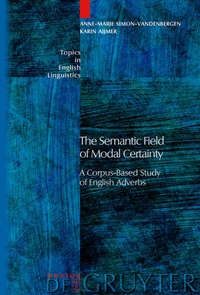
The Semantic Field of Modal Certainty
Description

In spite of the vast literature on modality in English, very little research has been done on modal adverbs as a group. While there are studies of individual adverbs, the semantic and pragmatic relations between them have been left largely unexplored. This book takes a close look at the whole field of modal certainty as expressed by adverbs in English. On the basis of corpus data the most frequent adverbs of certainty, including certainly, indeed , and no doubt , are examined from the point of view of their syntactic, semantic and pragmatic characteristics. The corpus used is the International Corpus of English - Great Britain , supplemented by data from other present-day English corpora, and questionnaires testing native speakers' intuitions on fine-grained similarities and differences between closely related adverbs. The methodology also includes the study of cross-linguistic equivalents as indicators of semantic-pragmatic relations between adverbs. Translation corpora yield correspondences in Swedish, Dutch, French and German. A detailed study of those correspondences adds useful information for setting up a semantic-pragmatic profile of each adverb, showing where their meanings overlap and where the boundaries are. The concept of semantic maps is relied on for plotting these relations.
The book not only provides a thorough empirical study of English adverbs expressing certainty, it also contributes to a better theoretical understanding of the complexity of modal certainty, how it is related to speakers' goals and to other semantic areas. It is the first in-depth study of this kind, combining rich information on English as well as opening up perspectives for further empirical and theoretical research into modality.
Reviews / Votes
"There is no doubt that this book will inspire similar studies in the domain of modality and in other domains."Ilse Depraetere in: Journal of English Language and Linguistics 3/2009<More details
Other editions
Additional editions
Persons
Content
2 - Table of contents [Seite 7]
3 - Chapter 1. Aims, methodology and data [Seite 11]
4 - Chapter 2. Establishing meaning relations: Problems and solutions [Seite 20]
5 - Chapter 3. The linguistic categories of modality and evidentiality [Seite 34]
6 - Chapter 4. An integrated model for describing adverbs of certainty [Seite 50]
7 - Chapter 5. Classification of adverbs of certainty [Seite 67]
8 - Chapter 6. The epistemic certainty adverbs certainly, definitely, indeed: Syntagmatic and paradigmatic dimensions [Seite 90]
9 - Chapter 7. The epistemic certainty adverbs no doubt, surely: Syntagmatic and paradigmatic dimensions [Seite 131]
10 - Chapter 8. Evidential, expectation and speech act adverbs: Syntagmatic and paradigmatic dimensions [Seite 157]
11 - Chapter 9. Adverbs of certainty and the wider context: Text types and genres [Seite 205]
12 - Chapter 10. Semantic-pragmatic relations: Networks and maps [Seite 257]
13 - Chapter 11. Semantic-pragmatic relations: Parameters and features [Seite 288]
14 - Chapter 12. Conclusions [Seite 331]
15 - Backmatter [Seite 335]
