

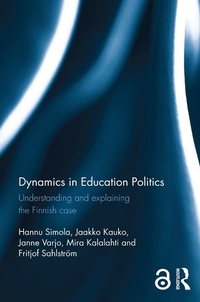
Dynamics in Education Politics
Understanding and explaining the Finnish case
Published on 16. March 2017
168 pages
978-1-135-08423-3 (ISBN)
Description

Dynamics in Education Politics: Understanding and Explaining the Finnish Case introduces a new theoretical framework characterised as Comparative Analytics of Dynamics in Education Politics (CADEP). Albeit the topicality of comparative research is obvious in the current era of global large-scale assessment, with its concomitant media visibility and political effects, comparative education is still suffering from certain methodological deficits and is in need of robust theorisation. Focusing on relational dynamics between policy threads, actors and institutions in education politics CADEP seriously considers the phenomena of complexity, contingency and trans-nationality in late-modern societies.
In this book CADEP is applied and validated in analysing the "Finnish Educational Miracle" that has been attracting attention in the educational world ever since they rocketed to fame following the PISA studies during the 2000s. This book will open up opportunities for mutual understanding and learning rather than just celebrating the exceptional circumstances or sustainable leadership.
Areas covered include:
The analytics of dynamics in education politics
The dynamics of policy making and governance
The dynamics of educational family strategies
The dynamics of classroom culture
It is vital for humankind to be able to learn from each other's successes and failures, and this applies in education, too. This book is thus a valuable read for anyone interested in the education system and wanting to shape the learning environment.
In this book CADEP is applied and validated in analysing the "Finnish Educational Miracle" that has been attracting attention in the educational world ever since they rocketed to fame following the PISA studies during the 2000s. This book will open up opportunities for mutual understanding and learning rather than just celebrating the exceptional circumstances or sustainable leadership.
Areas covered include:
The analytics of dynamics in education politics
The dynamics of policy making and governance
The dynamics of educational family strategies
The dynamics of classroom culture
It is vital for humankind to be able to learn from each other's successes and failures, and this applies in education, too. This book is thus a valuable read for anyone interested in the education system and wanting to shape the learning environment.
More details
Language
English
Place of publication
London
United Kingdom
Publishing group
Taylor & Francis Ltd
Target group
College/higher education
Professional and scholarly
Illustrations
8 s/w Tabellen, 9 s/w Zeichnungen
8 Tables, black and white; 9 Line drawings, black and white
File size
1,00 MB
ISBN-13
978-1-135-08423-3 (9781135084233)
Copyright in bibliographic data and cover images is held by Nielsen Book Services Limited or by the publishers or by their respective licensors: all rights reserved.
Schweitzer Classification
Other editions
Additional editions
Hannu Simola | Jaakko Kauko | Janne Varjo
Dynamics in Education Politics
Understanding and explaining the Finnish case
Book
10/2024
1st Edition
Routledge
€50.00
Shipment within 10-20 days
Hannu Simola | Jaakko Kauko | Janne Varjo
Dynamics in Education Politics
Understanding and explaining the Finnish case
Book
03/2017
1st Edition
Routledge
€238.09
Shipment within 15-20 days
Persons
Hannu Simola, PhD, is Professor in Sociology and Politics of Education, at the Universities of Turku and Helsinki, Finland. His research interests are currently focused on socioanalysis of teacherhood, contextual analytics of educational innovations and local educational ethos. His recent book is The Finnish Education Mystery (Routledge 2015).
Jaakko Kauko, PhD, MSocSc, is Associate Professor in Education at the School of Education, University of Tampere, Finland. His research is situated in the fields of politics of education and comparative education. He is interested in the questions of power, contingency, and complexity.
Janne Varjo, PhD, is Lecturer at the Institute of Behavioural Sciences, and more particularly within the Research Unit focusing on the Sociology and Politics of Education, at the University of Helsinki. His research interests include sociology of education, history of education and administration, economy and planning of education.
Mira Kalalahti, DrSocSc, MA, is Post-doctoral Researcher in the Research Unit Focusing on the Sociology and Politics of Education at the Department of Teacher Education, University of Helsinki, Finland. Her research interests involve sociology of education, especially questions concerning the equality of educational opportunities and educational transitions.
Fritjof Sahlstroem, PhD, is Professor in Education at Abo Akademi University, Finland. His research has focused on the organization of interaction in educational settings, on developing ways of documenting and analysing classroom interaction relying on conversation analysis, and on the relationships between interaction, participation and social reproduction.
Jaakko Kauko, PhD, MSocSc, is Associate Professor in Education at the School of Education, University of Tampere, Finland. His research is situated in the fields of politics of education and comparative education. He is interested in the questions of power, contingency, and complexity.
Janne Varjo, PhD, is Lecturer at the Institute of Behavioural Sciences, and more particularly within the Research Unit focusing on the Sociology and Politics of Education, at the University of Helsinki. His research interests include sociology of education, history of education and administration, economy and planning of education.
Mira Kalalahti, DrSocSc, MA, is Post-doctoral Researcher in the Research Unit Focusing on the Sociology and Politics of Education at the Department of Teacher Education, University of Helsinki, Finland. Her research interests involve sociology of education, especially questions concerning the equality of educational opportunities and educational transitions.
Fritjof Sahlstroem, PhD, is Professor in Education at Abo Akademi University, Finland. His research has focused on the organization of interaction in educational settings, on developing ways of documenting and analysing classroom interaction relying on conversation analysis, and on the relationships between interaction, participation and social reproduction.
Content
Acknowledgements
Introduction
1. Comparative Analytics in the Dynamics of Education Politics
1.1 Comparative education as a contested terrain
1.2 A proposal for a more systematic, flexible and vivid approach: CADEP
2. Orienting to the Finnish case
2.1 The history of political situations
2.2 The history of political possibilities
2.3 The history of politicking
3. Dynamics in Policymaking
3.1. Late but enduring structures reflecting a belief in schooling
3.2. Middle-class liberalist equity meets factory- and farmland-based equality
3.3 Equality enhanced by the recession and PISA
3.4. Conclusion: buffering and embedded egalitarianism
4. Dynamics in governance
4.1 From strict centralisation towards NPM and decentralisation
4.2 Punctuated trust
4.3 Non-materialised QAE
4.4 Conclusion: redistributing but punctuated trust
5. Dynamics in family educational strategies
5.1. Leaving the Peruskoulu monolith behind
5.2. Contradictory school choice
5.3. Local politicking for soft school choice
5.4. Conclusion: reliable but diverged parenthood
6. Dynamics in classroom cultures
6.1. From Herbart-Zillerian and social pedagogy to Peruskoulu didactics
6.2. Individualised Peruskoulu pedagogies since 1970
6.3. A hybrid of tradition and progress
6.4 Conclusion: consolidating but paternalistic progressivism
7. The dynamics of Finnish basic-education politics: from understanding to explanation
Introduction
1. Comparative Analytics in the Dynamics of Education Politics
1.1 Comparative education as a contested terrain
1.2 A proposal for a more systematic, flexible and vivid approach: CADEP
2. Orienting to the Finnish case
2.1 The history of political situations
2.2 The history of political possibilities
2.3 The history of politicking
3. Dynamics in Policymaking
3.1. Late but enduring structures reflecting a belief in schooling
3.2. Middle-class liberalist equity meets factory- and farmland-based equality
3.3 Equality enhanced by the recession and PISA
3.4. Conclusion: buffering and embedded egalitarianism
4. Dynamics in governance
4.1 From strict centralisation towards NPM and decentralisation
4.2 Punctuated trust
4.3 Non-materialised QAE
4.4 Conclusion: redistributing but punctuated trust
5. Dynamics in family educational strategies
5.1. Leaving the Peruskoulu monolith behind
5.2. Contradictory school choice
5.3. Local politicking for soft school choice
5.4. Conclusion: reliable but diverged parenthood
6. Dynamics in classroom cultures
6.1. From Herbart-Zillerian and social pedagogy to Peruskoulu didactics
6.2. Individualised Peruskoulu pedagogies since 1970
6.3. A hybrid of tradition and progress
6.4 Conclusion: consolidating but paternalistic progressivism
7. The dynamics of Finnish basic-education politics: from understanding to explanation
