

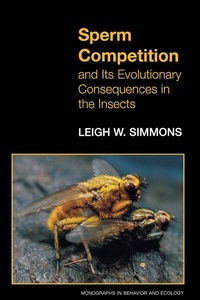
Sperm Competition and Its Evolutionary Consequences in the Insects
1st Edition
Published on 10. February 2020
456 pages
978-0-691-20703-2 (ISBN)
Description

One hundred years after Darwin considered how sexual selection shapes the behavioral and morphological characteristics of males for acquiring mates, Parker realized that sexual selection continues after mating through sperm competition. Because females often mate with multiple males before producing offspring, selection favors adaptations that allow males to preempt sperm from previous males and to prevent their own sperm from preemption by future males. Since the 1970s, this area of research has seen exponential growth, and biologists now recognize sperm competition as an evolutionary force that drives such adaptations as mate guarding, genital morphology, and ejaculate chemistry across all animal taxa. The insects have been critical to this research, and they still offer the greatest potential to reveal fully the evolutionary consequences of sperm competition.
This book analyzes and extends thirty years of theoretical and empirical work on insect sperm competition. It considers both male and female interests in sperm utilization and the sexual conflict that can arise when these differ. It covers the mechanics of sperm transfer and utilization, morphology, physiology, and behavior. Sperm competition is shown to have dramatic effects on adaptation in the context of reproduction as well as far-reaching ramifications on life-history evolution and speciation.
Written by a top researcher in the field, this comprehensive, up-to-date review of the evolutionary causes and consequences of sperm competition in the insects will prove an invaluable reference for students and established researchers in behavioral ecology and evolutionary biology.
This book analyzes and extends thirty years of theoretical and empirical work on insect sperm competition. It considers both male and female interests in sperm utilization and the sexual conflict that can arise when these differ. It covers the mechanics of sperm transfer and utilization, morphology, physiology, and behavior. Sperm competition is shown to have dramatic effects on adaptation in the context of reproduction as well as far-reaching ramifications on life-history evolution and speciation.
Written by a top researcher in the field, this comprehensive, up-to-date review of the evolutionary causes and consequences of sperm competition in the insects will prove an invaluable reference for students and established researchers in behavioral ecology and evolutionary biology.
More details
Other editions
Additional editions
Leigh W. Simmons
Sperm Competition and Its Evolutionary Consequences in the Insects
Book
11/2001
Princeton University Press
€99.04
Article exhausted; check different version
Leigh W. Simmons
Sperm Competition and Its Evolutionary Consequences in the Insects
Book
11/2001
Princeton University Press
€85.50
Shipment within 10-20 days
Person
Leigh W. Simmons is an Australian Research Council Senior Research Fellow and Research Professor in the Department of Zoology, University of Western Australia. He is an Associate Editor for Behavioral Ecology and Sociobiology and Executive Editor of Animal Behavior.
Content
- Cover
- Title
- Copyright
- Contents
- Preface
- Dedication and Acknowledgments
- 1 Sexual Selection and Sperm Competition
- 1.1 Sexual Selection
- 1.2 Sexual Differences and the Evolution of Anisogamy
- 1.3 Sperm Competition and Sexual Selection
- 1.4 Summary
- 2 Sperm Utilization: Concepts, Patterns, and Processes
- 2.1 Introduction
- 2.2 Classification and Definition of Terms Used in the Sperm Competition Literature
- 2.3 Quantifying Paternity
- 2.4 Patterns of Sperm Utilization: An Overview
- 2.5 Mechanisms
- 2.6 Sperm Utilization and Multiple Mating
- 2.7 Sperm Utilization in Natural Populations
- 2.8 Mechanisms and the Potential for Selection
- 2.9 Summary
- 3 Avoidance of Sperm Competition I: Morphological Adaptations
- 3.1 Introduction
- 3.2 Internal Fertilization
- 3.3 Sperm Removal and Repositioning
- 3.4 Alternative Explanations for Complex Genitalia
- 3.5 Summary
- 4 Avoidance of Sperm Competition II: Physiological Adaptations
- 4.1 Introduction
- 4.2 Mating Plugs
- 4.3 Seminal Products
- 4.4 Pheromones
- 4.5 Summary
- 5 Avoidance of Sperm Competition III: Behavioral Adaptations
- 5.1 Introduction
- 5.2 Theoretical Models of Mate Guarding
- 5.3 Evidence for Mate Guarding in Insects
- 5.4 Alternative Hypotheses
- 5.5 Adaptations for Efficient Guarding
- 5.6 Male Mate Choice
- 5.7 Summary
- 6 Copula Duration
- 6.1 Introduction
- 6.2 Sperm Displacement: Optimal Copula Duration in Dung Flies
- 6.3 Copula Duration with Sperm Mixing
- 6.4 Evidence Consistent with an Optimization of Copula Duration
- 6.5 Female Influences
- 6.6 Alternative Explanations
- 6.7 Summary
- 7 Sperm in Competition I : Strategic Ejaculation
- 7.1 Introduction
- 7.2 Sperm Competition Games
- 7.3 Cryptic Male Choice
- 7.4 Cryptic Female Choice
- 7.5 Summary
- 8 Sperm in Competition II : Sperm Morphology
- 8.1 Introduction
- 8.2 Sperm Size
- 8.3 Sperm Polymorphism
- 8.4 Intraejaculate Sperm Competition
- 8.5 Summary
- 9 Ejaculate Manipulation: Mechanisms of Female Choice
- 9.1 Introduction
- 9.2 Influence over Remating
- 9.3 Influence over Sperm Transfer
- 9.4 Influence over Sperm Storage
- 9.5 Sperm Selection
- 9.6 Summary
- 10 Social Insects
- 10.1 Introduction
- 10.2 Multiple Mating and Multiple Paternity
- 10.3 Social Consequences of Sperm Competition
- 10.4 Alternative Hypotheses for Multiple Mating
- 10.5 Summary
- 11 Broader Significance
- 11.1 Sperm Competition and Sexual Selection
- 11.2 Life History Evolution
- 11.3 Speciation
- 11.4 Concluding Remarks
- References
- Taxonomic Index
- Subject Index
