

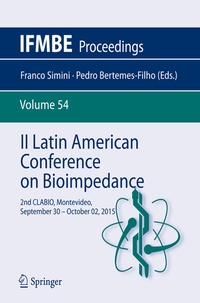
II Latin American Conference on Bioimpedance
2nd CLABIO,Montevideo,September 30 - October 02, 2015
Published on 26. September 2015
XIV, 87 pages
978-981-287-928-8 (ISBN)
Description

This volume presents the proceedings of CLABIO 2015 - II Latin American Conference on Bioimpedance, held in Montevideo, Uruguay - September 30 - October 02, 2015.
The works cover a broad range in Biomedical Engineering and Computing, Medical Physics and Medical Sciences, Environment, Biology and Chemistry.
The topics are:
·Bioimpedance Applications
·Bioimpedance Instrumentation
·Cell Culture and Cell Suspension
·Electrical Impedance Tomography
·Electrode Modelling
·Magnetic Induction - Electrical Impedance Tomography
·Magnetic Resonance - Electrical Impedance Tomography
·Nonlinear Phenomena
·Organ and Tissue Impedance
·Plant Tissue Impedance
·Skin Impedance Modelling
·Technological Advances in Bioimpedance
·Theory and Modelling
More details
Other editions
Additional editions
Franco Simini | Pedro Bertemes-Filho
II Latin American Conference on Bioimpedance
2nd CLABIO,Montevideo,September 30 - October 02, 2015
Book
01/2016
Springer
€106.99
Shipment within 15-20 days
Content
1 - Preface [Seite 6]
2 - CLABIO 2015 Committees [Seite 7]
3 - CLABIO 2015 CONFERENCE TOPICS [Seite 9]
4 - Speakers [Seite 10]
5 - Sponsors [Seite 11]
6 - Table of Contents [Seite 12]
7 - High Precision System for Bioimpedance Measurement [Seite 14]
7.1 - I. INTRODUCTION [Seite 14]
7.2 - II. HARDWARE [Seite 14]
7.3 - III. FAST ALGORITHM FOR BIO-IMPEDANCE MEASUREMENT [Seite 15]
7.4 - IV. EXPERIMENT RESULTS [Seite 16]
7.5 - V. CONCLUSION [Seite 17]
8 - Effects of Head Model Inaccuracies on Regional Scalp and Skull ConductivityEstimation Using Real EIT Measurements [Seite 18]
8.1 - I. INTRODUCTION [Seite 18]
8.2 - II. METHODS [Seite 19]
8.3 - III. RESULTS [Seite 20]
8.4 - IV. DISCUSSION [Seite 20]
8.5 - V. CONCLUSIONS [Seite 21]
9 - Electrolytic Extracellular Phantom to Study the Low-Frequency Conductivityof Cervical Neoplasia [Seite 22]
9.1 - I. INTRODUCTION [Seite 22]
9.2 - II. MATERIALS AND METHODS [Seite 22]
9.3 - III. RESULTS AND DISCUSSION [Seite 23]
9.4 - IV. CONCLUSIONS [Seite 23]
10 - Bone Electrical Impedance and Tomographic Reconstructionof Fracture Detection: A Review [Seite 25]
10.1 - I. INTRODUCTION [Seite 25]
10.2 - II. LONG BONE FRACTURE [Seite 25]
10.3 - III. THE ABERBEEN IMPEDANCE IMAGING SYSTEM [Seite 26]
10.4 - IV. REVIEW OF EIT APPLIED TO BONE [Seite 27]
10.5 - V. ANALYSIS OF THE RESULTS 2 DECADES LATER [Seite 27]
10.6 - VI. POSSIBLE APPLICATION AND IMPROVEMENTS [Seite 28]
10.7 - VII. DISCUSSION AND CONCLUSIONS [Seite 28]
11 - Audio Codec and Digital Signal Processor for an ElectricalImpedance Tomography System [Seite 29]
11.1 - I. INTRODUCTION [Seite 29]
11.2 - II. SYSTEM DESCRIPTION [Seite 30]
11.3 - III. RESULTS [Seite 31]
11.4 - IV. CONCLUSION [Seite 31]
12 - Segmental Electrical Bioimpedance Measurementswith a Single Lead (Electrode) Displacement [Seite 33]
12.1 - I. INTRODUCTION [Seite 33]
12.2 - II. MATERIALS AND METHODS [Seite 34]
12.3 - III. RESULTS [Seite 35]
12.4 - IV. DICUSSION [Seite 35]
12.5 - V. CONCLUSION [Seite 36]
13 - An Alternative Electrical Impedance Myography Technique for Assessmentof Local Muscular Fatigue [Seite 37]
13.1 - I. INTRODUCTION [Seite 37]
13.2 - II. METHODS [Seite 37]
13.3 - III. RESULTS [Seite 39]
13.4 - IV. DISCUSSION [Seite 40]
13.5 - V. CONCLUSION [Seite 40]
14 - In Vitro Luminal Measurements of Colon Electrical Impedance in Rabbits [Seite 41]
14.1 - I. INTRODUCTION [Seite 41]
14.2 - II - MATERIAL AND METHODS [Seite 42]
14.3 - III - RESULTS [Seite 42]
14.4 - IV. DISCUSSION [Seite 42]
14.5 - V - CONCLUSIONS [Seite 43]
15 - Assessment of Systolic Heart Function byWavelet Analysisof the Impedance Cardiogram [Seite 45]
15.1 - I. INTRODUCTION [Seite 45]
15.2 - II. MEASUREMENTS AND ITS PROCESSINGALGORITHM [Seite 46]
15.3 - III. RESULTS [Seite 47]
15.4 - IV. CONCLUSIONS [Seite 48]
16 - Impedance-Based Monitoring for Tissue Engineering Applications [Seite 49]
16.1 - I. INTRODUCTION [Seite 49]
16.2 - II. MONITORING TISSUE ENGINEERING PROCESSES [Seite 50]
16.3 - III. CONCLUSIONS [Seite 51]
17 - Total Body Water (TBW) for Body Composition Assessmentin Young Adult Females from Colombia [Seite 53]
17.1 - I. INTRODUCTION [Seite 53]
17.2 - II. MATERIALS AND METHODS [Seite 53]
17.3 - III. RESULTS [Seite 54]
17.4 - IV. DISCUSSION [Seite 55]
17.5 - V. CONCLUSIONS [Seite 56]
18 - Electrical Properties of Normal Cervical Human Cells in Suspension:The Relation between Normal Tissue and Electrical Impedance Spectrum [Seite 57]
18.1 - I. INTRODUCTION [Seite 57]
18.2 - II. MATERIALS AND METHODS [Seite 57]
18.3 - III. RESULTS AND DISCUSSION [Seite 58]
18.4 - IV. CONCLUSIONS [Seite 59]
19 - Analog Front-End for the Integrated Circuit AD5933Used in Electrical Bioimpedance Measurements [Seite 61]
19.1 - I. INTRODUCTION [Seite 61]
19.2 - II. METHODOLOGY [Seite 61]
19.3 - III. RESULTS [Seite 62]
19.4 - IV. DISCUSSIONS [Seite 63]
20 - Impedance Analysis for Medical and Electrochemical ApplicationsUsing a Low Cost Instrumentation [Seite 65]
20.1 - I. INTRODUCTION [Seite 65]
20.2 - II. MODELLING [Seite 65]
20.3 - III. INSTRUMENTATION STRUCTURE [Seite 66]
20.4 - IV. EXPERIMENTAL RESULTS [Seite 67]
21 - Low-Cost Body Impedance Analyzer for Healthcare Applications [Seite 69]
21.1 - I. INTRODUCTION [Seite 69]
21.2 - II. METHODOLOGY [Seite 70]
21.3 - III. RESULTS [Seite 71]
21.4 - IV. DISCUSSIONS [Seite 72]
21.5 - V. CONCLUSION [Seite 72]
22 - Development of Portable Device to Measure Respiratory ActivityBased on Impedance Pneumography [Seite 73]
22.1 - I. INTRODUCTION [Seite 73]
22.2 - II. IMPEDANCE PNEUMOGRAPHY [Seite 73]
22.3 - III. HARDWARE IMPLEMENTATION [Seite 74]
22.4 - IV. SIGNAL ACQUISITION AND VALIDATION [Seite 75]
22.5 - V. DISCUSSION AND CONCLUSIONS [Seite 76]
23 - Signal Processing Architecture for Electrical Tomography Impedance [Seite 77]
23.1 - I. INTRODUCTION [Seite 77]
23.2 - II. PROPOSED ARCHITECTURE [Seite 77]
23.3 - III. RESULTS AND DISCUSSION [Seite 79]
23.4 - IV. CONCLUSION [Seite 80]
24 - In vivo Electrical-Impedance Spectroscopy (EIS) Readings in the Human Rectum [Seite 81]
24.1 - I. INTRODUCTION [Seite 81]
24.2 - II. MATERIALS AND METHODS [Seite 81]
24.3 - III. RESULTS [Seite 82]
24.4 - IV. DISCUSSION [Seite 83]
24.5 - V. CONCLUSIONS [Seite 83]
25 - Correlation between Algometry and Electrical Bioimpedance in Subjectswith and without Fibromyalgia [Seite 85]
25.1 - I. INTRODUCTION [Seite 85]
25.2 - II. MATERIALS AND METHODS [Seite 85]
25.3 - III. RESULTS [Seite 86]
25.4 - IV. DISCUSSION [Seite 87]
25.5 - V. CONCLUSION [Seite 87]
26 - Use of Bioimpedance Method to Quantify Changes in Left Ventricular Contractilityin Experiments on Anesthetized Rats [Seite 89]
26.1 - I. INTRODUCTION [Seite 89]
26.2 - II. METHODS [Seite 89]
26.3 - III. RESULTS [Seite 90]
26.4 - IV. DISCUSSION [Seite 91]
26.5 - V. CONCLUSIONS [Seite 92]
27 - Evaluation of the Heath-Carter Somatotype Revisited: New BioimpedanceEquations for Children and Adolescents [Seite 93]
27.1 - I. INTRODUCTION [Seite 93]
27.2 - II. SUBJECTS AND METHODS [Seite 93]
27.3 - III. RESULTS [Seite 94]
27.4 - IV. CONCLUSIONS [Seite 96]
28 - Author Index [Seite 97]
29 - Keyword Index [Seite 98]
2 - CLABIO 2015 Committees [Seite 7]
3 - CLABIO 2015 CONFERENCE TOPICS [Seite 9]
4 - Speakers [Seite 10]
5 - Sponsors [Seite 11]
6 - Table of Contents [Seite 12]
7 - High Precision System for Bioimpedance Measurement [Seite 14]
7.1 - I. INTRODUCTION [Seite 14]
7.2 - II. HARDWARE [Seite 14]
7.3 - III. FAST ALGORITHM FOR BIO-IMPEDANCE MEASUREMENT [Seite 15]
7.4 - IV. EXPERIMENT RESULTS [Seite 16]
7.5 - V. CONCLUSION [Seite 17]
8 - Effects of Head Model Inaccuracies on Regional Scalp and Skull ConductivityEstimation Using Real EIT Measurements [Seite 18]
8.1 - I. INTRODUCTION [Seite 18]
8.2 - II. METHODS [Seite 19]
8.3 - III. RESULTS [Seite 20]
8.4 - IV. DISCUSSION [Seite 20]
8.5 - V. CONCLUSIONS [Seite 21]
9 - Electrolytic Extracellular Phantom to Study the Low-Frequency Conductivityof Cervical Neoplasia [Seite 22]
9.1 - I. INTRODUCTION [Seite 22]
9.2 - II. MATERIALS AND METHODS [Seite 22]
9.3 - III. RESULTS AND DISCUSSION [Seite 23]
9.4 - IV. CONCLUSIONS [Seite 23]
10 - Bone Electrical Impedance and Tomographic Reconstructionof Fracture Detection: A Review [Seite 25]
10.1 - I. INTRODUCTION [Seite 25]
10.2 - II. LONG BONE FRACTURE [Seite 25]
10.3 - III. THE ABERBEEN IMPEDANCE IMAGING SYSTEM [Seite 26]
10.4 - IV. REVIEW OF EIT APPLIED TO BONE [Seite 27]
10.5 - V. ANALYSIS OF THE RESULTS 2 DECADES LATER [Seite 27]
10.6 - VI. POSSIBLE APPLICATION AND IMPROVEMENTS [Seite 28]
10.7 - VII. DISCUSSION AND CONCLUSIONS [Seite 28]
11 - Audio Codec and Digital Signal Processor for an ElectricalImpedance Tomography System [Seite 29]
11.1 - I. INTRODUCTION [Seite 29]
11.2 - II. SYSTEM DESCRIPTION [Seite 30]
11.3 - III. RESULTS [Seite 31]
11.4 - IV. CONCLUSION [Seite 31]
12 - Segmental Electrical Bioimpedance Measurementswith a Single Lead (Electrode) Displacement [Seite 33]
12.1 - I. INTRODUCTION [Seite 33]
12.2 - II. MATERIALS AND METHODS [Seite 34]
12.3 - III. RESULTS [Seite 35]
12.4 - IV. DICUSSION [Seite 35]
12.5 - V. CONCLUSION [Seite 36]
13 - An Alternative Electrical Impedance Myography Technique for Assessmentof Local Muscular Fatigue [Seite 37]
13.1 - I. INTRODUCTION [Seite 37]
13.2 - II. METHODS [Seite 37]
13.3 - III. RESULTS [Seite 39]
13.4 - IV. DISCUSSION [Seite 40]
13.5 - V. CONCLUSION [Seite 40]
14 - In Vitro Luminal Measurements of Colon Electrical Impedance in Rabbits [Seite 41]
14.1 - I. INTRODUCTION [Seite 41]
14.2 - II - MATERIAL AND METHODS [Seite 42]
14.3 - III - RESULTS [Seite 42]
14.4 - IV. DISCUSSION [Seite 42]
14.5 - V - CONCLUSIONS [Seite 43]
15 - Assessment of Systolic Heart Function byWavelet Analysisof the Impedance Cardiogram [Seite 45]
15.1 - I. INTRODUCTION [Seite 45]
15.2 - II. MEASUREMENTS AND ITS PROCESSINGALGORITHM [Seite 46]
15.3 - III. RESULTS [Seite 47]
15.4 - IV. CONCLUSIONS [Seite 48]
16 - Impedance-Based Monitoring for Tissue Engineering Applications [Seite 49]
16.1 - I. INTRODUCTION [Seite 49]
16.2 - II. MONITORING TISSUE ENGINEERING PROCESSES [Seite 50]
16.3 - III. CONCLUSIONS [Seite 51]
17 - Total Body Water (TBW) for Body Composition Assessmentin Young Adult Females from Colombia [Seite 53]
17.1 - I. INTRODUCTION [Seite 53]
17.2 - II. MATERIALS AND METHODS [Seite 53]
17.3 - III. RESULTS [Seite 54]
17.4 - IV. DISCUSSION [Seite 55]
17.5 - V. CONCLUSIONS [Seite 56]
18 - Electrical Properties of Normal Cervical Human Cells in Suspension:The Relation between Normal Tissue and Electrical Impedance Spectrum [Seite 57]
18.1 - I. INTRODUCTION [Seite 57]
18.2 - II. MATERIALS AND METHODS [Seite 57]
18.3 - III. RESULTS AND DISCUSSION [Seite 58]
18.4 - IV. CONCLUSIONS [Seite 59]
19 - Analog Front-End for the Integrated Circuit AD5933Used in Electrical Bioimpedance Measurements [Seite 61]
19.1 - I. INTRODUCTION [Seite 61]
19.2 - II. METHODOLOGY [Seite 61]
19.3 - III. RESULTS [Seite 62]
19.4 - IV. DISCUSSIONS [Seite 63]
20 - Impedance Analysis for Medical and Electrochemical ApplicationsUsing a Low Cost Instrumentation [Seite 65]
20.1 - I. INTRODUCTION [Seite 65]
20.2 - II. MODELLING [Seite 65]
20.3 - III. INSTRUMENTATION STRUCTURE [Seite 66]
20.4 - IV. EXPERIMENTAL RESULTS [Seite 67]
21 - Low-Cost Body Impedance Analyzer for Healthcare Applications [Seite 69]
21.1 - I. INTRODUCTION [Seite 69]
21.2 - II. METHODOLOGY [Seite 70]
21.3 - III. RESULTS [Seite 71]
21.4 - IV. DISCUSSIONS [Seite 72]
21.5 - V. CONCLUSION [Seite 72]
22 - Development of Portable Device to Measure Respiratory ActivityBased on Impedance Pneumography [Seite 73]
22.1 - I. INTRODUCTION [Seite 73]
22.2 - II. IMPEDANCE PNEUMOGRAPHY [Seite 73]
22.3 - III. HARDWARE IMPLEMENTATION [Seite 74]
22.4 - IV. SIGNAL ACQUISITION AND VALIDATION [Seite 75]
22.5 - V. DISCUSSION AND CONCLUSIONS [Seite 76]
23 - Signal Processing Architecture for Electrical Tomography Impedance [Seite 77]
23.1 - I. INTRODUCTION [Seite 77]
23.2 - II. PROPOSED ARCHITECTURE [Seite 77]
23.3 - III. RESULTS AND DISCUSSION [Seite 79]
23.4 - IV. CONCLUSION [Seite 80]
24 - In vivo Electrical-Impedance Spectroscopy (EIS) Readings in the Human Rectum [Seite 81]
24.1 - I. INTRODUCTION [Seite 81]
24.2 - II. MATERIALS AND METHODS [Seite 81]
24.3 - III. RESULTS [Seite 82]
24.4 - IV. DISCUSSION [Seite 83]
24.5 - V. CONCLUSIONS [Seite 83]
25 - Correlation between Algometry and Electrical Bioimpedance in Subjectswith and without Fibromyalgia [Seite 85]
25.1 - I. INTRODUCTION [Seite 85]
25.2 - II. MATERIALS AND METHODS [Seite 85]
25.3 - III. RESULTS [Seite 86]
25.4 - IV. DISCUSSION [Seite 87]
25.5 - V. CONCLUSION [Seite 87]
26 - Use of Bioimpedance Method to Quantify Changes in Left Ventricular Contractilityin Experiments on Anesthetized Rats [Seite 89]
26.1 - I. INTRODUCTION [Seite 89]
26.2 - II. METHODS [Seite 89]
26.3 - III. RESULTS [Seite 90]
26.4 - IV. DISCUSSION [Seite 91]
26.5 - V. CONCLUSIONS [Seite 92]
27 - Evaluation of the Heath-Carter Somatotype Revisited: New BioimpedanceEquations for Children and Adolescents [Seite 93]
27.1 - I. INTRODUCTION [Seite 93]
27.2 - II. SUBJECTS AND METHODS [Seite 93]
27.3 - III. RESULTS [Seite 94]
27.4 - IV. CONCLUSIONS [Seite 96]
28 - Author Index [Seite 97]
29 - Keyword Index [Seite 98]
