

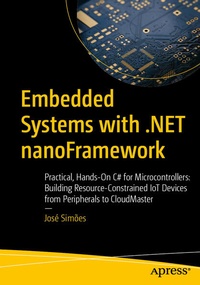
Embedded Systems with .NET nanoFramework
Description

Learn to build software that works on embedded devices using the .NET nanoFramework, a free and open-source framework for writing C# for microcontrollers. Whether you are working on an embedded electronic device or an Internet of Things (IoT) device, this book will help you develop software efficiently (and cheaper) when compared to traditional methods.
By using C# along with the tools and features of the .NET ecosystem, you'll find a pleasant, friendly, and efficient developer experience which will boost your productivity and decrease the time to market. You can address customer requirements in a much more flexible manner, come up with a proof of concept in a very short time, and even move between hardware platforms without having to rewrite code.
What You Will Learn
- Explore the entire .NET nanoFramework
- Develop software for Internet of Things (IoT) devices including sensors, wearables, robotics, and more
- Leverage a wide range of cheap boards from Espressif (ESP32), ST Microelectronics, Silicon Labs, Texas Instruments, and more
- Harness Visual Studio IDE and C# to quickly and cheaply write, debug, and deploy code
Who This Book Is For
This book is for .NET developers with an intermediate knowledge of C# who want to create software for embedded devices and IOT devices.
More details
Other editions
Additional editions
Person
José Simões is the CEO of Eclo Solutions, a software consulting company in Leiria, Portugal. He is the founder and core team member of .NET nanoFramework, an open-source project that allows programming in C# for micro-controllers. He was awarded Microsoft MVP five times for his work on Internet of Things (IoT) and developer technologies. He has shipped projects across embedded firmware, hardware design, and cloud-connected products with a toolbox that includes .NET and Azure technologies alongside C, C++, microcontrollers, and electronics.
Content
Chapter 1: Origins and Initial Concept.- Chapter 2: Architecture.- Chapter 3: The Build System.- Chapter 4: Being Part of the .NET Ecosystem.- Chapter 5: Interfacing with the Outside World.- Chapter 6: An IoT Embedded Device.- Chapter 7: Nano Devices Big-Time Connectivity.- Chapter 8: Testing for Embedded Success.- Chapter 9: Advanced Coding Topics.- Chapter 10: Beyond Connectivity - MCP in Embedded Devices.
