

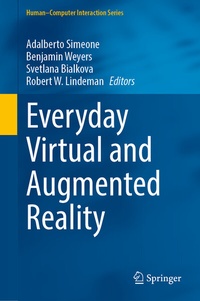
Everyday Virtual and Augmented Reality
Description

This edited book introduces readers to the area of "Everyday Virtual and Augmented Reality". With Virtual and Augmented Reality technologies, becoming more pervasive in our homes and workplaces, new use cases and scenarios emerge together with new challenges that need to be addressed. These challenges encompass the design and implementation of appropriate VR/AR applications for ordinary environments that were not built with the explicit intention of supporting VR systems. The everyday/domestic environments present a range of issues that are usually not present in the physical locations purposed for VR and AR use in academic or professional environments, such as constrained spaces, presence of obstacles, absence of instrumentation, social and organizational restrictions etc.
To address the above challenges, we collect the latest work from the Virtual Reality and Augmented Reality research community, by combining the presentation of general definitions and characterization of thefield, of interaction concepts and techniques, of a variety of use cases and areas. The constellation of different environment examples (from education, sport to consumer and marketing), from across the globe and platforms, provide a comprehensive discussion on scientific and engineering methods, which enable the development of VR/AR systems in everyday context.More details
Other editions
Additional editions
Content
Preface.- Introduction to Everyday Virtual and Augmented Reality.- XR for Knowledge Work in Everyday Environments.- The Use of MR for Temporal Coordination in Everyday Work Context.- Rotational and Positional Jitter in Virtual Reality Interaction in Everyday VR.- Development and Validation of a Mixed Reality Exergaming Platform for Fitness Training of Older Adults.- Networked Virtual Reality and Enhanced Sensing for Remote Classes and Presentations.- 7 Enhancing Multisensory Experience and Brand Value: Key Determinants for Extended, Augmented, and Virtual Reality Marketing Applications.- Immersive VR Evaluations.- Adaptive Virtual Neuroarchitecture
