

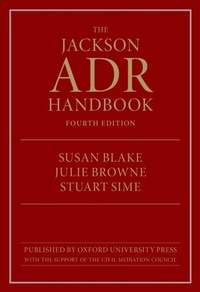
Jackson ADR Handbook
1st Edition
Published on 12. January 2025
432 pages
978-0-19-893765-4 (ISBN)
Description

The Jackson ADR Handbook^r was written to fulfil a recommendation by Lord Justice Jackson that there should be an authoritative handbook on alternative dispute resolution (ADR). The first edition, published in 2013, laid a strong foundation as an authoritative guide to ADR, receiving judicial endorsement from the Court of Appeal. Subsequent editions built upon that success, becoming a syllabus text prescribed by the Bar Standards Board. The use of ADR continues to be embedded in dispute resolution in England and Wales, with the Master of the Rolls and the Ministry of Justice implementing reforms that place the use of ADR alongside litigation. This revised fourth edition integrates important new case law, including the landmark case of Churchill v Merthyr Tydfil Borough Council [2023], in which the Court of Appeal decided a court can order parties to engage in a non-court based dispute resolution process, provided the right to a trial remains. Key changes in court rules and pre-action protocols are also covered. Designed with a concise, user-friendly format, the text provides an in-depth overview of the options and principles for ADR, placing them firmly within the context of litigation, and looking in detail at the relevant court rules and legal principles, such as privacy and legal professional privilege, as well as practical topics such as how to prepare for and what happens during mediation and recording and enforcing settlements.
More details
Content
- Cover
- THE JACKSON ADR HANDBOOK
- Copyright
- CONTENTS
- Table of Cases
- Table of Statutes
- Glossary and Abbreviations
- 1 GENERAL PRINCIPLES
- 1. General Principles of ADR
- A The Importance of ADR
- B The Definition of ADR
- C The Role of the Courts in the Use of ADR
- D The Role of Judges in the Use of ADR
- E The Context of the Jackson Review of Costs
- F Key Recent Developments
- G The Success of ADR
- H Compulsion to Use ADR
- I Regulation of ADR
- J The International Context
- 2. The Range of ADR Options
- A Adjudicative Options
- Arbitration
- Adjudication
- Expert determination
- Other adjudicative options
- B Non-?Adjudicative Options
- Offer and acceptance
- Negotiation
- Mediation
- Early neutral/?expert evaluation
- Mini trial
- Conciliation
- Complaint or grievance procedures
- Other options
- C Motivations for the Use of ADR
- Lower costs
- Speed of settlement
- Choice of forum/?decision taker
- Control of process
- Flexibility of process
- Confidentiality
- A wider range of issues/?outcomes may be considered
- Shared future interests may be protected
- Use of a problem-?solving approach
- Risk management
- D Criteria for the Selection of an ADR Option
- How important is it to minimize costs?
- How important is fast resolution?
- How much control does the party want?
- What are the main objectives of the party?
- Is a future relationship important?
- Is the view of an expert important to key issues?
- Would neutral assistance be valuable?
- E When ADR May Not be Appropriate
- The need for a precedent
- The importance of a court order
- The relevance of interim orders
- Evidential rules are important
- The strength of a case
- The complexity of the case
- High levels of animosity
- Power imbalance
- Quasi-?criminal allegations
- Having a day in court
- Enforcement may be an issue
- 3. Timing the Use of ADR in Relation to the Progress of a Case
- A The Importance of Timing
- B Procedural Factors Relevant to Timing
- Pre-?selection of ADR
- The use of ADR at the pre-?action stage
- On issue of proceedings
- Case and costs management and directions
- The use of ADR at an interim stage
- The use of ADR before and during trial
- The use of ADR in relation to appeals
- The use of ADR in relation to assessment of costs
- C Practical Factors Relevant to Timing
- The overriding objective
- The position as regards costs
- The timeframe for reaching resolution
- The issues in the case
- The availability of information
- The availability and importance of evidence
- The importance of interim applications
- The strength of a case
- Antagonism between the parties
- Specific types of case
- 4. Roles and Responsibilities of Lawyers and Parties in ADR
- A Overview
- B Duties under the Civil Procedure Rules
- C The Role of a Lawyer in Advising on ADR
- D Authority to Settle
- E The Role of a Lawyer in Advising on Terms of Settlement
- F The Role and Responsibilities of Parties in Relation to ADR
- G Addressing Concerns About ADR
- Appropriateness of the litigation process
- Robustness of process
- Proposing ADR may indicate weakness
- ADR might undermine litigation
- ADR might provide pressure to settle
- ADR may be used as a delaying tactic
- Limited knowledge of ADR process may be a concern
- ADR may incur extra expense
- ADR may be abused where a claim lacks merit
- H Persuading Another Party to Use ADR
- Identify and address concerns
- Propose specific benefits that ADR might offer
- Offer information about ADR options
- Propose a limited or simple ADR option
- Offer carrots
- Offer to pay reasonable ADR fees
- Engage the assistance of the judge
- I Potential Liability of a Lawyer in Relation to ADR
- Complaints
- Wasted costs
- Professional negligence
- 5. Privacy, Privilege, and Confidentiality Clauses
- A Importance of Privacy and Confidentiality in ADR
- B Control of Information in ADR
- C Legal Professional Privilege and ADR
- D The 'Without Prejudice' Principle
- E Confidentiality Clauses
- Negotiation
- Mediation
- Experts, early neutral evaluation, or expert determination
- Arbitration
- F Potential Loss of Confidentiality
- G Agreements to Keep Terms of Settlement Confidential
- 6. Ethics
- A Professional Responsibilities in ADR
- B Solicitors
- C Barristers
- D Acting in the Client's Best Interests
- E Acting within Instructions
- F Duties in Relation to Client Confidentiality
- G Duties in Relation to an Opponent
- H Duties in Relation to a Funder
- I Duties in Relation to a Court
- J Lawyers Who Provide ADR
- 7. Funding ADR Procedures
- A Expense and Funding
- B The Potential for ADR to Save Costs
- C The Potential Cost of an ADR Process
- Negotiation
- Mediation
- Arbitration
- Early neutral evaluation, expert determination, and adjudication
- D Funding Bases for an ADR Process
- Self-?funding
- Insurance
- Third party or litigation funding
- Conditional fee agreement (CFA)
- Damages-?based agreements (DBA)
- Legal Aid Agency funding
- Other options
- E Costs Management and Proportionality
- Costs management
- Proportionality
- F Overall Financial Analysis and Risk
- 8. ADR Prior to the Issue of Proceedings
- A The Context Where No Proceedings Have Been Issued
- B Powers of the Court Prior to Issue of Proceedings
- C Part 36 Offers Prior to Issue
- D Settlements Reached with No Issue of Proceedings
- E Pre-?Action Costs
- F Practice Direction Pre-?Action Conduct and Protocols Requirements
- G Making Reasonable Attempts to Settle Where No Proceedings Have Been Issued
- Proposing ADR
- Responding to a proposal to use ADR
- H Potential Justifications for Non-?Compliance
- I Key Proposed Developments for the General Pre-?Action Protocol
- 2 INTERPLAY BETWEEN ADR, CPR, AND LITIGATION
- 9. The Approach of the Courts to ADR
- A Introduction
- B Judicial Encouragement of ADR
- C Can the Court Compel the Parties to Use ADR?
- D The Court Guides
- E Pre-?Action Protocols
- F The Overriding Objective and ADR
- G Case Management Powers and ADR
- H Directions Questionnaires and ADR
- I Granting Stays for ADR
- J Embedding Dispute Resolution in the Digitalization of the Civil Courts
- K Contractual ADR Clauses
- L Costs Alternative Dispute Resolution
- 10. Costs and Cost Shifting in ADR
- A Liability to Pay for an ADR Process
- B Recovery of Costs within an ADR Process
- Advance agreement on costs
- Subsequent agreement on costs
- Award of costs in adjudicative ADR
- C Relevance of ADR to Costs within a Court Process
- General principles
- If a settlement is reached
- A decision on costs alone
- At an interim stage
- As part of damages
- At trial
- The amount of costs
- D Part 36 Offers
- Qualified one-?way cost shifting
- 11. Sanctions for Refusing to Engage in ADR Processes
- A Introduction
- B The Court's General Powers to Make Costs Orders
- C Failure to Comply with Pre-?Action Protocols
- D Refusal to Consider ADR
- The nature of the dispute
- The merits of the case
- Extent to which other settlement methods have been attempted
- Whether the costs of ADR would be disproportionately high
- Whether delay in setting up and attending ADR would be prejudicial
- Whether ADR had a reasonable prospect of success
- E Other Factors
- Whether an ADR order was made by the court
- Obtaining further evidence or information before using ADR
- The impact of Part 36 offers on a refusal to use ADR
- Unreasonable refusal of other offers
- F Failing to Make an Offer to Settle a Claim
- G Delay in Consenting to ADR
- H Both Parties at Fault
- I Rejecting ADR Before the Hearing of an Appeal
- J Backing Out of ADR
- K Unreasonable Conduct in Mediation
- L Sanctions for Failing to Attend Mandatory Mediation in Small Claims Track Cases
- M Sanctions in Fast Track and Intermediate Track Cases Subject to the Fixed Costs Regime
- N Indemnity Costs Orders for Unreasonable Conduct Regarding ADR
- O Silence in the Face of an Invitation to Use ADR
- P Prevarication in Relation to ADR
- Q What Practical Steps Should be Taken by a Party to Avoid Sanctions?
- R Privileged Material and Sanctions
- 3 NEGOTIATION
- 12. Negotiation and Joint Settlement Meetings
- A Negotiation as a Form of ADR
- B The Negotiation Process
- Professional conduct and ethics
- Procedure and evidence
- C Negotiation as a Context for Mediation
- D Joint Settlement Meetings
- 4 MEDIATION
- 13. Mediation: General Principles
- A What is Mediation?
- B Does Mediation Work?
- C Why Does Mediation Work?
- D Comparison between Negotiation and Mediation
- E Judicial Endorsement of Mediation
- F Disputes Suitable for Mediation
- G The Timing of Mediation
- H Persuading a Reluctant Party to Consider Mediation
- I What Can be Done by the Court to Make a Reluctant Party Consider Mediation?
- J The Costs of Mediation
- K The Funding of Mediation Costs, Fees, and Expenses
- L The Mediator's Role
- Organizing the mediation process
- Acting as a facilitator
- Acting as intermediary
- Post-?mediation role
- M Ethical Conduct Required of the Mediator
- Competence
- Independence and neutrality
- Impartiality
- The mediation procedure
- Fairness
- Confidentiality
- Termination of the mediation
- N Accreditation and Regulation of Mediation
- Training and accreditation requirements
- O The Civil Mediation Council
- P Confidentiality in Mediation
- Information given to the mediator 13.50
- Can the mediator enforce the confidentiality clause?
- When will the court override the confidentiality provisions?
- Other exceptions to confidentiality
- Q The Without Prejudice Rule in Mediation
- Communications that are not protected by the without prejudice rule in mediation
- Can the mediator rely on the without prejudice rule?
- R Legal Advice Privilege in Mediation
- S The Mediator as Witness
- T Can a Mediator be Sued?
- Legal proceedings
- Disciplinary proceedings
- 14. Preparation for the Mediation
- A Introduction
- B Styles of Mediation
- Facilitative mediation
- Evaluative mediation
- Transformative mediation
- C Selecting a Mediator
- Factors influencing the selection of a mediator
- D The Duration of Mediation
- E Selecting a Venue
- F The Agreement to Mediate
- G Pre-?Mediation Meeting/?Contact
- H The Attendees
- Representatives of the parties
- Person with authority to settle
- Lawyers
- Insurers
- Interest groups
- Experts
- Witnesses of fact
- I The Position Statements
- The aims in drafting the position statement
- The content of the position statement
- Joint position statement
- J The Key Supporting Documents
- Agreed bundle
- Confidential bundles
- K Disclosure of Other Documents
- L Complete Case Papers
- M Further Information the Mediator May Require
- N Risk Assessment
- O Options for Settlement
- P Specimen Settlement Clauses
- Q Conclusion
- 15. The Mediation Process
- A When Does the Mediation Start?
- B The Stages in Mediation
- C The Opening Stage
- The opening joint meeting (plenary session)
- Extension of the plenary session
- The separate private meetings (or closed meetings)
- D The Exploration/?Information Stage
- Carrying out a 'reality test'
- Probing the underlying issues
- Helping the parties to devise options for settlement
- E The Negotiating/?Bargaining Stage
- Joint meetings of the legal representatives of the parties
- Joint meetings between the lay clients
- Joint meetings of the experts
- F The Settlement/?Closing Stage
- If settlement is reached
- If no settlement is reached
- G The Closing Joint Meeting
- H The Mediator's Role Following the Conclusion of the Mediation
- I Main Variations in the Process
- Evaluative mediation
- J Med-?Arb
- K Arb-?Med
- Telephone mediations
- Mediations conducted online
- L Mediation Advocacy
- 16. Court Mediation Schemes and Other Schemes
- A Introduction
- B Historic Schemes
- C Current Court Mediation Schemes
- The HMCTS Small Claims Mediation Service
- The County Court Mediation Scheme for fast track and intermediate track cases
- Independent Conciliation Service for County Court small claims track disputes
- The High Court Appeals Mediation Scheme
- The Court of Appeal Mediation Scheme
- D Civil Mediation Online Directory
- The Fixed Fee Mediation Scheme
- E Judicial Mediation Schemes
- Court settlement process in the Technology and Construction Court
- Judicial mediation in Employment Tribunals
- F Mediation in Specific Cases
- Mediation in cases in the Commercial Court
- Complex construction, engineering, and technology disputes
- Family cases
- Workplace mediation
- Mediation in employment disputes
- G Mediating Multi-?Party Disputes
- H Other Mediation Processes
- Project mediation
- Mini-?trial or executive tribunal
- Consensus-?building mediation
- Deal mediation
- I Community Mediation
- J Pro Bono Mediation and LawWorks
- 17. EU Directive on Mediation in Civil and Commercial Cases
- A Introduction
- B The EU Mediation Directive
- Objective of the Directive
- Application of the Directive
- Main provisions of the EU Directive
- Ensuring the quality of mediation
- Implementation of the Directive by the UK
- The effect of Brexit
- Implementation of the EU Mediation Directive in other Member States
- C European Code of Conduct for Mediators
- 5 RECORDING AND ENFORCING SETTLEMENT
- 18. Recording Settlement-?Private Agreement
- A Reaching a Clear Outcome
- Funding arrangements and reasonable offers
- B Forms of Recorded Outcome
- Written agreement
- Full and final settlement
- C Records Made During the ADR Process
- D Forms for Recording Settlement
- Oral contract
- Exchange of letters or emails
- Formal written contract
- Other legal documents
- E Drafting Terms of Settlement
- 19. Recording Settlement-?Court Proceedings
- A Settlements in Existing Court Proceedings
- B Methods of Recording Settlements in Court Proceedings
- Judgment for immediate payment or by instalments
- Endorsement of settlement on backsheets
- Interim consent order
- Tomlin Order
- Restrictions on consent orders and judgments
- C Dealing with the Proceedings
- D Drafting of Consent Orders
- E Terms as to Costs
- F Administrative Consent Orders
- G Informing the Court of Settlement
- H Interpreting Consent Orders
- 20. Enforcement of Settlements
- A Introduction
- B Methods of Enforcing Compromise Agreements
- C Discharge of Original Obligation by Compromise
- D Enforcement of Compromise Contracts
- Effect of endorsements on briefs
- Enforcement by civil proceedings
- Bankruptcy and winding-?up
- E Challenging Compromise Contracts
- F Enforcement of Court Orders
- 6 OTHER ALTERNATIVE DISPUTE RESOLUTIONOPTIONS AND THE INTERNATIONAL PERSPECTIVE
- 21. Online ADR and ODR
- A Overview
- B The Use of Portals for Claim Management and Settlement
- C The Use of Online Resources to Support ADR Processes
- D The Development of ODR Options
- E The Development of Online Courts and Dispute Resolution
- F International Developments
- 22. Early Neutral Evaluation
- A Introduction
- B At What Stage Should ENE be Employed?
- C When Should ENE be Used?
- D Choice of Evaluator
- E Procedure
- F Neutral Fact-?Finding
- G Judicial Evaluation
- Judicial evaluation in the Commercial Court
- Judicial evaluation in the Technology and Construction Court
- Judicial evaluation in the Chancery Division
- Judicial evaluation in the King's Bench Division
- Judicial ENE in the Employment Tribunals
- Court-?ordered non-?court-?based ENE
- 23. Conciliation, Complaints, Grievances, and Ombudsmen
- A Introduction
- Definitions
- B Conciliation
- Employment conciliation
- C Complaints and Grievance Procedures
- Raising a complaint or grievance
- Complaints handling
- Acting for a party in a complaint
- Decisions in complaints and grievance investigations
- Information following exhaustion of complaints procedures
- D Ombudsmen
- Complaints handling by ombudsmen
- Procedure on references to ombudsmen
- Grounds on which ombudsmen make their decisions
- Relief available
- Can a complainant bring court proceedings?
- 24. Expert (or Neutral) Determination
- A What is Expert Determination?
- B Cases Suitable for Expert Determination
- C Contractual Nature of Expert Determination
- D Selection of the Expert
- E Procedure
- Implied duty to cooperate
- F Confidential Information
- G Nature of the Decision
- H Reasons for the Decision
- I Issues That Can Arise in Expert Determination
- J Ignoring an Expert Determination Clause
- Breach of contract
- Seeking pre-?action disclosure in advance of expert determination
- Applications to stay court proceedings pending expert determination
- K The Extent of the Expert's Jurisdiction
- L Grounds for Challenging the Decision
- M Contractual Grounds for Challenge
- No reasons for decision
- Manifest error
- An error of law
- Failure to act lawfully or fairly
- The decision is not intended to be final on matters of construction
- N Other Grounds on Which an Expert's Determination Can be Challenged
- Material departure from instructions
- Fraud
- Collusion
- O Procedure for Making a Challenge
- P Enforcing a Decision
- Q Suing the Expert
- R Disputes Review Panels
- 25. Arbitration
- A Introduction
- B Fundamental Concepts in Arbitration
- C Requirements
- Contractual foundation of arbitration
- Mandate of the arbitral tribunal
- D Stay of Legal Proceedings
- E Commencement
- F Procedure in Arbitrations
- Preliminary meeting
- Pre-?trial hearing/?conference
- Bundles
- No right to an oral hearing
- The hearing
- G Privacy and Confidentiality
- H Awards
- I Enforcement of Awards
- J Appeals
- 26. Construction Industry Adjudication
- A Introduction
- B Requirements
- Construction contract
- Dispute
- C Contractual Right to Adjudication
- D Commencement of the Adjudication
- Notice of adjudication: the commencement of adjudication
- Ambit of the reference
- Nomination of adjudicator
- Referral notice
- E Procedure
- Timetable for procedural steps
- Response to referral notice
- Subsequent statements of case
- F Adjudicator's Decision
- G After the Adjudication
- Index
