

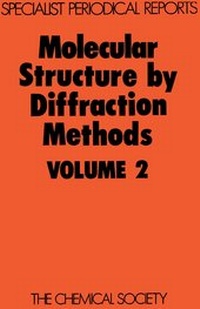
Molecular Structure by Diffraction Methods
Volume 2
1st Edition
Published on 31. October 2007
520 pages
978-1-84755-675-2 (ISBN)
Description

Specialist Periodical Reports provide systematic and detailed review coverage of progress in the major areas of chemical research. Written by experts in their specialist fields the series creates a unique service for the active research chemist, supplying regular critical in-depth accounts of progress in particular areas of chemistry. For over 80 years the Royal Society of Chemistry and its predecessor, the Chemical Society, have been publishing reports charting developments in chemistry, which originally took the form of Annual Reports. However, by 1967 the whole spectrum of chemistry could no longer be contained within one volume and the series Specialist Periodical Reports was born. The Annual Reports themselves still existed but were divided into two, and subsequently three, volumes covering Inorganic, Organic and Physical Chemistry. For more general coverage of the highlights in chemistry they remain a 'must'. Since that time the SPR series has altered according to the fluctuating degree of activity in various fields of chemistry. Some titles have remained unchanged, while others have altered their emphasis along with their titles; some have been combined under a new name whereas others have had to be discontinued. The current list of Specialist Periodical Reports can be seen on the inside flap of this volume.
More details
Series
Edition
1. Auflage
Language
English
Place of publication
Cambridge
United Kingdom
Target group
Professional and scholarly
ISBN-13
978-1-84755-675-2 (9781847556752)
DOI
10.1039/9781847556752
Copyright in bibliographic data and cover images is held by Nielsen Book Services Limited or by the publishers or by their respective licensors: all rights reserved.
Schweitzer Classification
Other editions
Additional editions
Book
01/1974
Royal Society of Chemistry
€398.50
Shipment within 3-4 weeks
Persons
Content
- Molecular Structure By Diffraction Methods
- Contents
- Part I Electron Diffraction
- Introduction to Part I
- Structures Determined by Gas-phase Electron Diffraction
- 1 Introduction
- 2 Hydrocarbons
- 3 Carbon-Nitrogen and Carbon-Oxygen Compounds
- 4 Carbon-Halogen Compounds
- 5 GroupsI-IV
- 6 Group V
- 7 Groups VI and VII
- 8 The Transition Elements
- Introduction to Parts II and III
- Part II Neutron Diffraction
- 1 Introduction
- 2 Hydrogen-bonding, the Water Molecule, and Related Topics
- 3 An Asymmetric Bifluoride Ion
- 4 Constrained Refinement
- 5 Amino-acids, Peptides, and Other Molecules Related to Natural Products
- Other Organic Molecules
- 6 Inorganic Crystals
- Some Simple Structures
- Location of Light Atoms in the Presence of Very Heavy Atoms
- Organometallic Compounds
- Combined X-Ray and N.D. Analysis
- Part III X-Ray Diffraction
- Chapter 1 Aromatic and other Analogous Compounds
- 1 Benzene Derivatives
- 2 Pyridine and Analogous Heterocyclic Derivatives
- 3 Polyaromatic and Related Heterocyclic Compounds
- 4 Biphenyl and Cyclophane Derivatives
- 5 Porphyrins and Pseudo-aromatic Compounds
- 6 Thiathiophthens and Related Compounds
- Chapter 2 Intermolecular Interactions
- 1 Charge-transfer Interactions
- 2 Solid-state Rearrangements and Reactions
- 3 Hydrogen Bonding
- Chapter 3 Saturated Hydrocarbons, Heterocyclic Analogues, and Derivatives
- 1 Derivatives of Methane, Ethane, Propane, and Butane
- 2 Cyclopropane and Cyclobutane Derivatives and Analogues
- 3 Cyclopentane and Five-membered Heterocyclic Analogues
- Cyclopentane Derivatives
- Heterocyclic Analogues containing One Heteroatom
- Heterocyclic Analogues containing Two Heteroatoms
- Heterocyclic Analogues containing Three Heteroatoms
- 4 Cyclohexane Derivatives and Heterocyclic Analogues
- 5 Medium and Large Rings
- 6 Bridged Ring Systems
- 7 Ylides and Related Systems
- Chapter 4 Natural Products and Small Biological Molecules
- 1 Alkaloids and Amines
- 2 Amino-acids and Peptides
- 3 Nitrogen Heterocycles
- Porphyrins
- Penicillins
- Flavins
- Pyrimidine Heterocycles
- Nucleosides
- Nucleotides
- 4 Sugars
- 5 Terpenoids
- Monoterpenoids
- Sesquiterpenoids
- Diterpenoids
- Sesterterpenoids
- Triterpenoids
- 6 Steroids
- 7 Carboxylic Acids, Esters, Lactones, and Miscellaneous Materials
- Chapter 5 Globular Proteins
- 1 Introduction
- 2 Structural Principles
- 3 Protein Structures
- Hydrolases
- Transferases
- Oxidoreductases
- Ligases
- Redox Proteins
- Agglutinants
- Haemoglobins
- Immunoglobulins
- Other Protein Structures
- 4 Methods of Structure Analysis
- Chapter 6 Titanium, Zirconium, and Hafnium
- 1 Titanium
- 2 Zirconium and Hafnium
- Chapter 7 Vanadium, Niobium, and Tantalum
- 1 Vanadium
- 2 Niobium and Tantalum
- Chapter 8 Chromium, Molybdenum, and Tungsten
- 1 Chromium
- Inorganic Complexes
- Organometallic Complexes
- Carbonyl Complexes
- Alkyl and Aryl Complexes
- p-Complexes with Carbocyclic and Heterocyclic Ligands
- 2 Molybdenum and Tungsten
- Inorganic Complexes
- Oxo-complexes
- Organometallic Complexes
- Carbonyl Complexes
- Carbamoyl, Alkyl, Oxa-allyl, and Allyl Complexes
- p-Arene Complexes
- Chapter 9 Manganese, Technetium, and Rhenium
- 1 Introduction
- 2 Manganese
- Inorganic Compounds
- Organometallic Compounds
- Mononuclear Carbonyls
- Dinuclear Carbonyls
- Isocyanide, Carbene, Aryl, and Alkene Complexes
- 3 Technetium and Rhenium
- Inorganic Compounds
- Organometallic Compounds
- Chapter 10 Iron, Ruthenium, and Osmium
- 1 Iron
- Compounds of Iron (II)
- Compounds of Iron (III)
- Organo-iron Compounds
- Mononuclear Derivatives of [Fe(CO)5]
- Ferrocene Derivatives
- Dinuclear Derivatives of [Fe2(CO)9]
- Tri- and Tetra-nuclear Organo-iron Compounds
- Other Low-spin Compounds of Iron
- 2 Ruthenium and Osmium
- Organo-ruthenium and -osmium Compounds
- Nitrosyl Compounds and Complexes with other Nitrogen Donors
- Hydride, Phosphine, and other Complexes of Ruthenium
- Chapter 11 Cobalt, Rhodium, and Iridium
- 1 Cobalt
- Inorganic Complexes of Cobalt (II)
- Trigonal Planar Complexes
- Tetrahedral Complexes
- Square-planar Complexes
- Five-co-ordinate Complexes
- Octahedral Complexes
- Inorganic Complexes of Cobalt (III)
- Organometallic Complexes of Cobalt
- 2 Rhodium and Iridium
- Inorganic Complexes
- Five co-ordinate Complexes
- Octahedral Complexes
- Organometallic Complexes
- Chapter 12 Nickel, Palladium, and Platinum
- 1 Introduction
- 2 Nickel
- Complexes of Nickel (0) and Nickel (I)
- Complexes of Nickel (II)
- Square-planar Complexes
- Tetrahedral Complexes
- Five-co-ordinate Complexes
- Octahedral Complexes
- Trigonal Prismatic Complexes
- Complexes of Nickel (III) and Nickel (IV)
- Organometallic Complexes of Nickel
- Ligands with One Donor Carbon Atom
- Olefin Complexes
- Allyl Complexes
- Ligands with more than Three Donor Carbon Atoms
- 3 Palladium and Platinum
- Complexes of Palladium (II) and Platinum (II)
- Complexes with Unidentate Ligands
- Chelate Complexes
- Polynuclear Complexes
- Platinum (IV) Complexes and Mixed-valence Platinum (II)-Platinum (IV) Complexes
- Organometallic Complexes of Palladium and Platinum
- Complexes containing Metal-Carbon (sp3) Bonds
- Complexes containing Metal-Carbon (sp2) Bonds
- Complexes containing Metal-Carbon (sp) Bonds
- p-Complexes
- Chapter 13 Copper, Silver, and Gold
- 1 Copper
- Complexes of Copper (I)
- Complexes of Copper (II)
- Non-chelate Complexes
- Bidentate Chelate Complexes
- Terdentate Chelate Complexes
- Quadridentate Chelate Complexes
- Complexes of Copper (III)
- 2 Silver and Gold
- Complexes of Silver (I) and Gold (I)
- Complexes of Silver (II)
- Complexes of Silver (III) and Gold (III)
- Gold (v)
- Cluster Compounds of Gold
- Chapter 14 Scandium, Yttrium, Lanthanides, and Actinides
- 1 Scandium, Yttrium, and the Lanthanides
- Inorganic Compounds
- Complex Compounds
- Organometallic Compounds
- 2 Actinides
- Thorium
- Uranium
- Inorganic Compounds
- Complexes
- Organometallic Compounds
- Chapter 15 Zinc, Cadmium, and Mercury
- 1 Zinc and Cadmium
- 2 Mercury
- Chapter 16 Boron, Aluminium, Gallium, Indium, and Thallium
- 1 Boron
- 2 Aluminium
- 3 Gallium, Indium, and Thallium
- Chapter 17 Carbon, Silicon, Germanium, Tin, and Lead
- 1 Carbon
- 2 Silicon
- 3 Germanium
- 4 Tin
- 5 Lead
- Chapter 18 Nitrogen, Phosphorus, Arsenic, Antimony, and Bismuth
- 1 Nitrogen
- 2 Phosphorus
- 3 Arsenic
- 4 Antimony
- 5 Bismuth
- Chapter 19 Oxygen, Sulphur, Selenium, and Tellurium
- 1 Oxygen
- 2 Sulphur
- 3 Selenium and Tellurium
- Chapter 20 Fluorine, Chlorine, Bromine, lodine, and the Noble Gases
- 1 The Halogens
- 2 Noble Gas Compounds
- Chapter 21 Lithium, Sodium, Potassium, Rubidium, and Caesium
- 1 Lithium
- 2 Sodium, Potassium, Rubidium, and Caesium
- Chapter 22 Beryllium, Magnesium, Calcium, Strontium, and Barium
- 1 Beryllium
- 2 Magnesium, Calcium, Strontium, and Barium
- Author Index
