

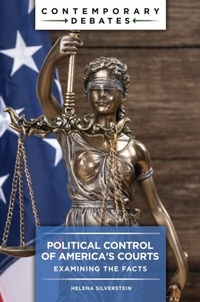
Political Control of America's Courts
Examining the Facts
1st Edition
Published on 18. January 2023
224 pages
978-1-4408-7806-0 (ISBN)
Available for download
Description

This volume explores the many ways in which politics shapes the allegedly nonpartisan judicial system in America, ranging from how judges are selected to the bench to how they rule when they get there. Each title in the Contemporary Debates series examines the veracity of controversial claims or beliefs surrounding a major political/cultural issue in the United States. Each book gives readers a clear and unbiased understanding of current high-interest issues by informing them about falsehoods, half-truths, and misconceptions-and confirming the factual validity of other assertions-that have gained traction in America's cultural and political discourse.This volume in the series provides a deeply researched and even-handed account of the relationship between America's judicial branch-which is supposed to view law through a nonpartisan lens-and the sometimes poisonous partisanship that is such a notorious factor in the nation's other two branches of government. Is political combat over judicial nominations worse than ever before? What impact is the politicization of the courts having on public faith in the legitimacy of the courts and our wider political system? Was former Supreme Court justice Sandra Day right when she asserted that "e,judicial independence is a bedrock principle of our court system, and we are losing it"e,? This work will provide insights into all these questions and more.
More details
Series
Language
English
Place of publication
New York
United States
Publishing group
Bloomsbury Publishing Plc
ISBN-13
978-1-4408-7806-0 (9781440878060)
Copyright in bibliographic data and cover images is held by Nielsen Book Services Limited or by the publishers or by their respective licensors: all rights reserved.
Schweitzer Classification
Other editions
Additional editions
Book
01/2023
ABC-CLIO
€78.00
Shipment within 10-20 days
Content
- Cover
- Title Page
- Copyright
- Contents
- Acknowledgments
- How to Use This Book
- 1. Nominations, Confirmations, and Departures of Federal Judges
- Q1. Are nominations and confirmations to the federal bench based on factors beyond merit?
- Q2. Do outside organizations influence whom the president nominates to the federal bench?
- Q3. Do interest groups influence the Supreme Court confirmation process?
- Q4. Is it unusual for the Senate to reject a Supreme Court nominee?
- Q5. Was the Senate's refusal to take action on President Obama's Supreme Court nomination of Merrick Garland really unprecedented?
- Q6. Are Supreme Court confirmation hearings a "vapid and hollow charade"?
- Q7. Is the timing of judicial retirements from the Supreme Court influenced by politics?
- Q8. Did President Trump's judicial appointments fundamentally re-make the federal judiciary for decades to come?
- 2. Judicial Elections to State Courts
- Q9. Have contested judicial elections become more political over recent decades?
- Q10. Are nonpartisan judicial elections less political than partisan judicial elections?
- Q11. Has politicization of judicial retention elections increased?
- Q12. Does the growth of campaign spending by interest groups affect judicial independence?
- Q13. Do politicized judicial elections threaten the legitimacy of state courts?
- 3. Structures Affecting the Courts
- Q14. Has Congress or the president ever sought to adjust the size of the Supreme Court for political gain?
- Q15. Can Congress strip the Supreme Court and lower federal courts of their jurisdiction?
- Q16. Would term limits make the Supreme Court less politicized?
- Q17. Was the end of the filibuster in federal judicial confirmations a historic rule change?
- Q18. Is the end of the filibuster in federal judicial confirmations likely to increase polarization on the federal courts?
- 4. Decisions and Decision Making
- Q19. Are Supreme Court justices influenced by public opinion?
- Q20. Do judges' political attitudes and ideologies influence their legal decisions?
- Q21. Did the Supreme Court's "switch in time that saved nine" occur in direct response to external political pressure?
- Q22. Is the influence of amicus briefs on the Supreme Court growing?
- Q23. Is the Supreme Court using the "shadow docket" more frequently?
- 5. Public Perceptions of the Judiciary
- Q24. Is public faith and confidence in the Supreme Court in decline?
- Q25. Does the public believe the courts are political and partisan?
- Q26. Does the public's perception of the judiciary vary by party affiliation?
- Q27. Has the judicial philosophy known as "originalism" become dominant in American jurisprudence and accepted by the public?
- 6. Politicization, Partisanship, and Legitimacy
- Q28. Were President Trump's criticisms of the judiciary unusual?
- Q29. Has the Supreme Court become more partisan?
- Q30. Is the Supreme Court facing a legitimacy crisis?
- Index

