

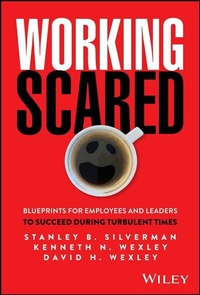
Working Scared
Description

Transform workplace uncertainty into career confidence with proven strategies that work for both employees and organizations
In Working Scared: Blueprints for Employees and Leaders to Succeed During Turbulent Times, authors Stanley B. Silverman, Kenneth N. Wexley, and David H. Wexley deliver a comprehensive roadmap for navigating today's volatile work environment. Drawing on decades of consulting experience across organizations ranging from small companies to Fortune 500 corporations, combined with extensive research and executive coaching credentials that establish them as leading authorities on workplace dynamics, the authors directly address eight primary sources of job insecurity plaguing the modern workforce. They discuss AI transformation, arrogant leadership, hybrid work challenges, economic turmoil, and more, providing dual-perspective solutions that empower both individual employees seeking career advancement and leaders working to optimize team effectiveness.
The book systematically examines each workplace challenge through a structured framework that combines data-driven analysis with real-world case studies, revealing how successful employees and leaders have navigated similar situations. Avoiding boilerplate, generalized advice, the authors identify ten overarching Keys for Success that create resilience and adaptability in the face of organizational uncertainty. Each chapter delivers actionable strategies grounded in practical experience, moving readers from reactive anxiety to proactive confidence in their professional lives.
You'll find:
An original, dual-perspective approach: Unique strategies tailored specifically for both employees and leaders facing the same workplace challenges
Eight critical workplace scenarios: Comprehensive coverage of an AI organizational transformation, difficult leadership, team dynamics, hybrid work, restructuring, mergers, economic instability, and personal well-being
Ten universal success principles: Overarching keys for success that apply across all workplace uncertainties and organizational changes
Real-world case studies: Practical examples from the authors' experience with diverse industries and organizational levels, from front-line workers to C-suite executives
Evidence-based solutions: Strategies validated through extensive consulting work and research across small companies to global organizations
An essential resource for all employees, including mid-career professionals, emerging leaders, and managers navigating workplace uncertainty or leading teams through organizational change, Working Scared is also the perfect guide for HR professionals, executive coaches, and business consultants required to solve problems for both individual workers and organizations.
More details
Other editions
Additional editions
Persons
STANLEY B. SILVERMAN is Dean and Professor Emeritus at The University of Akron and President of Human Resource Decisions, Inc.
KENNETH N. WEXLEY, PHD, is founder and CEO of Wexley Consulting, an internationally known consulting firm.
DAVID H. WEXLEY is President of Wexley Consulting, specializing in organizational development and management consulting.
Content
Preface ix
Prologue: Stop Working Scared and Start Working Confidently xi
1 Adapting to a Changing Workplace: Lessons from an AI Transformation 1
2 Succeeding Amidst Arrogant Leadership: Steps to Succeed, Persist, and Protect Yourself 25
3 Amplifying Your Voice in a Team Culture: How to Open Up Dialogue Even When It Feels Risky 49
4 Thriving in a Hybrid Team: From the Office to Remote to Somewhere In-Between 67
5 Enduring a Restructuring/Downsizing: Ways to Keep Your Job and Your Peace of Mind 85
6 Prevailing Through Mergers and Acquisitions: Techniques to Face the Unknown and Find Your Place Again 103
7 Building a Sense of Security Amidst Economic Turmoil: What to Do to Stay Grounded, Prepared, and Productive 123
8 Prioritizing Personal Well-Being: The ROI of Taking Care of Yourself 141
Bringing It All Together: The Toolbox to Succeed During Turbulent Times 155
Appendix: The 10 Keys for Success Survey 187
Acknowledgments 197
The Authors 199
Notes 203
Index 211
Prologue
Stop Working Scared and Start Working Confidently
Working scared" has become a common reality for employees around the world. As markets shift and competition intensifies, organizations push harder to stay ahead. That pressure quickly cascades to individual employees, who face intensifying demands to perform. Those mounting expectations can feel overwhelming, creating fear and unease across all levels of the workplace.
Through our work with clients, we hear directly about the stress of today's workplace. In fact, we have experienced it ourselves. From these conversations and experiences, eight recurring themes of anxiety have emerged. Together with our clients, we have explored ways to address these challenges and developed practical actions that work. This book distills those lessons into a survival guide designed to help employees and leaders not only cope but also thrive in today's turbulent environment. Each of the eight themes forms a chapter and presents:
- Facts about the issue.
- A story of an employee who faced the situation.
- Proven actions for the employee and their manager - what employees can do to succeed in such a situation, and what leaders can do to mitigate the fear in their teams so they can work more effectively.
In the subsequent chapters, we discuss:
- Adapting to a Changing Workplace. Change is constant in every organization, now more than ever. Whether it's economic shifts, leadership transitions, new products, or evolving policies, adapting successfully requires commitment, skill, and focus. Successful organizations, teams, and individuals focus on building the capacity for change. When you, as an individual, aim for a clear goal and make steady progress toward it, you give yourself - and your team - the best chance at long-term success.
- Succeeding Amidst Arrogant Leadership. Leadership shapes the culture of an organization. When leaders are perceived as being arrogant, it can drag down organizational performance and employee morale. Yet, arrogant leadership is becoming more prevalent. Confidence often propels individuals into leadership. But when that confidence becomes exaggerated, arrogance ensues, stifling others and hindering organizations. Greater awareness and behavioral adjustments can shift the dynamic toward a more constructive form of leadership.
- Amplifying Your Voice in a Team Culture. Teams can survive without everyone contributing - but they don't thrive. The highest-performing teams make space for everyone to contribute fully. These teams are most cohesive, collaborative, innovative, and high performing over time. For team members to contribute, the team atmosphere must provide the encouragement, safety, and openness to welcome divergent voices.
- Thriving in a Hybrid Team. Organizations are rethinking where and how we work. Traditional office life gave way to remote work, and more recently, many teams are navigating hybrid models. Today, teams face a wide array of work arrangements. While the ingredients for effective teamwork remain the same - clear goals, strong collaboration, and open communication - the ways we work together, collaborate, and communicate have changed dramatically. As a result, we need to adapt how we connect and contribute to our organization.
- Enduring a Restructuring/Downsizing. Restructuring is often driven by economic pressure - and it frequently means downsizing. These decisions are made at the organizational level - with long-term goals in mind, but they come with an immediate human cost. Whether you're one of the people leaving the organization, one of those who stay, or you're waiting to find out, the effects are felt deeply. But even during difficult transitions, there are opportunities to refocus and align one's efforts to capitalize on the change.
- Prevailing Through Mergers and Acquisitions. Whether you follow business news or just hear it in passing, mergers and acquisitions are everywhere. These deals create entirely new organizations - and every person within them feels the impact. The workplace may look the same, but the dynamics, culture, and expectations often shift dramatically. After the M&A, it's not just who stays that matters, but how they align with the changes that come next.
- Building a Sense of Security Amidst Economic Turmoil. These are turbulent times. Financial fluctuations, policy changes, and industry shifts create economic turmoil, putting pressure on organizations - and the people who work in them. When a company performs well, it can buffer some of that strain. But when it falters, employees often bear the brunt. That's why creating a sense of stability matters more than ever.
- Prioritizing Personal Well-Being. Organizational performance depends on the well-being of its employees. When employees are healthy, they are more productive, more innovative, less absent, and more likely to stay with an organization. It therefore follows that organizations should prioritize the well-being of their employees. And yet, many fall short. That's why it's important for employees to take an active role in caring for their own well-being.
These areas of anxiety can trigger fear and even helplessness. Left unchecked, working scared undermines your ability to succeed on the job. Being scared isn't pleasant, but it is a natural human response. Fortunately, there are techniques to cope, and to succeed during today's turbulent times. That's what this book is all about. You will learn specific techniques you can use in each of the eight scenarios - and build better skills to help you navigate through any situation. First, let's find out what's happening in your work environment. Take a few minutes to complete the Working Scared Survey by answering each of the 50 questions below.
Working Scared Survey
Never Rarely Sometimes Often Always Adapting to a Changing Workplace My organization .
- . explains clearly what change means and encourages me to connect with it personally.
- . clarifies what meaningful goals I should pursue during times of change.
- . provides meaningful feedback on my progress toward those goals.
- . identifies whom I can reach out to for insight, support, and feedback during change.
- . celebrates progress made toward achieving change-related goals.
- . builds trust by helping employees feel less uncertain and vulnerable during change.
- . fosters psychological safety by helping team members feel secure enough to take risks, speak up, or admit knowledge gaps.
- . reinforces that organizational objectives take priority over personal agendas.
- . emphasizes that feedback should be based on behaviors and results, not personal traits.
- . encourages leaders to listen to input before making decisions that impact others.
- . supports individuals in taking responsibility for both successes and...
