

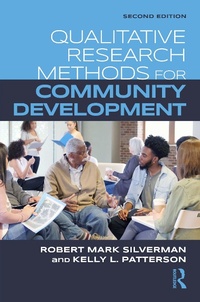
Qualitative Research Methods for Community Development
2nd Edition
Published on 30. December 2021
162 pages
978-1-000-50497-2 (ISBN)
Description

The second edition of Qualitative Research Methods for Community Development teaches the basic skills, tools, and methods of qualitative research with special attention to the needs of community practitioners. This book teaches students entering planning, community development, nonprofit management, social work, and similar applied fields the core skills necessary to conduct systematic research designed to empower communities and promote social change.
Focusing on the basic elements of qualitative research, such as field observation, interviewing, focus groups, and content analysis, this second edition of this book provides an overview of core methods and theoretical underpinnings of successful research. It also includes two new chapters on qualitative data analysis software and techniques for conducting online qualitative interviews and focus groups.
From housing, community organizing, neighborhood planning, and urban revitalization, this book gives students the skills they need to undertake their own projects and provides professionals a valuable reference for their future research. This book serves as a primary text for courses in applied qualitative research and as a reference book for professionals and community-based researchers.
Focusing on the basic elements of qualitative research, such as field observation, interviewing, focus groups, and content analysis, this second edition of this book provides an overview of core methods and theoretical underpinnings of successful research. It also includes two new chapters on qualitative data analysis software and techniques for conducting online qualitative interviews and focus groups.
From housing, community organizing, neighborhood planning, and urban revitalization, this book gives students the skills they need to undertake their own projects and provides professionals a valuable reference for their future research. This book serves as a primary text for courses in applied qualitative research and as a reference book for professionals and community-based researchers.
Reviews / Votes
"Qualitative Research Methods for Community Development is an accessible text on qualitative methods suitable to undergraduates, master's students, and even professionals. With a unique focus on community development, social work, and planning, the book makes qualitative research and data analysis techniques approachable. The discussion of online research tools and methods is a valuable addition to the new edition."Alessandro Rigolon, Department of City and Metropolitan Planning, the University of Utah
"New content on online engagement techniques is a very useful addition to the second edition of Qualitative Research Methods for Community Development. This is increasingly forming the cornerstone of participation strategies in professional practice, so understanding its potential is essential for practitioners. The online approach is also now ever-present in students' projects and something that is integral to research."
Nick Croft, charted town planner (MRTPI) with 19 years professional planning practice in the UK. He has worked as a university senior lecturer since 2006, leading online distance learning master's programs
"Succinct, accessible, and full of good examples of how mixed methods for community research is actually done, Qualitative Research Methods for Community Development is useful to all students who want to take on a project that involves participatory research and/or civic engagement. With notes on participatory action research and ethics, and a particular emphasis on writing and presentations, community groups will also find the book helpful. A particular strength of the new edition is the added analysis of online tools, which are becoming increasingly important."
Louise Jezierski, associate professor of social relations and policy and comparative cultures and politics, James Madison College, Michigan State University
More details
Edition
2nd edition
Language
English
Place of publication
London
United Kingdom
Publishing group
Taylor & Francis Ltd
Target group
College/higher education
Illustrations
26 Tables, black and white; 4 Line drawings, black and white; 7 Halftones, black and white; 11 Illustrations, black and white
ISBN-13
978-1-000-50497-2 (9781000504972)
Copyright in bibliographic data and cover images is held by Nielsen Book Services Limited or by the publishers or by their respective licensors: all rights reserved.
Schweitzer Classification
Other editions
Additional editions
Robert Mark Silverman | Kelly Patterson
Qualitative Research Methods for Community Development
Book
12/2021
2nd Edition
Routledge
€207.10
Shipment within 10-20 days
Robert Mark Silverman | Kelly Patterson
Qualitative Research Methods for Community Development
Book
12/2021
2nd Edition
Routledge
€57.40
Shipment within 10-20 days
Persons
Robert Mark Silverman is a professor in the Department of Urban and Regional Planning at the University at Buffalo. He holds a PhD in urban studies from the University of Wisconsin-Milwaukee. He also holds a BS in political science and a master's in public administration from Arizona State University. Robert's research focuses on community development, nonprofit sector, community-based organizations, education reform, and inequality in inner-city housing markets. He has published in Journal of Urban Affairs, Urban Affairs Review, Urban Studies, Urban Education, National Civic Review, Cityscape, Journal of Community Practice, Community Development, Journal of Black Studies, Journal of Social History, and other peer-reviewed journals. He is coauthor of Affordable Housing in US Shrinking Cities: From Neighborhoods of Despair to Neighborhoods of Opportunity? (2016). Robert is coeditor of Schools and Urban Revitalization: Rethinking Institutions and Community Development (Routledge, 2013) and Fair and Affordable Housing in the US: Trends, Outcomes, Future Directions (2011). He is also editor of Community-Based Organizations: The Intersection of Social Capital and Local Context in Contemporary Urban Society (2004).
Kelly L. Patterson is an associate professor in the School of Social Work at the University at Buffalo. She holds a PhD in urban studies from the University of Wisconsin-Milwaukee, a master's in public affairs from the University at Buffalo, and a BA in sociology from North Carolina Central University. Her research focuses on rent vouchers, fair housing, discrimination, social policy, and the African American experience. Kelly has published in Journal of Community Practice, Journal of Urban Affairs, Housing Policy Debate, Housing and Society, Cityscape, Journal of Social Service Research, Journal of Black Psychology, and other peer-reviewed journals. She is coauthor of Affordable Housing in US Shrinking Cities: From Neighborhoods of Despair to Neighborhoods of Opportunity? (2016). Kelly is coeditor of Schools and Urban Revitalization: Rethinking Institutions and Community Development (Routledge, 2013) and Fair and Affordable Housing in the US: Trends, Outcomes, Future Directions (2011).
Kelly L. Patterson is an associate professor in the School of Social Work at the University at Buffalo. She holds a PhD in urban studies from the University of Wisconsin-Milwaukee, a master's in public affairs from the University at Buffalo, and a BA in sociology from North Carolina Central University. Her research focuses on rent vouchers, fair housing, discrimination, social policy, and the African American experience. Kelly has published in Journal of Community Practice, Journal of Urban Affairs, Housing Policy Debate, Housing and Society, Cityscape, Journal of Social Service Research, Journal of Black Psychology, and other peer-reviewed journals. She is coauthor of Affordable Housing in US Shrinking Cities: From Neighborhoods of Despair to Neighborhoods of Opportunity? (2016). Kelly is coeditor of Schools and Urban Revitalization: Rethinking Institutions and Community Development (Routledge, 2013) and Fair and Affordable Housing in the US: Trends, Outcomes, Future Directions (2011).
Content
1. Qualitative Research for Students and Professionals 2. Qualitative Analysis as an Iterative Process 3. An Introduction to Qualitative Data Analysis Software 4. Field Notes and Observations 5. Semi-Structured Interviewing 6. Focus Groups 7. Online Qualitative Interviewing and Focus Groups 8. Content Analysis 9. Dissemination of Qualitative Findings
