

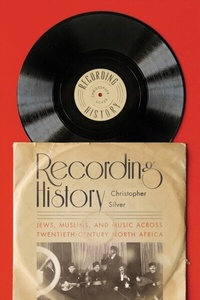
Recording History
Jews, Muslims, and Music Across Twentieth-Century North Africa
Published on 28. June 2022
320 pages
978-1-5036-3169-4 (ISBN)
Available for download
Description

A new history of twentieth-century North Africa, that gives voice to the musicians who defined an era and the vibrant recording industry that carried their popular sounds from the colonial period through decolonization.
If twentieth-century stories of Jews and Muslims in North Africa are usually told separately, Recording History demonstrates that we have not been listening to what brought these communities together: Arab music. For decades, thousands of phonograph records flowed across North African borders. The sounds embedded in their grooves were shaped in large part by Jewish musicians, who gave voice to a changing world around them. Their popular songs broadcast on radio, performed in concert, and circulated on disc carried with them the power to delight audiences, stir national sentiments, and frustrate French colonial authorities.
With this book, Christopher Silver provides the first history of the music scene and recording industry across Morocco, Algeria, and Tunisia, and offers striking insights into Jewish-Muslim relations through the rhythms that animated them. He traces the path of hit-makers and their hit records, illuminating regional and transnational connections. In asking what North Africa once sounded like, Silver recovers a world of many voices-of pioneering impresarios, daring female stars, cantors turned composers, witnesses and survivors of war, and national and nationalist icons-whose music still resonates well into our present.
If twentieth-century stories of Jews and Muslims in North Africa are usually told separately, Recording History demonstrates that we have not been listening to what brought these communities together: Arab music. For decades, thousands of phonograph records flowed across North African borders. The sounds embedded in their grooves were shaped in large part by Jewish musicians, who gave voice to a changing world around them. Their popular songs broadcast on radio, performed in concert, and circulated on disc carried with them the power to delight audiences, stir national sentiments, and frustrate French colonial authorities.
With this book, Christopher Silver provides the first history of the music scene and recording industry across Morocco, Algeria, and Tunisia, and offers striking insights into Jewish-Muslim relations through the rhythms that animated them. He traces the path of hit-makers and their hit records, illuminating regional and transnational connections. In asking what North Africa once sounded like, Silver recovers a world of many voices-of pioneering impresarios, daring female stars, cantors turned composers, witnesses and survivors of war, and national and nationalist icons-whose music still resonates well into our present.
Reviews / Votes
"Masterfully orchestrating the sounds of the North African music industry, Recording History provides a fresh and unique tune to North African history. Analyzing the silences, echoes, and sounds of Jewish-Muslim relations, this delightful book is a classic in the making."-Aomar Boum, University of California, Los Angeles, editor of Wartime North Africa "Recording History is a highly original transnational study that masterfully fills an important gap in the history of popular culture in Tunisia, Morocco, and Algeria. By astutely listening to the past, Christopher Silver paints a rich and complex picture of North African music, aural culture, and recording history."-Ziad Fahmy, Cornell University, author of Street Sounds "Christopher Silver's noble quest to bring this lost world back to life, via obscure Maghrebi music stores and dusty boxes of shellac records in Montreal and Paris, allows us to restore its missing notes and fill in a silence in the soundtrack of our history."-Matti Friedman, Jewish Review of Books "Silver's contribution to the rapidly growing field of Sephardic Studies is a great achievement. I commend him for his active efforts to not only rescue this history from obscurity, but to bring it back to life and share it with the world."-Hannah Srour-Zackon, The Canadian Jewish News "Based on meticulous research and the [Silver]'s impressive knowledge of multiple languages and musical genres, the book represents a landmark in the study of the musical cultures of North Africa and provides an exhaustive history of the music, thereby setting a high bar for future scholarship on the region and its cultural dynamics."-Jonathan Shannon, The Journal of North African Studies "This book is a welcome addition to the fields of Jewish Studies, Middle Eastern Studies, and cultural history more broadly.... Recording History has opened the door to a brilliant new historiographical soundscape."-Alma Rachel Heckman, Canadian Jewish Studies "Recording History is both exciting new research on music itself, and an unexpected history of North African Jews and Jewish-Muslim relations, through the framework of a shared musical heritage."-Phoebe Maltz Bovy, Canadian Jewish News "Recording History is a well-written and compelling book. Silver meticulously narrates the rich stories of artists and songs and contextualizes them in the social, political, and economic contexts of their times."-Hugo Hadji, Musica Judaica Online Reviews "Recording History makes an invaluable contribution to scholarship on the complex musical histories of North Africa in the 20th century. It will be of great benefit to anyone interested in not only the music of the region but also histories of colonialism, technology, and religion within North Africa."-Stephen Wilford, International Journal of Middle East Studies "Silver excels at depicting a landscape that is as detailed as it is comprehensive, and in balancing the panoramic gaze with the meticulous analysis of local realities. The book delineates a complex web of cultural, sonic, and human flows that make up the region, its constituent states, and its minorities and majorities, challenging understandings of the Maghreb as a monolith."-Smuel Llano, Revue de musicologieMore details
Edition
New edition
Language
English
Place of publication
Palo Alto
United States
Target group
Professional and scholarly
Edition type
New edition
Illustrations
20 halftones, 1 map
ISBN-13
978-1-5036-3169-4 (9781503631694)
Copyright in bibliographic data and cover images is held by Nielsen Book Services Limited or by the publishers or by their respective licensors: all rights reserved.
Schweitzer Classification
Other editions
Additional editions
Book
06/2022
Stanford University Press
€30.00
Shipment within 15-20 days
Book
12/2020
Stanford University Press
€122.50
Shipment within 15-20 days
Person
Christopher Silver is the Segal Family Assistant Professor in Jewish History and Culture at McGill University. He is the founder and curator of the website Gharamophone.com, a digital archive of North African records from the first half of the twentieth century.
Content
- Cover
- Title Page
- Copyright
- Dedication
- Contents
- Map and Figures
- Note on Transliteration and Translation
- Acknowledgments
- Introduction
- 1. The Birth of the Recording Industry in North Africa
- 2. The Arab Foxtrot and the Charleston
- 3. Nationalist Records
- 4. Listening for World War II
- 5. Singing Independence
- 6. Curtain Call
- Conclusion
- Notes
- Discography and Bibliography
- Index

