

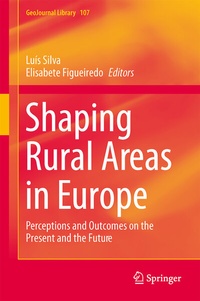
Shaping Rural Areas in Europe
Description

Shaping Rural Areas in Europe. Perceptions and Outcomes on the Present and the Future sets out to investigate the effect of urban perceptions about the rural and consequent demands on rurality on the present and future configurations of rural territories in Europe in the early twenty-first century. This volume presents and discusses a broad range of case studies and theoretical and methodological approaches from different academic fields, mainly Anthropology, Sociology and Geography.
More details
Other editions
Additional editions
Persons
Elisabete Figueiredo is a sociologist, PhD in Environmental Sciences. She is an assistant professor at the Department of Social, Political andTerritorial Sciences - University of Aveiro (UAVR) and Full Researcher at GOVCOPP - Research Unit on Governance, Competitiveness and Public Policies [elisa@ua.pt]. Her principal research interests are rural sociology and rural studies, especially contrasting social representations and imaginaries on rural areas and on rurality; rural development policies and strategies; rural reconfiguration and restructuring processes; rural tourism impacts. She is also interested in environmental sociology and risk studies. She is author and co-author of more than 100 papers, in international and national books and journals. She is the general coordination of the book Rural Plural - Olhar o presente, imaginar o future [Plural Rural - looking at the present, imagining the future] (2011, 100Luz).
Content
Chapter 1. What is Shaping Rural Areas in Europe? Introduction; Luís Silva and Elisabete Figueiredo.- Part I. Living in the Rural: New and Old Actors and their Visions on Rurality.- Chapter 2. Running Wild in the Country?: Mobilising Rural In-Migration; Keith Halfacree.- Chapter 3. Translating Ex-Urban Dwellers' Rural Representations into Residential Practices and Rural Futures; María J. Rivera.- Chapter 4. Perceptions and Appropriations of Discourses in the National Park Island of Ons (Galicia, Spain); Juan M. Dabezies and Paula Ballesteros-Arias.- Chapter 5. Having, Loving, Being in the Periphery: Interpretations of Locality in the National Landscape of Koli, Eastern Finland; Eeva Uusitalo and Laura Assmuth.- Chapter 6. Projecting the ''Disadvantaged'': Project Class, Scale Hopping and the Creation of Ruralities; Alexandra Szoke.- Part II. Consuming and Representing the Rural.- Chapter 7. The Pastoral Ideal in Portugal: From Literature to Touristic Practices; Luís Silva.- Chapter8. Mediating Rurality, History and Exclusivity in Pousadas de Portugal; Marta L. Prista.- Chapter 9. McRural, No Rural or What Rural? : Some Reflections on Rural Reconfiguration Processes Based on the Promotion of Schist Villages Network, Portugal; Elisabete Figueiredo.- Chapter 10. Connecting Food Memories with the Rural: The Case of Portuguese and British Consumers; Mónica Truninger.- Chapter 11. Does the Countryside Still Feed the Country?: Producing and Re-Producing the Rural in Transylvania; Árpád T. Szabó.- Chapter 12. In Search of the Rurban Idyll?: Developing the Residential Rural Areas in Finland; Pilvi Hämeenaho.- Chapter 13. The Foraged Countryside: Perceptions of Nature and Culture in Four Encounters with Fungi; Maria Kennedy.- Chapter 14. The Rurality Reinvention Discourse: Urban Demands, Expectations and Representations in the Construction of an Urban Rurality Project; Ana M. Fernandes.- Chapter 15. Cross-Cultural Perceptions and Discourses between Rural andUrban in Galicia; Xerardo Pereiro and Santiago Prado.- Chapter 16. Concluding Remarks on Perceived and Lived Ruralities and the Future of Rural Europe; Luís Silva.- Index.
