

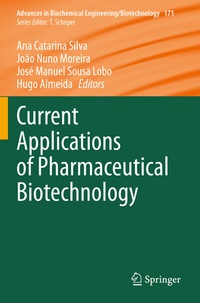
Current Applications of Pharmaceutical Biotechnology
Description

This book offers an authoritative review of biopharmaceuticals and their clinical relevance. Biopharmaceuticals have been showing high therapeutic potential by means of biological and biosimilar medicines, particularly for the treatment of cancer, chronic diseases (e.g. diabetes, Crohn's disease, psoriasis and rheumatoid arthritis), neurodegenerative disorders (e.g. multiple sclerosis), and they have also been contributing to the progress of innovative therapies such as assisted reproductive medicine. Since the eighties, several biopharmaceuticals have been approved and, due to patents expiration, many biosimilars are also marketed.
In this book, readers will find the most relevant updated information about the main clinical applications of pharmaceutical biotechnology. The authors provide expert analysis about the industrial challenges of recombinant proteins and the different classes of biopharmaceuticals, including monoclonal antibodies, vaccines, growth factors and stem cells. Topics such as bioprinting technologies in tissue engineering, gene therapy and personalized medicine are also covered in this book. Professionals, students and researchers interested in this field will find this work an important account.
More details
Other editions
Additional editions
Persons
Professor Ana Catarina Silva is an Assistant Professor of Pharmaceutical Technology and Biotechnology, and a Researcher at the Applied Molecular Biosciences Unit (UCIBIO) and UFP Energy, Environment and Health Research Unit (FP-ENAS), where she is currently developing lipid-based nanosystems to improve drug delivery and alternative systems to improve delivery of biopharmaceuticals. She has authored a number of scientific publications, and served as a referee for various international funding agencies.
Professor João Nuno Moreira is a group leader at the Center for Neuroscience and Cell Biology (CNC) and Assistant Professor with "Habilitation" (and Tenure) at the Faculty of Pharmacy, University of Coimbra, Portugal. His scientific work focuses on lipid-based nanosystems for targeted drug delivery and formulation of proteins. He is a co-author of several publications in peer-reviewed journals, 9 book chapters and 10 filed patents (3 of which have been grantedin the United States and 2 in Europe).
Professor José Manuel Sousa Lobo is Head of the Laboratory of Pharmaceutical Technology and Executive Council Director of the FFUP. He is also President of the Portuguese Pharmacopoeia Commission. An expert on industrial pharmacy, he is responsible for Quality Overall Summaries for the EMA, and is an investigator at UCIBIO.
Dr. Hugo Almeida
holds a PhD in Pharmaceutical Sciences, and is Technical Director of a Medical Device company. He has authored numerous scientific publications, and his main research focuses on the application of stimuli-responsive polymers and lipid-based nanocarriers in ophthalmic drug delivery systems..
