

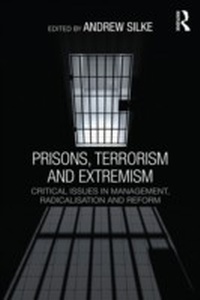
Prisons, Terrorism and Extremism
Critical Issues in Management, Radicalisation and Reform
1st Edition
Published on 18. February 2014
312 pages
978-1-136-65789-4 (ISBN)
Description

This volume provides an overview of intervention and management strategies for dealing with terrorist and extremist offenders in prisons.
The management of terrorist and extremist prisoners has long been recognised as a difficult problem in prisons. In most countries, such offenders are relatively rare, but when their numbers increase these prisoners can undermine the effectiveness and safety of the prison system. At a global level there is an increasing recognition of the problem of militant jihadi extremists in prison and their ability to recruit new members among other prisoners. The numbers of such prisoners are low but growing and, as a result, prisons are becoming centres of radicalisation; indeed, in some cases, terrorist plots appear to have been based entirely on networks that were radicalised in prison.
This volume presents an expertly informed assessment of what we know about terrorists, extremists and prison, exploring the experience of a wide range of countries and of different political movements. Drawing critical lessons from historical case studies, the book examines critical issues around management strategies, radicalisation and deradicalisation, reform, risk assessment, as well as post-release experiences. The role that prisoners play in the conflicts beyond the jail walls is also examined, with case studies illustrating how prisoners can play a critical role in bringing about a peace process or alternatively in sustaining or even escalating campaigns of violence.
Written by leading experts in the field, this volume will be of much interest to students of terrorism/counter-terrorism, criminology, security studies and IR in general.
The management of terrorist and extremist prisoners has long been recognised as a difficult problem in prisons. In most countries, such offenders are relatively rare, but when their numbers increase these prisoners can undermine the effectiveness and safety of the prison system. At a global level there is an increasing recognition of the problem of militant jihadi extremists in prison and their ability to recruit new members among other prisoners. The numbers of such prisoners are low but growing and, as a result, prisons are becoming centres of radicalisation; indeed, in some cases, terrorist plots appear to have been based entirely on networks that were radicalised in prison.
This volume presents an expertly informed assessment of what we know about terrorists, extremists and prison, exploring the experience of a wide range of countries and of different political movements. Drawing critical lessons from historical case studies, the book examines critical issues around management strategies, radicalisation and deradicalisation, reform, risk assessment, as well as post-release experiences. The role that prisoners play in the conflicts beyond the jail walls is also examined, with case studies illustrating how prisoners can play a critical role in bringing about a peace process or alternatively in sustaining or even escalating campaigns of violence.
Written by leading experts in the field, this volume will be of much interest to students of terrorism/counter-terrorism, criminology, security studies and IR in general.
Reviews / Votes
'Although many if not most terrorists eventually end up in prison, there has been surprisingly little research on what happens to them while in prison and after they have been released. This volume, edited by a prominent expert in the field, Andrew Silke, makes an important contribution to fill this gap in our knowledge. Several of the chapters challenge the conventional wisdom that "prisons are universities of terror". Prisons may also provide opportunities for disengagement, deradicalisation and rehabilitation. Wise policies may contribute constructively to facilitate these processes. To achieve this, Silke and his colleagues provide indispensable insights.' -- Tore Bjorgo, Norwegian Police University College and the Norwegian Institute of International Affairs'Andrew Silke has brought together a truly international group of experts to examine how we understand and manage extremists in our prison systems. The contributors have carefully integrated scientific rigour and effective risk management approaches; they provide much needed depth and sophistication to thinking about the role of prisons in the management of such prisoners. This book is a must-read for practitioners and policy makers tasked with protecting society from this most formidable of threats.' -- David Cooke, Glasgow Caledonian University
'Radicalization is an issue of such beguiling complexity that it is poorly understood even by those who run our prisons. Andrew Silke has done a great service by bringing together some of the most talented scholars on the radicalization problem in the world today. This book shows that radicalization cannot be dealt with through normal techniques of prison management, but only through creative administrative methods informed by the social sciences. The work is destined to become an indispensable guide for the reformers of tomorrow.' -- Mark S. Hamm, author of The Spectacular Few: Prisoner Radicalization and the Evolving Terrorist Threat
More details
Series
Language
English
Place of publication
London
United Kingdom
Publishing group
Taylor & Francis Ltd
Target group
College/higher education
Professional and scholarly
Product notice
Reflowable
Illustrations
2 s/w Tabellen, 7 s/w Zeichnungen
2 Tables, black and white; 7 Line drawings, black and white
File size
3,42 MB
ISBN-13
978-1-136-65789-4 (9781136657894)
Copyright in bibliographic data and cover images is held by Nielsen Book Services Limited or by the publishers or by their respective licensors: all rights reserved.
Schweitzer Classification
Other editions
Additional editions
Andrew Silke
Prisons, Terrorism and Extremism
Critical Issues in Management, Radicalisation and Reform
Book
12/2013
1st Edition
Routledge
€232.20
Shipment within 15-20 days
Andrew Silke
Prisons, Terrorism and Extremism
Critical Issues in Management, Radicalisation and Reform
Book
12/2013
1st Edition
Routledge
€77.40
Shipment within 15-20 days
Person
Andrew Silke holds a Chair in Criminology at the University of East London, where he is the Head of Criminology and the Programme Director for Terrorism Studies. He is author/editor of several books on terrorism, including The Psychology of Counter-Terrorism (Routledge, 2010), Research on Terrorism (Routledge, 2004), and Terrorists, Victims and Society (2003).
Content
PART I: INTRODUCTION 1. Terrorists, Extremists and Prison: An Introduction to the Critical Issues, Andrew Silke 2. 'To Punish, Deter and Incapacitate': Incarceration and Radicalisation in UK Prisons after 9/11, Colin Murray PART II: RADICALISATION, DE-RADICALISATION AND DISENGAGEMENT 3. Developing a Model of Prison Radicalisation, Joshua Sinai 4. From Criminals to Terrorists: The US Experience of Prison Radicalisation, Liran Goldman 5. Does De-radicalisation Work? Considering Communication and Psychological Impact in Prison De-radicalisation Programmes, Kurt Braddock 6. A Time to Think, A Time to Talk: Irish Republican Prisoners in the Northern Irish Peace Process, John Morrison PART III: CRITICAL ISSUES IN MANAGEMENT, RISK ASSESSMENT AND REFORM 7. The Healthy Identity Intervention: The UK's Development of a Psychologically Informed Intervention to address Extremist Offending, Chris Dean 8. Risk Assessment of Terrorist and Extremist Prisoners, Andrew Silke 9. Violent Extremist Risk Assessment: Issues and Applications of the VERA-2 in a High Security Correctional Setting, D. Elaine Pressman and John Flockton 10. The Israeli Experience of Terrorist Prisoner Management and Risk Assessment, Sagit Yehoshua PART IV: KEY CASE STUDIES 11. Terrorism, Extremism, Radicalisation and the Offender Management System in England and Wales, Richard Pickering 12. Saudi Arabia's "Soft" Approach to Terrorist Prisoners: A Model for Others?, Marisa Porges 13. De-radicalising the Liberation Tigers of Tamil Eelam (LTTE), Arie Kruglanski, Michele Gelfand, Jocelyn Belanger, Rohan Gunaratna and Malkanthi Hetiarachchi 14. The "Three Rings" of Terrorist Rehabilitation and Counter-Ideological Work in Singapore: A Decade On, Kumar Ramakrishna 15. Radicalisation, Recidivism and Rehabilitation: Convicted terrorists and Indonesian prisons, Sulastri Osman 16. The Red Army Faction Prisoners in West Germany: Equal treatment or unfairly tough?, Gisela Diewald-Kerkmann 17. Prison Policy as an Anti-Terrorist Tool: Lessons from Spain, Manuel R. Torres Soriano PART V: POST-RELEASE EXPERIENCES 18. Do Leopards Change Their Spots? Probation, Risk Assessment and Management of Terrorism-Related Offenders on Licence in the UK, Ben Wilkinson 19. Northern Irish Ex-Prisoners: The impact of Imprisonment on Prisoners and the Peace Process in Northern Ireland, Neil Ferguson
