

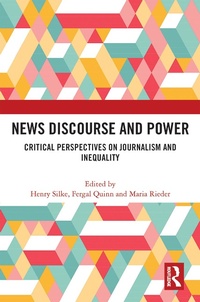
News Discourse and Power
Critical Perspectives on Journalism and Inequality
1st Edition
Published on 21. March 2021
152 pages
978-1-000-35639-7 (ISBN)
Description

The issue of socio-economic inequality has become an increasingly important question for journalism and the academy. The 2008 economic crisis and the years of austerity which followed exasperated class and regional division and as an even greater economic shock emerges from the aftermath of the Covid 19 pandemic, the role of journalism and the wider media in the production and reproduction of inequality assumes greater importance.
This edited collection includes eight chapters examining instances of where inequality is examined in the media, for example coverage of Thomas Piketty, precarity, corporate tax rates and race-, class- and gender-related issues, in order to address the following questions:
Does journalism treat the issue of inequality in a satisfactory fashion?
Does journalism challenge powerful interests, or does journalism play an ideological role in the reproduction of structures of inequality itself?
How do increasingly poor working conditions of journalists impact on the coverage of inequality?
The chapters in this book were originally published as a special issue of the Critical Discourse Studies journal.
This edited collection includes eight chapters examining instances of where inequality is examined in the media, for example coverage of Thomas Piketty, precarity, corporate tax rates and race-, class- and gender-related issues, in order to address the following questions:
Does journalism treat the issue of inequality in a satisfactory fashion?
Does journalism challenge powerful interests, or does journalism play an ideological role in the reproduction of structures of inequality itself?
How do increasingly poor working conditions of journalists impact on the coverage of inequality?
The chapters in this book were originally published as a special issue of the Critical Discourse Studies journal.
More details
Edition
1. Auflage
Language
English
Place of publication
London
United Kingdom
Publishing group
Taylor & Francis Ltd
Target group
College/higher education
Product notice
Reflowable
ISBN-13
978-1-000-35639-7 (9781000356397)
Copyright in bibliographic data and cover images is held by Nielsen Book Services Limited or by the publishers or by their respective licensors: all rights reserved.
Schweitzer Classification
Other editions
Additional editions
Henry Silke | Fergal Quinn | Maria Rieder
News Discourse and Power
Critical Perspectives on Journalism and Inequality
Book
09/2023
1st Edition
Routledge
€61.30
Shipment within 15-20 days
Henry Silke | Fergal Quinn | Maria Rieder
News Discourse and Power
Critical Perspectives on Journalism and Inequality
Book
03/2021
1st Edition
Routledge
€192.04
Shipment within 15-20 days
Persons
Henry Silke lectures in journalism at the University of Limerick, Ireland. His research interests include ideology, the political economy of journalism and the role of communications and journalism in economic systems.
Fergal Quinn lectures in journalism at the University of Limerick, Ireland. His research focuses on comparative ethical norms in journalism, media representation of minorities and risk communication.
Maria Rieder is Lecturer in Sociolinguistics at the University of Limerick, Ireland. Her research focuses on social and economic inequality, minority communities and languages, language in the media, social movements and intercultural communication, with a specific focus on the role of language in the production of power and social conflict.
Fergal Quinn lectures in journalism at the University of Limerick, Ireland. His research focuses on comparative ethical norms in journalism, media representation of minorities and risk communication.
Maria Rieder is Lecturer in Sociolinguistics at the University of Limerick, Ireland. Her research focuses on social and economic inequality, minority communities and languages, language in the media, social movements and intercultural communication, with a specific focus on the role of language in the production of power and social conflict.
Content
Introduction: Journalism, Discourse and the Reproduction of Inequality
Henry Silke, Fergal Quinn and Maria Rieder
1. 'Piketty is a genius, but ... ': an analysis of journalistic delegitimation of Thomas Piketty's economic policy proposals
Maria Rieder and Hendrik Theine
2. Denying, downplaying, debating: defensive discourses of inequality in the debate on Piketty
Andrea Grisold and Henry Silke
3. 'Overpaid' and 'inefficient': print media framings of the public sector in The Irish Times and The Irish Independent during the financial crisis
Aileen Marron
4. Cooking a corporation tax controversy: Apple, Ireland and the EU
Ciara Graham and Brendan K. O'Rourke
5. Her name was Clodagh: Twitter and the news discourse of murder suicide
Fergal Quinn, Muireann Prendergast and Audrey Galvin
6. Discourses of tragedy: a comparative corpus-based study of newspaper reportage of the Berkeley balcony collapse and Carrickmines fire
Fergal Quinn and Elaine Vaughan
7. Fake news? A critical analysis of the 'Welfare Cheats, Cheat Us All' campaign in Ireland
Eoin Devereux and Martin J. Power
8. Narrowing the discourse? Growing precarity in freelance journalism and its effect on the construction of news discourse
Kathryn Hayes and Henry Silke
Henry Silke, Fergal Quinn and Maria Rieder
1. 'Piketty is a genius, but ... ': an analysis of journalistic delegitimation of Thomas Piketty's economic policy proposals
Maria Rieder and Hendrik Theine
2. Denying, downplaying, debating: defensive discourses of inequality in the debate on Piketty
Andrea Grisold and Henry Silke
3. 'Overpaid' and 'inefficient': print media framings of the public sector in The Irish Times and The Irish Independent during the financial crisis
Aileen Marron
4. Cooking a corporation tax controversy: Apple, Ireland and the EU
Ciara Graham and Brendan K. O'Rourke
5. Her name was Clodagh: Twitter and the news discourse of murder suicide
Fergal Quinn, Muireann Prendergast and Audrey Galvin
6. Discourses of tragedy: a comparative corpus-based study of newspaper reportage of the Berkeley balcony collapse and Carrickmines fire
Fergal Quinn and Elaine Vaughan
7. Fake news? A critical analysis of the 'Welfare Cheats, Cheat Us All' campaign in Ireland
Eoin Devereux and Martin J. Power
8. Narrowing the discourse? Growing precarity in freelance journalism and its effect on the construction of news discourse
Kathryn Hayes and Henry Silke
