

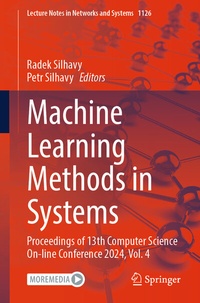
Machine Learning Methods in Systems
Description

This book requires an in-depth exploration of machine learning and its integration into system engineering. This book presents contemporary research methodologies, with a strong focus on the innovative application of machine learning techniques in developing and optimizing systems. It includes the meticulously reviewed proceedings from the Machine Learning Methods in Systems session of the 13th Computer Science Online Conference 2024 (CSOC 2024), held virtually in April 2024.
More details
Other editions
Additional editions
Content
.- 1: Extrapolation of periodic signal with Poisson noise using neural networks.
.- 2: Method for Complexing Information From Intelligent Sensors of Mobile Components of Monitoring Systems.
.- 3: Using regression models to analyze data.
.- 4: Improving Password Generation Algorithm with Parallellism: comparative performance study.
.- 5: Assessing the Feasibility of Implementing Information Systems and Management Systems Projects Using Fuzzy Modeling Tools.
.- 6: Semi-phenomenological approach to the description of gold nanoclusters.
.- 7: "Imaginary boundary" method in studying the optical properties of ordered nanostructures.
.- 8: A method for controlling the efficiency of second harmonic generation by controlled change in the refractive index of an external dielectric medium.
.- 9: Study of the properties of selectively transparent metasurfaces tunable through external control of the properties of 2D materials, etc.
