

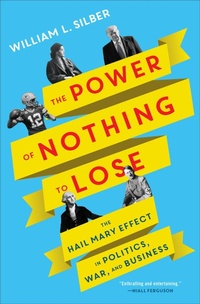
The Power of Nothing to Lose
Description

Following books by Malcolm Gladwell and Dan Ariely, noted economics professor William L. Silber explores the Hail Mary effect, from its origins in sports to its applications to history, nature, politics, and business.
A quarterback like Green Bay's Aaron Rodgers gambles with a Hail Mary pass at the end of a football game when he has nothing to lose -- the risky throw might turn defeat into victory, or end in a meaningless interception. Rodgers may not realize it, but he has much in common with figures such as George Washington, Rosa Parks, Woodrow Wilson, and Adolph Hitler, all of whom changed the modern world with their risk-loving decisions.
In The Power of Nothing to Lose, award-winning economist William Silber explores the phenomenon in politics, war, and business, where situations with a big upside and limited downside trigger gambling behavior like with a Hail Mary. Silber describes in colorful detail how the American Revolution turned on such a gamble. The famous scene of Washington crossing the Delaware on Christmas night to attack the enemy may not look like a Hail Mary, but it was. Washington said days before his risky decision, "If this fails I think the game will be pretty well up." Rosa Parks remained seated in the white section of an Alabama bus, defying local segregation laws, an act that sparked the modern civil rights movement in America. It was a life-threatening decision for her, but she said, "I was not frightened. I just made up my mind that as long as we accepted that kind of treatment it would continue, so I had nothing to lose."
The risky exploits of George Washington and Rosa Parks made the world a better place, but demagogues have inflicted great damage with Hail Marys. Towards the end of World War II, Adolph Hitler ordered a desperate counterattack, the Battle of the Bulge, to stem the Allied advance into Germany. He said, "The outcome of the battle would spell either life or death for the German nation." Hitler failed to change the war's outcome, but his desperate gamble inflicted great collateral damage, including the worst wartime atrocity on American troops in Europe.
Silber shares these illuminating insights on these figures and more, from Woodrow Wilson to Donald Trump, asylum seekers to terrorists and rogue traders. Collectively they illustrate that downside protection fosters risky undertakings, that it changes the world in ways we least expect.
More details
Other editions
Additional editions
Content
- Intro
- Cover
- Title Page
- Dedication
- Contents
- Prologue: An Invitation
- Part I: Introduction
- Chapter 1: Downside Protection
- Part II: Risky Confrontations
- Chapter 2: Lame-Duck U.S. Presidents
- Chapter 3: Pardon Me
- Chapter 4: Asylum Seekers
- Chapter 5: Rosa Parks
- Chapter 6: Medical Crises and Pandemics
- Part III: Man-Made Disasters
- Chapter 7: Rogue Traders
- Chapter 8: Adolf Hitler and the Battle of the Bulge
- Part IV: Something to Lose
- Chapter 9: Prison Violence
- Chapter 10: Mohamed Atta and Suicide Terrorists
- Part V: Getting Personal
- Chapter 11: Freedom to Succeed
- Acknowledgments
- Selected Readings
- Notes
- Index
- About the Author
- Also by William L. Silber
- Copyright
- About the Publisher
