

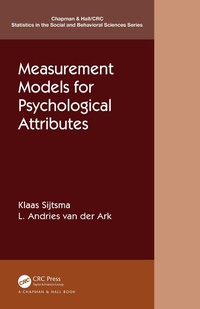
Measurement Models for Psychological Attributes
Classical Test Theory, Factor Analysis, Item Response Theory, and Latent Class Models
1st Edition
Published on 22. October 2020
300 pages
978-1-4398-8136-1 (ISBN)
Description

Despite the overwhelming use of tests and questionnaires, the psychometric models for constructing these instruments are often poorly understood, leading to suboptimal measurement. Measurement Models for Psychological Attributes is a comprehensive and accessible treatment of the common and the less than common measurement models for the social, behavioral, and health sciences. The monograph explains the adequate use of measurement models for test construction, points out their merits and drawbacks, and critically discusses topics that have raised and continue to raise controversy. Because introductory texts on statistics and psychometrics are sufficient to understand its content, the monograph may be used in advanced courses on applied psychometrics, and is attractive to both researchers and graduate students in psychology, education, sociology, political science, medicine and marketing, policy research, and opinion research.
The monograph provides an in-depth discussion of classical test theory and factor models in Chapter 2; nonparametric and parametric item response theory in Chapter 3 and Chapter 4, respectively; latent class models and cognitive diagnosis models in Chapter 5; and discusses pairwise comparison models, proximity models, response time models, and network psychometrics in Chapter 6. The chapters start with the theory and methods of the measurement model and conclude with a real-data example illustrating the measurement model.
The monograph provides an in-depth discussion of classical test theory and factor models in Chapter 2; nonparametric and parametric item response theory in Chapter 3 and Chapter 4, respectively; latent class models and cognitive diagnosis models in Chapter 5; and discusses pairwise comparison models, proximity models, response time models, and network psychometrics in Chapter 6. The chapters start with the theory and methods of the measurement model and conclude with a real-data example illustrating the measurement model.
Reviews / Votes
"There are very few measurement textbooks that are accompanied with such a strong quantitative foundation, and those that are tend to be quite dated. This book is thus unique in providing a contemporary measurement text that is also designed for students that have a good quantitative background (as might be provided by a good introductory statistics course). Another very appealing feature of this book is its extensive coverage of various models and methodological tools that can be applied in the context of measurement. Network models and diagnostic models, for example, are relatively recent innovations in measurement. Having a single book covering all these techniques gives readers an appreciation for the different ways in which measurement can be considered from a quantitative perspective. The book would thus be an excellent choice for a graduate-level or advanced undergraduate-level measurement course. But the book would also function well as a reference text given the variety of topics covered." ~Daniel Bolt, University of Wisconsin, Madison"I read the chapters with great interest. I think that a book like this is certainly useful as similar books are either too technical, too conceptual, or too narrow focused. In the chapters I read, the authors found a nice balance between technical and conceptual detail. This makes the book useful as both a textbook to be used for master students and as a reference book for (applied) researchers. I especially liked the boxes with derivations."
~Dylan Molenaar, University of Amsterdam
"I think many people could find this book useful. You could think of researchers in the social and behavorial sciences, Phd students, research master students and peer psychometricians. The additional value of this book is that it goes just beyond the basics of psychometrics. People may both use it as a reference and a textbook."
~Samantha Bouwmeester, Erasmus University Rotterdam
"It was a joy to read chapter 4. It was well written and interesting to persons who start with IRT and persons who worked with it for years. It explains the principles very well, as well has an eye for interesting subtleties."
~Bas Hemker, CITO
"This chapter 3 would be useful for statisticians, epidemiologists, psychometricians, methodologists, and mathematical psychologists who are working with social scientists or behavioral scientists, or in health care research or in educational research. It would also be useful for graduate students in the fields of statistics, epidemiology, etc. I would say that knowledge of statistics at an intermediate level is required."
~J.L. Ellis, Behavioural Science Institute, Radboud University "There are very few measurement textbooks that are accompanied with such a strong quantitative foundation, and those that are tend to be quite dated. This book is thus unique in providing a contemporary measurement text that is also designed for students that have a good quantitative background (as might be provided by a good introductory statistics course). Another very appealing feature of this book is its extensive coverage of various models and methodological tools that can be applied in the context of measurement. Network models and diagnostic models, for example, are relatively recent innovations in measurement. Having a single book covering all these techniques gives readers an appreciation for the different ways in which measurement can be considered from a quantitative perspective. The book would thus be an excellent choice for a graduate-level or advanced undergraduate-level measurement course. But the book would also function well as a reference text given the variety of topics covered." ~Daniel Bolt, University of Wisconsin, Madison
"I read the chapters with great interest. I think that a book like this is certainly useful as similar books are either too technical, too conceptual, or too narrow focused. In the chapters I read, the authors found a nice balance between technical and conceptual detail. This makes the book useful as both a textbook to be used for master students and as a reference book for (applied) researchers. I especially liked the boxes with derivations."
~Dylan Molenaar, University of Amsterdam
"I think many people could find this book useful. You could think of researchers in the social and behavorial sciences, Phd students, research master students and peer psychometricians. The additional value of this book is that it goes just beyond the basics of psychometrics. People may both use it as a reference and a textbook."
~Samantha Bouwmeester, Erasmus University Rotterdam
"It was a joy to read chapter 4. It was well written and interesting to persons who start with IRT and persons who worked with it for years. It explains the principles very well, as well has an eye for interesting subtleties."
~Bas Hemker, CITO
"This chapter 3 would be useful for statisticians, epidemiologists, psychometricians, methodologists, and mathematical psychologists who are working with social scientists or behavioral scientists, or in health care research or in educational research. It would also be useful for graduate students in the fields of statistics, epidemiology, etc. I would say that knowledge of statistics at an intermediate level is required."
~J.L. Ellis, Behavioural Science Institute, Radboud University
"[This] is a comprehensive book summarizing a wide range of psychometric concepts and theories. Unlike introductory texts on psychological measurement, this book aims to get readers acquainted with statistical models and assumptions underlying psychometric theories. (...). Overall, this is a well-organized book that provides comprehensive coverage of both traditional and modern psychometric theories. The authors, who are well-known researchers in psychomet rics, provide valuable insights into psychometric theories and models through this book. For researchers, practitioners, and graduate students who want to build a solid foundation in psychometrics, this book would be a great resource to understand the relationships among various psychometric theories. Furthermore, readers with some knowledge of psychometrics may also benefit from this book to learn more about the advantages and disadvantages of different psychometric models."
~Hatice Cigdem Bulut, Okan Bulut, in Psychometrika, June 2021
"The book is written for graduate and Ph.D. students, psychometricians and researchers in the areas of the social, behavioral, and health sciences. It can enrich other applied studies by new ideas and statistical techniques as well."
~Stan Lipovetsky, in Technometrics, ?July 2022
More details
Series
Edition
1. Auflage
Language
English
Place of publication
London
United Kingdom
Publishing group
Taylor & Francis Ltd
Target group
Professional and scholarly
Illustrations
50 b/w images
ISBN-13
978-1-4398-8136-1 (9781439881361)
Copyright in bibliographic data and cover images is held by Nielsen Book Services Limited or by the publishers or by their respective licensors: all rights reserved.
Schweitzer Classification
Other editions
Additional editions
Klaas Sijtsma
Measurement Models for Psychological Attributes
Classical Test Theory, Factor Analysis, Item Response Theory, and Latent Class Models
Book
10/2020
1st Edition
Chapman & Hall/CRC
€253.30
Shipment within 15-20 days
Klaas Sijtsma
Measurement Models for Psychological Attributes
Classical Test Theory, Factor Analysis, Item Response Theory, and Latent Class Models
Book
10/2020
1st Edition
Chapman & Hall/CRC
€108.80
Shipment within 15-20 days
Person
Klaas Sijtsma is a professor of Methods of Psychological Research at the Tilburg School of Social and Behavioral Sciences, Tilburg University, the Netherlands. His research specializes in psychometrics, in particular, all issues related to the measurement of psychological attributes by means of tests and questionnaires. He is a past President of the Psychometric Society, associate editor of Psychometrika, editorial board member for other journals, and has authored several books on measurement.
Andries van der Ark is professor of Psychometrics at the Research Institute of Child Development and Education. His primary research interests include reliability analysis and nonparametric item response theory. The authors have published over 40 papers together on measurement in the social and behavioral sciences.
Andries van der Ark is professor of Psychometrics at the Research Institute of Child Development and Education. His primary research interests include reliability analysis and nonparametric item response theory. The authors have published over 40 papers together on measurement in the social and behavioral sciences.
Content
1. Introduction
