

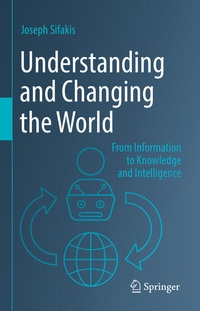
Understanding and Changing the World
Description

This book discusses the importance of knowledge as an intangible asset, separate from physical entities, that can enable us to understand and/or change the world. It provides a thorough treatment of knowledge, one that is free of ideological and philosophical preconceptions, and which relies exclusively on concepts and principles from the theory of computing and logic. It starts with an introduction to knowledge as truthful and useful information, and its development and management by computers and humans. It analyses the relationship between computational processes and physical phenomena, as well as the processes of knowledge production and application by humans and computers.
In turn, the book presents autonomous systems that are called upon to replace humans in complex operations as a step toward strong AI, and discusses the risks - real or hypothetical - of the careless use of these systems. It compares human and machine intelligence, attempting to answer the question ofwhether and to what extent computers, as they stand today, can approach human-level situation awareness and decision-making.
Lastly, the book explains the functioning of individual consciousness as an autonomous system that manages short- and long-term objectives on the basis of value criteria and accumulated knowledge. It discusses how individual values are shaped in society and the role of institutions in fostering and maintaining a common set of values for strengthening social cohesion.
The book differs from books on the philosophy of science in many respects, e.g. by considering knowledge in its multiple facets and degrees of validity and truthfulness. It follows the dualist tradition of logicians, emphasizing the importance of logic and language and considering an abstract concept of information very different from the one used in the physical sciences. From this perspective, it levels some hopefully well-founded criticism at approaches that consider informationand knowledge as nothing more than the emergent properties of physical phenomena.
The book strikes a balance between popular books that sidestep fundamental issues and focus on sensationalism, and scientific or philosophical books that are not accessible to non-experts. As such, it is intended for a broad audience interested in the role of knowledge as a driver for change and development, and as a common good whose production and application could shape the future of humanity.
Reviews / Votes
In Understanding and Changing the World: From Information to Knowledge and Intelligence , Joseph Sifakis (a 2007 Turing Award recipient) amasses a lifetime of knowledge as a deep thinker and effective practitioner of computer science-indeed, collecting a civilization's wisdom-to provide a valuable framework that is rooted in the philosophy of science and society."Akash Deshpande, SIAM News, https://sinews.siam.org/Details-Page/intelligence-whence-and-whitherMore details
Other editions
Additional editions
Person
Professor Joseph Sifakis is Emeritus Research Director of Verimag laboratory, Grenoble, France. His current research interests include fundamental and applied aspects of autonomous system design focusing on self-driving cars.
A full professor at the Ecole Polytechnique Fédérale de Lausanne (EPFL) from 2011 to 2016, he is the founder of Verimag, a leading laboratory in the area of safety-critical systems, which he has directed for 13 years.
In 2007, together with Edmund Clarke and Allen Emerson, Joseph Sifakis received the Turing Award, recognized as the "highest distinction in computer science", for his contributions to the theory and application of model checking, the most widely used system verification technique.
Joseph Sifakis is a member of the French Academy of Sciences, the French National Academy of Engineering, Academia Europaea, the American Academy of Arts and Sciences, the National Academy of Engineering and the Chinese Academy of Sciences. He is a Grand Officer of the French National Order of Merit, a Commander of the French Legion of Honor, and a Commander of the Greek Order of the Phoenix. He received the Leonardo da Vinci Medal in 2012.
