

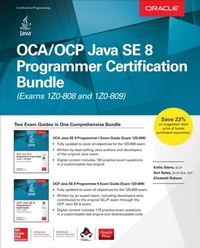
OCA/OCP Java SE 8 Programmer Certification Bundle (Exams 1Z0-808 and 1Z0-809)
1st Edition
Published on 9. October 2018
1467 pages
978-1-260-45220-4 (ISBN)
Available for download
Description

Publisher's Note: Products purchased from Third Party sellers are not guaranteed by the publisher for quality, authenticity, or access to any online entitlements included with the product.Prepare for the Java SE 8 OCA and OCP Programmer exams with this money-saving, comprehensive study packageDesigned as a complete self-study program, this collection offers a variety of proven, exam-focused resources to use in preparation for for OCA and OCP certification exams 1Z0-808 and 1Z0-809. Comprised of OCA Java SE 8 Programmer I Exam Guide and OCP Java SE 8 Programmer II Exam Guide, this bundle thoroughly covers every topic on both exams all at a discount of 23% off MSRP.OCA/OCP Java SE 8 Programmer Certification Bundle (Exams 1Z0-808 & 1Z0-809) contains hundreds of practice questions that match those on the live exams in content, style, tone, format, and difficulty. Step-by-step exercises, self-tests, and Exam Watch, Inside the Exam, and On the Job sections highlight salient points and aid in learning. You will get real-world examples, professional insights, and concise explanations. This authoritative, cost-effective bundle serves both as a study tool AND a valuable on-the-job reference. This bundle is 23% cheaper than purchasing the books individually Written by a team of Java OCA and OCP experts Electronic content includes 330 practice exam questions in a fully-customizable test engine
More details
Content
- Cover
- Copyright Page
- Contents
- OCA Java® SE 8 Programmer I Exam Guide (Exam 1Z0-808)
- Cover
- Title Page
- Copyright Page
- Contents
- Acknowledgments
- Preface
- Introduction
- 1 Declarations and Access Control
- Java Refresher
- Features and Benefits of Java (OCA Objective 1.5)
- Identifiers and Keywords (OCA Objectives 1.2 and 2.1)
- Legal Identifiers
- Oracle's Java Code Conventions
- Define Classes (OCA Objectives 1.2, 1.3, 1.4, 6.4, and 7.5)
- Source File Declaration Rules
- Using the javac and java Commands
- Using public static void main(String[ ] args)
- Import Statements and the Java API
- Static Import Statements
- Class Declarations and Modifiers
- Exercise 1-1: Creating an Abstract Superclass and Concrete Subclass
- Use Interfaces (OCA Objective 7.5)
- Declaring an Interface
- Declaring Interface Constants
- Declaring default Interface Methods
- Declaring static Interface Methods
- Declare Class Members (OCA Objectives 2.1, 2.2, 2.3, 4.1, 4.2, 6.2, 6.3, and 6.4)
- Access Modifiers
- Nonaccess Member Modifiers
- Constructor Declarations
- Variable Declarations
- Declare and Use enums (OCA Objective 1.2)
- Declaring enums
- Certification Summary
- Two-Minute Drill
- Q&A Self Test
- Self Test Answers
- 2 Object Orientation
- Encapsulation (OCA Objectives 6.1 and 6.5)
- Inheritance and Polymorphism (OCA Objectives 7.1 and 7.2)
- The Evolution of Inheritance
- IS-A and HAS-A Relationships
- Polymorphism (OCA Objective 7.2)
- Overriding/Overloading (OCA Objectives 6.1 and 7.2)
- Overridden Methods
- Overloaded Methods
- Casting (OCA Objectives 2.2 and 7.3)
- Implementing an Interface (OCA Objective 7.5)
- Java 8-Now with Multiple Inheritance!
- Legal Return Types (OCA Objectives 2.2 and 6.1)
- Return Type Declarations
- Returning a Value
- Constructors and Instantiation (OCA Objectives 6.3 and 7.4)
- Constructor Basics
- Constructor Chaining
- Rules for Constructors
- Determine Whether a Default Constructor Will Be Created
- Overloaded Constructors
- Initialization Blocks (OCA Objectives 1.2 and 6.3-ish)
- Statics (OCA Objective 6.2)
- Static Variables and Methods
- Certification Summary
- Two-Minute Drill
- Q&A Self Test
- Self Test Answers
- 3 Assignments
- Stack and Heap-Quick Review
- Literals, Assignments, and Variables (OCA Objectives 2.1, 2.2, and 2.3)
- Literal Values for All Primitive Types
- Assignment Operators
- Exercise 3-1: Casting Primitives
- Scope (OCA Objective 1.1)
- Variable Scope
- Variable Initialization (OCA Objectives 2.1, 4.1, and 4.2)
- Using a Variable or Array Element That Is Uninitialized and Unassigned
- Local (Stack, Automatic) Primitives and Objects
- Passing Variables into Methods (OCA Objective 6.6)
- Passing Object Reference Variables
- Does Java Use Pass-By-Value Semantics?
- Passing Primitive Variables
- Garbage Collection (OCA Objective 2.4)
- Overview of Memory Management and Garbage Collection
- Overview of Java's Garbage Collector
- Writing Code That Explicitly Makes Objects Eligible for Collection
- Exercise 3-2: Garbage Collection Experiment
- Certification Summary
- Two-Minute Drill
- Q&A Self Test
- Self Test Answers
- 4 Operators
- Java Operators (OCA Objectives 3.1, 3.2, and 3.3)
- Assignment Operators
- Relational Operators
- instanceof Comparison
- Arithmetic Operators
- Conditional Operator
- Logical Operators
- Operator Precedence
- Certification Summary
- Two-Minute Drill
- Q&A Self Test
- Self Test Answers
- 5 Flow Control and Exceptions
- Using if and switch Statements (OCA Objectives 3.3 and 3.4)
- if-else Branching
- switch Statements
- Exercise 5-1: Creating a switch-case Statement
- Creating Loops Constructs (OCA Objectives 5.1, 5.2, 5.3, 5.4, and 5.5)
- Using while Loops
- Using do Loops
- Using for Loops
- Using break and continue
- Unlabeled Statements
- Labeled Statements
- Exercise 5-2: Creating a Labeled while Loop
- Handling Exceptions (OCA Objectives 8.1, 8.2, 8.3, 8.4, and 8.5)
- Catching an Exception Using try and catch
- Using finally
- Propagating Uncaught Exceptions
- Exercise 5-3: Propagating and Catching an Exception
- Defining Exceptions
- Exception Hierarchy
- Handling an Entire Class Hierarchy of Exceptions
- Exception Matching
- Exception Declaration and the Public Interface
- Exercise 5-4: Creating an Exception
- Rethrowing the Same Exception
- Common Exceptions and Errors (OCA Objective 8.5)
- Where Exceptions Come From
- JVM-Thrown Exceptions
- Programmatically Thrown Exceptions
- A Summary of the Exam's Exceptions and Errors
- Certification Summary
- Two-Minute Drill
- Q&A Self Test
- Self Test Answers
- 6 Strings, Arrays, ArrayLists, Dates, and Lambdas
- Using String and StringBuilder (OCA Objectives 9.2 and 9.1)
- The String Class
- Important Facts About Strings and Memory
- Important Methods in the String Class
- The StringBuilder Class
- Important Methods in the StringBuilder Class
- Working with Calendar Data (OCA Objective 9.3)
- Immutability
- Factory Classes
- Using and Manipulating Dates and Times
- Formatting Dates and Times
- Using Arrays (OCA Objectives 4.1 and 4.2)
- Declaring an Array
- Constructing an Array
- Initializing an Array
- Using ArrayLists and Wrappers (OCA Objectives 9.4 and 2.5)
- When to Use ArrayLists
- ArrayList Methods in Action
- Important Methods in the ArrayList Class
- Autoboxing with ArrayLists
- The Java 7 "Diamond" Syntax
- Advanced Encapsulation (OCA Objective 6.5)
- Encapsulation for Reference Variables
- Using Simple Lambdas (OCA Objective 9.5)
- Certification Summary
- Two-Minute Drill
- Q&A Self Test
- Self Test Answers
- A About the Download
- System Requirements
- Downloading from McGraw-Hill Professional's Media Center
- Installing the Practice Exam Software
- Running the Practice Exam Software
- Practice Exam Software Features
- Removing Installation
- Help
- Technical Support
- Windows 8 Troubleshooting
- McGraw-Hill Education Content Support
- Index
- OCP Java SE 8 Programmer II Exam Guide (Exam 1Z0-809)
- Cover
- Title Page
- Copyright Page
- Dedication
- Contents
- Acknowledgments
- Preface
- Introduction
- 1 Declarations, Access Control, and Enums
- Java Class Design and Object Orientation: A Refresher
- Define Classes and Interfaces (OCP Objectives 1.2, 2.1, and 2.2)
- Class Declarations and Modifiers
- Exercise 1-1: Creating an Abstract Superclass and Concrete Subclass
- Use Interfaces (OCP Objective 2.5)
- Declaring an Interface
- Declaring Interface Constants
- Declaring default Interface Methods
- Declaring static Interface Methods
- Declare Class Members (OCP Objectives 1.2, 1.6, 2.1, and 2.2)
- Access Modifiers
- Nonaccess Member Modifiers
- Constructor Declarations
- Variable Declarations
- Declare and Use enums (OCP Objective 2.4)
- Declaring enums
- Certification Summary
- Two-Minute Drill
- Q&A Self Test
- Self Test Answers
- 2 Object Orientation
- Encapsulation (OCP Objective 1.1)
- Inheritance and Polymorphism (OCP Objectives 1.2 and 1.3)
- The Evolution of Inheritance
- IS-A and HAS-A Relationships
- Polymorphism (OCP Objective 1.3)
- Overriding/Overloading (OCP Objectives 1.2, 1.3, and 2.5)
- Overridden Methods
- Overloaded Methods
- Casting (OCP Objectives 1.2 and 1.3)
- Implementing an Interface (OCP Objective 2.5)
- Java 8-Now with Multiple Inheritance!
- Legal Return Types (OCP Objectives 1.2 and 1.3)
- Return Type Declarations
- Returning a Value
- Constructors and Instantiation (OCP Objectives 1.2 and 1.3)
- Constructor Basics
- Constructor Chaining
- Rules for Constructors
- Determine Whether a Default Constructor Will Be Created
- Overloaded Constructors
- Singleton Design Pattern (OCP Objective 1.5)
- What Is a Design Pattern?
- Problem
- Solution
- Benefits
- Immutable Classes (OCP Objective 1.5)
- Initialization Blocks (OCP Objective 1.6)
- Statics (OCP Objective 1.6)
- Static Variables and Methods
- Certification Summary
- Two-Minute Drill
- Q&A Self Test
- Self Test Answers
- 3 Assertions and Java Exceptions
- Working with the Assertion Mechanism (OCP Objective 6.5)
- Assertions Overview
- Using Assertions
- Using Assertions Appropriately
- Working with Exception Handling (OCP Objectives 6.1, 6.2, 6.3, and 6.4)
- Use the try Statement with multi-catch and finally Clauses
- AutoCloseable Resources with a try-with-resources Statement
- Certification Summary
- Two-Minute Drill
- Q&A Self Test
- Self Test Answers
- 4 Dates, Times, Locales, and Resource Bundles
- Dates, Times, and Locales (OCP Objectives 7.1, 7.2, 7.3, and 12.1)
- Working with Dates and Times
- The java.time.* Classes for Dates and Times
- Properties Files (OCP Objective 12.2)
- Resource Bundles (OCP Objectives 12.1, 12.2, and 12.3)
- Java Resource Bundles
- Default Locale
- Choosing the Right Resource Bundle
- Certification Summary
- Two-Minute Drill
- Q&A Self Test
- Self Test Answers
- 5 I/O and NIO
- File Navigation and I/O (OCP Objectives 8.1 and 8.2)
- Creating Files Using the File Class
- Using FileWriter and FileReader
- Using FileInputStream and FileOutputStream
- Combining I/O Classes
- Working with Files and Directories
- The java.io.Console Class
- Files, Path, and Paths (OCP Objectives 9.1 and 9.2)
- Creating a Path
- Creating Files and Directories
- Copying, Moving, and Deleting Files
- Retrieving Information about a Path
- Normalizing a Path
- Resolving a Path
- Relativizing a Path
- File and Directory Attributes (OCP Objective 9.2)
- Reading and Writing Attributes the Easy Way
- Types of Attribute Interfaces
- Working with BasicFileAttributes
- Working with DosFileAttributes
- Working with PosixFileAttributes
- Reviewing Attributes
- DirectoryStream (OCP Objectives 9.2 and 9.3)
- FileVisitor
- PathMatcher
- WatchService
- Serialization (Objective 8.2)
- Working with ObjectOutputStream and ObjectInputStream
- Object Graphs
- Using writeObject and readObject
- How Inheritance Affects Serialization
- Serialization Is Not for Statics
- Certification Summary
- Two-Minute Drill
- Q&A Self Test
- Self Test Answers
- 6 Generics and Collections
- Override hashCode(), equals(), and toString() (OCP Objective 1.4)
- The toString() Method
- Overriding equals()
- Overriding hashCode()
- Collections Overview (OCP Objective 3.2)
- So What Do You Do with a Collection?
- Key Interfaces and Classes of the Collections Framework
- List Interface
- Set Interface
- Map Interface
- Queue Interface
- Using Collections (OCP Objectives 2.6, 3.2, and 3.3)
- ArrayList Basics
- Autoboxing with Collections
- The Java 7 "Diamond" Syntax
- Sorting Collections and Arrays
- Navigating (Searching) TreeSets and TreeMaps
- Other Navigation Methods
- Backed Collections
- Using the PriorityQueue Class and the Deque Interface
- Method Overview for Arrays and Collections
- Method Overview for List, Set, Map, and Queue
- Generic Types (OCP Objective 3.1)
- The Legacy Way to Do Collections
- Generics and Legacy Code
- Mixing Generic and Nongeneric Collections
- Polymorphism and Generics
- Generic Methods
- Generic Declarations
- Certification Summary
- Two-Minute Drill
- Q&A Self Test
- Self Test Answers
- 7 Inner Classes
- Nested Classes (OCP Objective 2.3)
- Inner Classes
- Coding a "Regular" Inner Class
- Referencing the Inner or Outer Instance from Within the Inner Class
- Method-Local Inner Classes
- What a Method-Local Inner Object Can and Can't Do
- Anonymous Inner Classes
- Plain-Old Anonymous Inner Classes, Flavor One
- Plain-Old Anonymous Inner Classes, Flavor Two
- Argument-Defined Anonymous Inner Classes
- Static Nested Classes
- Instantiating and Using Static Nested Classes
- Lambda Expressions as Inner Classes (OCP Objective 2.6)
- Comparator Is a Functional Interface
- Certification Summary
- Two-Minute Drill
- Q&A Self Test
- Self Test Answers
- 8 Lambda Expressions and Functional Interfaces
- Lambda Expression Syntax (OCP Objective 2.6)
- Passing Lambda Expressions to Methods
- Accessing Variables from Lambda Expressions
- Functional Interfaces (OCP Objectives 3.5, 4.1, 4.2, 4.3, and 4.4)
- Built-in Functional Interfaces
- What Makes an Interface Functional?
- Categories of Functional Interfaces
- Method References (OCP Objective 3.8)
- Kinds of Method References
- Write Your Own Functional Interface
- Functional Interface Overview
- Certification Summary
- Two-Minute Drill
- Q&A Self Test
- Self Test Answers
- 9 Streams
- What Is a Stream? (OCP Objective 3.4)
- How to Create a Stream (OCP Objectives 3.5 and 9.3)
- Create a Stream from a Collection
- Build a Stream with Stream.of()
- Create a Stream from an Array
- Create a Stream from a File
- Primitive Value Streams
- Summary of Methods to Create Streams
- Why Streams?
- The Stream Pipeline (OCP Objective 3.6)
- Streams Are Lazy
- Operating on Streams (OCP Objectives 3.7 and 5.1)
- Map-Filter-Reduce with average() and Optionals (OCP Objectives 5.3 and 5.4)
- Reduce
- Using reduce()
- Associative Accumulations
- map-filter-reduce Methods
- Optionals (OCP Objective 5.3)
- Searching and Sorting with Streams (OCP Objectives 5.2 and 5.5)
- Searching to See Whether an Element Exists
- Searching to Find and Return an Object
- Sorting
- Methods to Search and Sort Streams
- Don't Modify the Source of a Stream
- Collecting Values from Streams (OCP Objectives 3.8, 5.6, and 9.3)
- Using collect() with Files.lines()
- Exercise 9-1: Collecting Items in a List
- Grouping and Partitioning
- Summing and Averaging
- Counting, joining, maxBy, and minBy
- Stream Methods to Collect and Their Collectors
- Streams of Streams (OCP Objective 5.7)
- Generating Streams (OCP Objective 3.4)
- Methods to Generate Streams
- Caveat Time Again
- A Taste of Parallel Streams
- Certification Summary
- Two-Minute Drill
- Q&A Self Test
- Self Test Answers
- Exercise Answer
- 10 Threads
- Defining, Instantiating, and Starting Threads (OCP Objective 10.1)
- Making a Thread
- Defining a Thread
- Instantiating a Thread
- Starting a Thread
- Thread States and Transitions
- Thread States
- Preventing Thread Execution
- Sleeping
- Exercise 10-1: Creating a Thread and Putting It to Sleep
- Thread Priorities and yield( )
- Synchronizing Code, Thread Problems (OCP Objectives 10.2 and 10.3)
- Preventing the Account Overdraw
- Synchronization and Locks
- Exercise 10-2: Synchronizing a Block of Code
- Thread Deadlock
- Thread Livelock
- Thread Starvation
- Race Conditions
- Thread Interaction (OCP Objectives 10.2 and 10.3)
- Using notifyAll( ) When Many Threads May Be Waiting
- Certification Summary
- Two-Minute Drill
- Q&A Self Test
- Self Test Answers
- Exercise Answers
- 11 Concurrency
- Concurrency with the java.util.concurrent Package
- Apply Atomic Variables and Locks (OCP Objective 10.3)
- Atomic Variables
- Locks
- Use java.util.concurrent Collections (OCP Objective 10.4)
- Copy-on-Write Collections
- Concurrent Collections
- Blocking Queues
- Controlling Threads with CyclicBarrier
- Use Executors and ThreadPools (OCP Objective 10.1)
- Identifying Parallel Tasks
- How Many Threads Can You Run?
- CPU-Intensive vs. I/O-Intensive Tasks
- Fighting for a Turn
- Decoupling Tasks from Threads
- Use the Parallel Fork/Join Framework (OCP Objective 10.5)
- Divide and Conquer
- ForkJoinPool
- ForkJoinTask
- Parallel Streams (OCP Objective 10.6)
- How to Make a Parallel Stream Pipeline
- Embarrassingly Parallel, Take Two (with Parallel Streams)
- A Parallel Stream Implementation of a RecursiveTask
- Reducing Parallel Streams with reduce()
- Certification Summary
- Two-Minute Drill
- Q&A Self Test
- Self Test Answers
- 12 JDBC
- Starting Out: Introduction to Databases and JDBC
- Talking to a Database
- Bob's Books, Our Test Database
- Core Interfaces of the JDBC API (OCP Objective 11.1)
- Connect to a Database Using DriverManager (OCP Objective 11.2)
- The DriverManager Class
- The JDBC URL
- JDBC Driver Implementation Versions
- Submit Queries and Read Results from the Database (OCP Objective 11.3)
- All of Bob's Customers
- Statements
- ResultSets
- When Things Go Wrong-Exceptions and Warnings
- Certification Summary
- Two-Minute Drill
- Q&A Self Test
- Self Test Answers
- A About the Online Content
- McGraw-Hill Professional Media Center Download
- Total Tester Online System Requirements
- Single User License Terms and Conditions
- Total Tester Online
- Technical Support
- Index

