

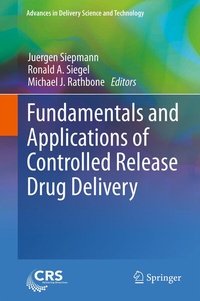
Fundamentals and Applications of Controlled Release Drug Delivery
Description

More details
Other editions
Additional editions
Persons
Professor Juergen Siepmann is Professor of Pharmaceutics at the College of Pharmacy, Université Lille Nord de France, Lille, France. He studied pharmacy and received his doctoral degree from the Freie Universitaet Berlin, Berlin, Germany, in 1999. His research focuses on the elucidation of the underlying mass transport phenomena in controlled drug delivery systems. Prof. Siepmann is reviews editor of the International Journal of Pharmaceutics and president of APGI (French Association of Pharmaceutical Technology). Since 2010 he is heading the INSERM (French National Institute of Health and Medical Research) research group "Controlled Drug Delivery Systems and Biomaterials".
Ronald A. Siegel, Sc.D., is Professor of Pharmaceutics and Biomedical Engineering at the University of Minnesota. He received his doctoral degree from MIT under the direction of Prof. Robert Langer in 1984, and taught at the University of California, San Francisco until 1998, when he moved to Minnesota. Professor Siegel is Fellow of the Controlled Release Society (CRS), the American Association of Pharmaceutical Scientists, and the American Institute of Medical and Biological Engineering. He was president of CRS from 1997-1998. His present research interests include hydrogels, block polymers, microfabricated sensors and drug delivery systems, and mathematical modeling of transport.
Michael J. Rathbone is Associate Professor of Pharmaceutics at the School of Pharmacy, Griffith University, Australia. Dr. Rathbone's research interests are in the modified delivery of bioactives to the mouth, polymeric delivery systems and long acting veterinary drug delivery systems. He is a Fellow of the Controlled Release Society (CRS) and received the CRS Distinguished Service Award in 2006. He has edited or co-edited many books in the fields of modified release drug delivery, oral mucosal drug delivery andveterinary drug delivery.
Content
The Need for Drugs and Drug Delivery Systems.- Overview of Controlled Release Mechanisms.- Hydrophobic Polymers of Pharmaceutical Significance.- Hydrogels.- Biodegradable Polymers in Drug Delivery Systems.- Diffusion Controlled Drug Delivery Systems.- Swelling Controlled Drug Delivery Systems.- Degradable Polymeric Carriers for Parenteral Controlled Drug Delivery Systems.- Porous Systems.- Targeted Delivery Using Biodegradable polymeric Nanoparticles.- Liposomes in Drug Delivery.- Receptor Mediated Delivery Systems for Cancer Therapeutics.- Biological Rhythms, Drug Delivery, and Chronotherapeutics.- Site Specific Controlled Release for Cardiovascular Disease - Translational Direction.- Drug Delivery Systems to Fight Cancer.- Applications of Vaccine Delivery in Infectious Diseases.- Tissue Engineering in Drug Delivery.- The Shaping of Controlled Release Drug Product Development by Emerging Trends in the Commercial, Regulatory and Political Macro-Environment
