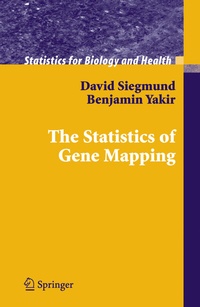
The Statistics of Gene Mapping
Description

Gene mapping is used in experimental genetics to improve the hardiness or productivity of animals or plants of agricultural value, to explore basic mechanisms of inheritance, or to study animal models of human inheritance. In human populations it is used as a first step to identify genes associated with human health and disease. This book presents a unified discussion of the statistical concepts applied in gene mapping, first in the experimental context of crosses of inbred lines and then in outbred populations, primarily humans. The development involves elementary principles of probability and statistics, which are implemented by computational tools based on the R programming language to simulate genetic experiments and evaluate statistical analyses. The viewpoint reflects the modern approach of using anonymous DNA markers distributed throughout the genome to identify regions likely to contain genes of interest. The reader is assumed to have some familiarity with probability/statistics and with elementary genetics. Important topics are reviewed in the first three chapters. The R programming language is developed in the text. Each chapter contains exercises, both theoretical and computational, some routine and others that are more challenging. The book is suitable for upper level undergraduate students or graduate students of genetics or statistics.
Reviews / Votes
From the reviews:
" The Statistics of Gene Mapping ...is a welcome addition to the statistical genetics literature, that in fact includes a very small number of textbooks. ...The exercises at the end of the chapters will provide a useful pedagogical tool, with their mix of computer implementation and conceptual questions. ...[This book] provides the reader with clar, concises introduction to a number of important topics and I think it will prove to be a useful teaching instrument." Chiara Sabatti, Journal of Statistical Software, August 2007, Vol. 21
"The book is an excellent addition to the statistics-for-biology and health book series. It is also a very good textbook is statistical genetics. All statistical models and methods in the book are illustrated and simulated using R Language. . Overall, the book covers both classical and up-to-date important topics in statistical genetics. It is a well-written book for both researchers and graduate students in statistics, biostatistics, statistical genetics, and other related fields." (Xianggui Qu, Technometrics, Vol. 50 (1), 2008)
"This book presents an excellent introduction to the basic statistical principles used in gene mapping. . Computer algorithms are given . . There are numerous challenging problems. . This is a rewarding read . . those that work through the book will gain a deep understanding of the statistical challenges of the field. With this knowledge they would be prepared for more encyclopedic or data analytic works. I recommend the book to any graduate student who might consider contributing to the field." (David F. Andrews, International Statistical Review, Vol. 75 (2), 2007)
More details
Other editions
Additional editions