

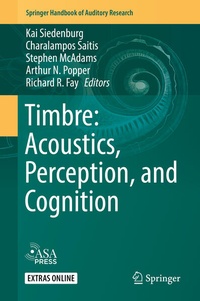
Timbre: Acoustics, Perception, and Cognition
Description

This volume will be the first book dedicated to a comprehensive and authoritative presentation of timbre perception and cognition research and the acoustic modeling of timbre. The volume will serve as a natural complement to the SHAR volumes on the basic auditory parameters of Pitch edited by Plack, Oxenham, Popper, and Fay, and Loudness by Florentine, Popper, and Fay. Moreover, through the integration of complementary scientific methods ranging from signal processing to brain imaging, the book has the potential to leverage new interdisciplinary synergies in hearing science. For these reasons, the volume will be exceptionally valuable to various subfields of hearing science, including cognitive auditory neuroscience, psychoacoustics, music perception and cognition, but may even exert significant influence on fields such as musical acoustics, music information retrieval, and acoustic signal processing.
It is expected that the volume will have broad appeal to psychologists, neuroscientists, and acousticians involved in research on auditory perception and cognition. Specifically, this book will have a strong impact on hearing researchers with interest in timbre and will serve as the key publication and up-to-date reference on timbre for graduate students, postdoctoral researchers, as well as established scholars.
More details
Other editions
Additional editions
Persons
Dr. Charalampos Saitis is Humboldt Research Fellow in the Audio Communication Group at the Technical University of Berlin. Drs. Saitis and Siedenburg have published papers on musical sound quality and timbre, respectively. They conceived and co-organized the 2017 Berlin Interdisciplinary Workshop on Timbre.
Dr. Stephen McAdams is Canada Research Chair in Music Perception and Cognition and professor in the Schulich School of Music at McGill University, Montreal. Dr. McAdams is an internationally recognized expert on the perception and cognition of timbre.
Content
Preface.- The Present, Past, and Future of Timbre Research.- The Perceptual Representation of Timbre.- Timbre Recognition and Sound Source Identification.- Memory for Timbre.- The Semantics of Timbre.- Neural Correlates of Timbre Processing.- Voice Processing and Voice-Identity Recognition.- Timbre as a Structuring Force in Music.- Timbre, Sound Quality, and Sound Design.- Timbre Perception with Cochlear Implants.- Audio Content Descriptors of Timbre.- Modulation Representations for Speech and Music.- Timbre from Sound Synthesis and High-level Control Perspectives.
