

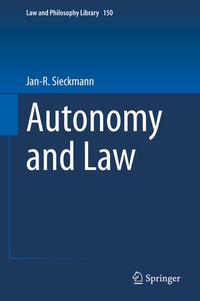
Autonomy and Law
Description

This book defends the idea of autonomy as the balancing of normative arguments, which captures the essential feature of autonomous judgement as being simultaneously free and normatively bound. However, this approach runs counter to the dominant view of arguments as propositions, and to Kantian notions of autonomy. Here, it is applied to three core dimensions of law: law as legal system, as legal practice, and as normative judgement, leading to specific views of legal validity, legal interpretation, and the necessary content of law in the form of human rights principles. Lastly, the autonomous reasoning perspective is applied to conflicts of law with morality and with competing legal systems.
More details
Other editions
Additional editions
Person
Prof. Dr. jur. Jan-Reinard Sieckmann , Professor of Legal Theory and Philosophy of Law at the University of Erlangen-Nürnberg, studied Law and Philosophy at the University of Göttingen, First and Second Law Exam (1983, 1990), Doctorate at the University Göttingen 1988, Habilitation at the University of Kiel 1997, Professor of Public Law at the University of Bamberg 1998-2008, since 2009 at the University of Erlangen-Nürnberg, since 2016 Professor of Legal Theory and Philosophy of Law; DAAD-Professor at the University of Buenos Aires 2007-2012. Main fields of research: legal philosophy, argumentation theory, human and constitutional rights.
Content
1 Introduction.- 2 Autonomous Reasoning Revisited.- 3 The Logical Structure Of Principles.- 4 Balancing As Optimisation.- 5 Alternative Approaches To Balancing.- 6 Epistemic Issues Of Balancing.- 7 Dimensions Of Law.- 8 Competences And Formal Principles.- 9 Balancing And Interpretation.- 10 The Foundation Of Fundamental Rights.- 11 Rights Balancing.- 12 Normative Legal Pluralism.- 13 Law And Morality.- 14 Resume.- 15 Appendix.
