

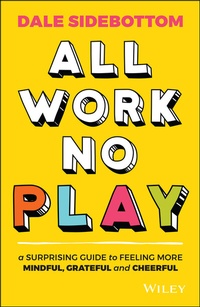
All Work No Play
Description

Explore effective strategies to improve your mental health, and the health of your colleagues and employees, with this engaging and practical book
All Work No Play: A Surprising Guide to Feeling More Mindful, Grateful and Cheerful is a practical and rewarding handbook for reconnecting with joy and happiness daily. The book shares strategies for play-based mindfulness, empathy, and gratitude exercises that will help readers rediscover their inner child; promote good mental health; build and foster more meaningful connections with others; and help combat loneliness and deep-rooted toxic behaviors and thoughts.
You'll learn to:
- Recognize and become self-aware of thoughts blocking your way to healthy relationships and attitudes
- Prioritize mental wellbeing in your daily life and put an end to burnout and fatigue
- Use visual tools and self-assessment forms to guide you through exercises that will increase your happiness, focus, and productivity
Perfect for anyone who hopes to improve their ability to take joy and happiness from their daily routines, All Work No Play is also ideal for businesses who wish to improve the health and wellbeing of their employees and colleagues.
Dale Sidebottom is the creator and founder of Energetic Education and Jugar Life, a movement that helps people bring play back into their lives. A top-rated podcaster and popular TEDx speaker, Dale empowers individuals to move and learn in a fun way.
More details
Other editions
Additional editions
Content
- Cover
- Title Page
- Copyright Page
- Contents
- About the author
- How to use this book
- Introduction
- Lift your mood
- The old me
- The new me
- Part I Playing the game of life
- Chapter 1 What is play?
- Chapter 2 How play forms part of our life
- What counts as play?
- Born to play
- Chapter 3 Adults' play
- Age is no barrier
- The power of play
- Chapter 4 Play and our mental health
- Introducing 'The Daily PEGG'
- Chapter 5 The birth of play-based mindfulness
- Part II the proof behind play
- Chapter 6 Our brain during play
- Boosting our mood
- Chapter 7 The power of play
- An 'ANZAC clash' in Turkey
- Soccer on the bank of the Nile
- The language of soccer
- Connecting in Machu Picchu
- Part III the benefits of play
- Chapter 8 Less work, more play
- Chapter 9 Play for individuals, couples and families
- The benefits of play for individuals
- The benefits of play for couples
- The benefits of play for families
- Chapter 10 Play in the classroom
- My 'aha' moment
- What is ClassBreak?
- Chapter 11 Team players
- Chapter 12 Play in the workplace and beyond
- Play around the world
- Part IV Play in action
- Chapter 13 The play-based mindfulness toolkit
- The Daily PEGG
- Daily mission cards
- Chapter 14 PEGG: Play options
- Chapter 15 PEGG: Exercise options
- Chapter 16 PEGG: Gratitude and Giving options
- G - Gratitude options
- G - Giving options
- Part V Never stop playing
- Chapter 17 Being mindful
- The play and mindfulness trap
- Ritualising play-based mindfulness
- Ten final lessons
- Lesson 1: Don't let education get in the way of your learning
- Lesson 2: Invest in people
- Lesson 3: Keep serving
- Lesson 4: Build up, don't tear down
- Lesson 5: It's okay to say you don't know
- Lesson 6: Don't buy green bananas
- Lesson 7: Every choice has a consequence
- Lesson 8: Be curious, not judgemental
- Lesson 9: Be you
- Lesson 10: Treasure what you have
- One final challenge
- Acknowledgements
- Index
- EULA
Chapter 1
What is play?
PLAY IS NOT JUST a word to describe an action or activity children participate in when they are young. Play is life.
When you think about it, play is one of the most significant actions for helping human beings connect (with ourselves and others) and experience moments of happiness, however fleeting.
It's also somewhat hard to define. Which makes 'play' a little mysterious and somewhat complex. Before I share my definition with you, I'll share a research-based response I received from Professor Alison James, who is also a professional coach, HE specialist and accredited LEGO® Serious Play® facilitator.
This is what Alison said when I asked her, 'What is play?' (and it's far more measured and insightful than what I've come up with!).
What is play?
This might seem like a silly question. After all, play is such a familiar word to us all that we surely know what it means. Yet theoreticians over centuries have tried to explain what play is, why we play and what happens in our bodies and our minds when we do. While their definitions may have common elements, they don't universally agree. So there is no single, agreed explanation of play. However, we can draw on the significant work they and others have done to help us understand the nature of play better.
Play is most obviously associated with childhood: aiding development, learning skills, practising behaviours and rehearsing what it will mean to be a grown up. We see play as having its place outside school or work; it's the thing we do to let off steam. We play to have fun and escape the shackles of chores, duties, work, study or other constraints. As a result, it is often seen as the opposite of serious activity, and therefore trivial or less important.
And yet, in 1997, renowned play theorist Brian Sutton-Smith distilled his 40-year professional fascination with play to reveal its complex and ambiguous nature. Identifying more than 100 concepts associated with play characteristics, he showed that play is determined by social, cultural and other perspectives. These might be influenced by upbringing, social background, education, profession, values and so on. Biologists, sociologists, anthropologists, philosophers, psychologists and others may all see it differently.
Neuroscientific studies, pioneered by Marian Diamond's investigation into the relationship between brain size and enrichment activities in rats, have also provided physiological evidence of the power of play. Her work and that of others reveals how play develops brain plasticity and function. Play helps us develop new neural paths and different ways of thinking and acting. Play keeps us adaptable and alive.
Animal behaviourists such as Robert Fagen, Patrick Bateson and Paul Martin see the key characteristics of play as being something that is freely undertaken and done for the joy of it. Play has no intended purpose, is often repetitive in nature and mimics certain behaviours (fighting, arguing) in a gentler form. We can see this recurring in human play as well. Sutton-Smith and others have made the case that play is part of evolution. This is seen in the way many living things have used play as a means of survival, trying out and adapting ways of behaving (interacting, hunting, mastering goals) in known and unknown situations. Play is not just learned, it is genetically programmed and instinctive. We do it not only because we want to but also because we can't help it.
Play is also about rehearsing important skills, dispositions and approaches to situations in safe environments such as the demarcations of a tennis court, a rugby pitch, a theatre stage, a hopscotch grid or an imaginary space. If you have ever seen a TED Talk, look at the red circle of carpet on the floor. That's where the speaker has to stand. It's part of the ritual. It's also a great metaphor for the 'magic circle', a special and protected play space separate from ordinary life.
There is debate about how play is defined and structured and how to categorise its different forms. Many forms of play are bounded by rules or have particular requirements or limits. These are often seen as games, but not all games fit definitions of play. In educational settings there is playtime, where children are free to choose their forms of play, and then there is play within formal learning. Adult or child, participants cannot always choose whether or not they will play, and there is often an agenda or purpose attached to it. The boundaries of what play is and how we use it are therefore sometimes blurry.
Play and playfulness can be seen as two sides of the same coin. Play might appear in a very obvious form (a game or performance, or a friendly sporting encounter) or it might emerge through our playful approaches to non-play things. We use these in every facet of our lives: getting babies to eat things they don't like by pretending the spoon is an aeroplane; through banter, in-the-know jokes, nicknames and teasing in our work and social groups; gamifying things for ourselves in non-game situations (if I finish this essay by 3 pm I can have a chocolate biscuit; if I manage it before 3 pm I can have two). Video game designer Ian Bogost describes this beautifully when he writes about his daughter playing around the cracks in the pavement (hands up if you've played it too) in his book Play Anything.
So far we have concentrated on play as purely positive. However, there is disagreement between theorists as to whether or not play can have a dark side. For some theorists, if there is harm or malicious intent, then the activity is no longer play. A kitten that pats you on the head with its claws in is playing; a kitten that swipes at you with its claws out, intending to draw blood, is not.
For others (such as, Sutton-Smith), play is not always a joyful affair. Think of office politics, business manoeuvrings, war games, initiation rites, the joke that has a sting in its tail. An alternative aspect of this darker side of play might be when it is used as a coping strategy.
We see this at work in highly dangerous or fraught situations where people use humour as a coping mechanism to deal with the challenges of their work: soldiers, firefighters, medics, for example. They don't underestimate for a moment the seriousness of what they are doing, but step back from it mentally through a play filter to alleviate the pressure. Dr Stuart Brown, founder of the National Institute for Play, produced significant data examining the relationship between healthy socialisation and development and play deprivation. Through this he showed that youths who had been deprived of play in their formative years were likely to commit antisocial behaviours or crimes.
Investigation into play over the past two decades has prompted and revealed an increasing interest in the value of play in adulthood. Particular methodologies such as LEGO Serious Play have featured in business and organisational development alongside the use of other play activities. Some of these include team-building activities through outdoor challenges or even the use of sheepdogs in leadership training. In higher education internationally, conferences, events and teaching techniques have all focused on the use of play. We are becoming braver in opening ourselves up to the possibility that play is far richer, more valuable and more complex than we first gave it credit for. We are also recognising that play is for life, not just for childhood.
So, as Professor Alison James suggests, defining play is complicated. But, to understand what play means to my life, and for the context of this book, it may help to understand how I view play, and what memories I have of 'play' as a child.
Like many kids, growing up, I was obsessed with LEGO. My two younger sisters Kayla and Hannah and I would spend hours on end building communities, businesses, houses and just about anything we could imagine. While we got pleasure and enjoyment from this, what we didn't realise at the time (obviously because we were kids and play was a natural instinct) was how this activity was helping us to learn to 'play fair', to socialise and to compromise. Admittedly, there was the odd occasion when Mum would be called into our playroom because I had made one of my sisters cry. But again, these more difficult, disagreeable and less-jovial times helped us all build the resilient natures we continue to benefit from to this day.
It's true that play helps us to deal with situations and to build the skills required to find solutions that work unanimously so everyone can move on without hurt or anger.
Another formative memory of mine relating to play is fort building. I have countless memories of my sisters and I building cubby houses inside our home. We'd create cubby holes out of pillows and almost any other material we could rummage up inside (or sometimes outside) our home. These activities taught us how to make solid foundations and the importance of having a strong base because without a solid base, our cubby, fort or castle would crumble under pressure. It aided our ability to be experimentative and comfortable with the trial-and-error process, which is important later on in life.
As a child, I also loved to play card games such as 'Snap' and 'Cheat'. I got so much delight out of almost any card game I could master. In fact, I still carry around a set of cards everywhere I go as I find they always come in handy.
Thinking...
