

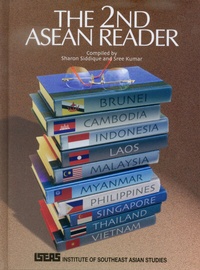
The 2nd ASEAN Reader
2nd ASEAN Reader
Published on 11. June 2018
626 pages
978-981-230-529-9 (ISBN)
Description

No detailed description available for "The 2nd ASEAN Reader".
More details
Edition
Digital original
Language
English
Place of publication
Singapore
Singapore
Target group
Professional and scholarly
US School Grade: College Graduate Student
Edition type
Digital original
File size
2,52 MB
ISBN-13
978-981-230-529-9 (9789812305299)
Copyright in bibliographic data and cover images is held by Nielsen Book Services Limited or by the publishers or by their respective licensors: all rights reserved.
Schweitzer Classification
Other editions
Additional editions
Content
- Intro
- CONTENTS
- Preface
- Director's Message
- Foreword: New Challenges for ASEAN
- Member States of ASEAN
- SECTION I: ASEAN: INSTITUTIONAL REDESIGN AND DYNAMICS
- Introduction by Sree Kumar
- 1. Early Southeast Asian Political Systems
- 2. Post-Colonial Southeast Asia
- 3. Post-War Regional Co-operation
- 4. The Formation of ASEAN
- 5. Institutional Framework: Recommendations for Change
- 6. The Structure of Decision-Making
- 7. The Association of Southeast Asian Nations: Challenges and Responses
- 8. ASEAN Institution Building
- 9. ASEAN during the Crisis
- 10. The "ASEAN Way"
- 11. ASEAN and Non-interference
- 12. ASEAN: An Image Problem
- 13. Intramural Challenges to the "ASEAN Way"
- 14. Strategic Centrality: Indonesia's Changing Role in ASEAN
- SECTION II: MEMBERSHIP EXPANSION ON A NEW POLITICAL CANVAS
- Introduction by Sree Kumar
- 15. Intra-ASEAN Political, Security and Economic Co-operation
- 16. ASEAN and Indochina: The Dialogue
- 17. Challenges for Society and Politics
- 18. Expectations and Experiences of the New Members: A Vietnamese Perspective
- 19. Between China and ASEAN: The Dialectics of Recent Vietnamese Foreign Policy
- 20. Vietnam and Its Neighbours: The Border Dispute Dimension
- 21. ASEAN Enlargement and Myanmar
- 22. The ASEAN Troika on Cambodia
- 23. The Greater Mekong Subregion: An ASEAN Issue
- 24. The Security Challenges in the GMS
- 25. The GMS Co-operation Within the ASEAN Context
- 26. Impact of ASEAN Enlargement on GMS Countries
- 27. Neighbourhood Watch and the East Timor/Aceh Crises
- SECTION III: SOCIETY, CULTURE AND RELIGION: INGREDIENTS FOR A NEW TAPESTRY
- Introduction by Sharon Siddique
- 28. Managing Mobilization and Migration of Southeast Asia's Population
- 29. Media in Southeast Asia
- 30. The Role of Education in ASEAN Economic Growth
- 31. Climbing up the Technological Ladder
- 32. Human Rights and Regional Order
- 33. Promoting Human Rights
- 34. Human Security in Vietnam, Laos, and Cambodia
- 35. Role of Nonstate Actors in Building an ASEAN Community
- 36. Ethnicity and Religion in Social Development
- 37. Asia: Al Qaeda's New Theatre
- 38. Islam and Society in Southeast Asia after 11 September
- 39. Islam in Southeast Asia: At the Crossroads
- 40. Building Knowledge Societies: ASEAN in the Information Age
- 41. ASEAN, the Wider Region and the World: The Social Agenda
- SECTION IV: ECONOMICS, MODERNIZATION, AND CRISIS: AFTA AND AFTER
- Introduction by Sree Kumar
- 42. The ASEAN Model of Regional Co-operation
- 43. The ASEAN Free Trade Area: The Search for a Common Prosperity
- 44. Co-operation and Institutional Transformation in ASEAN: Insights from the AFTA Project
- 45. AFTA and the Politics of Regional Economic Co-operation
- 46. Intra-ASEAN Economic Co-operation
- 47. The Expansion of AFTA
- 48. AFTA = Another Futile Trade Area?
- 49. Foreign Direct Investment in ASEAN: Can AFTA Make a Difference?
- 50. Privatization and Deregulation in ASEAN
- 51. ASEAN and the Asian Crisis
- 52. External Capital Flows and Policy Challenges in the ASEAN Economies
- 53. ASEAN and the Idea of an "Asian Monetary Fund"
- SECTION V: GEOPOLITICS, DEFENCE AND SECURITY
- Introduction by Sharon Siddique
- 54. Is ASEAN a Security Organization?
- 55. A Post-Cold War Architecture for Peace and Security
- 56. ASEAN and the Southeast Asian Security Complex
- 57. The ASEAN Regional Forum
- 58. The ASEAN-ISIS and CSCAP Experience
- 59. Evolution of the Security Dialogue Process in the Asia-Pacific Region
- 60. New Security Issues and the Impact on ASEAN
- 61. The Limits of Conflict Resolution in Southeast Asia
- 62. Alternative Security Models: Implications for ASEAN
- 63. Disputes in the South China Sea: Approaches for Conflict Management
- 64. Integrating ASEAN and Fragmenting ARF in a Subregional and Regional Context
- 65. Northeast Asia and ASEAN: Security Linkages, Implications and Arrangements
- 66. Asia-Pacific Security: Strategic Trends and Military Developments
- 67. The Interrelationship Between Global and Regional Security Issues
- SECTION VI: ASEAN AND MULTILATERAL RELATIONS
- Introduction by Sree Kumar
- 68. ASEAN and the North-South Dialogue
- 69. The Parallel Tracks of Asian Multilateralism
- 70. ASEAN and the International Trading System
- 71. EU-ASEAN Relationship
- 72. The Asian Crisis Seen from Europe
- 73. The ASEM Process and Co-operative Engagement in the 21st Century
- 74. ASEAN and the Asia-Europe Meeting
- 75. APEC and ASEAN: Complementing or Competing?
- 76. APEC and ASEAN: New Roles, New Directions
- 77. The Asian Crisis and the Adequacy of Regional Institutions
- 78. AFTA and NAFTA: Complementing or Competing?
- 79. Regionalism and Economic Integration in East Asia
- 80. ASEAN Policy Responses to North American and European Trading Agreements
- SECTION VII: SIGNIFICANT OTHERS: ASEAN AND NATION-STATES
- Introduction by Sharon Siddique
- 81. ASEAN's Engagement with the U.S. in the 21st Century
- 82. Is There a U.S. Strategy for East Asia?
- 83. The United States and the Aborted Asian Monetary Fund
- 84. Trends in U.S. Politics and Their Implications for America's Asian Policy
- 85. ASEAN-China Relations Turn the Corner
- 86. ASEAN's Role in the Chinese Foreign Policy Framework
- 87. ASEAN-China Trade and Investment Relations
- 88. China-ASEAN Free Trade Area
- 89. The Rhetoric of Australia's Regional Policy
- 90. The ASEAN-10 and Japan
- 91. Outlook for Japanese FDI in ASEAN
- 92. ASEAN's Role in Integrating Russia into the Asia Pacific Economy
- 93. ASEAN in India's Foreign Policy
- SECTION VIII: THE CHANGING LANDSCAPE: ASEAN GOING FORWARD
- Introduction by Sharon Siddique
- 94. ASEAN Towards 2020: Strategic Goals and Critical Pathways
- 95. The Evolving Regional Role of ASEAN
- 96. The Future of ASEAN
- 97. Prospects for Intra- and Extraregional Relations
- 98. Future Directions for ASEAN
- 99. ASEAN's Past and the Challenges Ahead
- 100. ASEAN Vision 2020 and the Hanoi Plan of Action
- 101. Overview of the Political Dimension of ASEAN's Security
- 102. ASEAN in a New Asia
- 103. Towards an ASEAN Economic Community
- 104. Institutional Reforms to Achieve ASEAN Market Integration
- 105. Region, Security and the Return of History
- DOCUMENTATION
- ASEAN Declaration, Bangkok, 8 August 1967
- Singapore Declaration of 1992, Singapore, 28 January 1992
- ASEAN Vision 2020
- Ha Noi Plan of Action
- Declaration on Terrorism, Phnom Penh, 2002
- List of Abbreviations
- Bibliography
- The Contributors
