

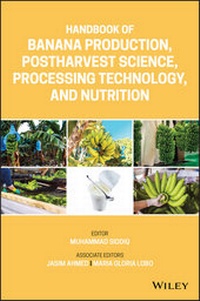
Handbook of Banana Production, Postharvest Science, Processing Technology, and Nutrition
Description

The banana is the world's fourth major fruit crop. Offering a unique and in-depth overview of the fruit's entire value chain, this important new handbook charts its progression from production through to harvest, postharvest, processing, and consumption. The most up-to-date data and best practices are drawn together to present guidelines on innovative storage, processing, and packaging technologies, whilefresh approaches to quality management and the value-added utilization of banana byproducts are also explained. Additionally, the book examines the banana's physiology, nutritional significance, and potential diseases and pests. The book also Edited by noted experts in the field of food science, this essential text:
* Provides a new examination of the world's fourth major fruit crop
* Covers the fruit's entire value chain
* Offers dedicated chapters on bioactive and phytochemical compounds found in bananas and the potential of processing byproducts
* Gives insight into bananas' antioxidant content and other nutritional properties
* Identifies and explains present and possible effects of bioactive and phytochemical compounds
Handbook of Banana Production, Postharvest Science, Processing Technology, and Nutritionoffersthe mostfar-reaching overview of the banana currently available. It will be of great benefit to food industry professionals specializing in fruit processing, packaging, and manufacturing banana-based products. The book is also an excellent resource for those studying or researching food technology, food science, food engineering, food packaging, applied nutrition, biotechnology,and more.
More details
Other editions
Additional editions
Person
Muhammad Siddiq, PhD,¿is an Associate Professor of Food Science at Michigan State University, USA, and äFood Science Consultant, Guelph, Ontario, Canada. His area of expertise is postharvest biochemistry and value-added processing of fruits, vegetables, and other plant-based commodities. He¿is associate editor of ¿the Legume Science (Wiley); ¿was an associate editor of the¿Handbook of Vegetables and Vegetable Processing; and ¿has ¿been the lead editor of five other books including Tropical and Subtropical Fruits Packaging, Processing and Nutrition.
Jasim Ahmed, PhD,¿is a Research Scientist at the Kuwait Institute for Scientific Research, and has been the author or co-author of 150 journal articles, over 50 conference papers, and 35 book chapters. He has co-edited eight books, including ¿Glass and State Transitions in Food and Biological Materials¿ and ¿Handbook of Food Process Design. He is editor-in-chief of Legume Science (Wiley) and a professional member of the Institute of Food Technology (IFT).¿
Gloria Lobo,¿PhD,¿is a Tenured Scientist at the Postharvest and Food Technology Laboratory, Tropical Fruits Department, Instituto Canario de Investigaciones Agrarias, Canary Island (Spain). Her published work includes postharvest quality aspects including minimal processing of tropical fruits, mainly banana, papaya, and pineapple. She is co-editor of¿ Pineapple Production, Postharvest Science, Processing Technology and Nutrition and Tropical and Subtropical Fruits - Postharvest Physiology, Processing, and Nutrition.¿¿
Content
List of Contributors vii
Preface ix
1 Banana Production, Global Trade, Consumption Trends, Postharvest Handling, and Processing 1
Edward A. Evans, Fredy H. Ballen, and Muhammad Siddiq
2 Biology and Postharvest Physiology of Banana 19
Maria Gloria Lobo and Francisco Javier Fernández Rojas
3 Banana Pathology and Diseases 45
Andressa de Souza-Pollo and Antonio de Goes
4 Harvesting and Postharvest Technology of Banana 61
Maria Gloria Lobo and Marta Montero-Calderón
5 Packaging Technologies for Banana and Banana Products 81
Pattarin Leelaphiwat and Vanee Chonhenchob
6 Ripe Banana Processing, Products, and Nutrition 99
Neelima K. Shandilya and Muhammad Siddiq
7 Processing of Dehydrated Banana Products 117
Mark A. Uebersax and Muhammad Siddiq
8 Green Banana Processing, Products and Functional Properties 141
Jasim Ahmed
9 Innovative Processing Technologies for Banana Products 169
Jasim Ahmed
10 Value-Added Processing and Utilization of Banana By-Products 191
Dalbir Singh Sogi
11 Chemical Composition and Nutritional Profile of Raw and Processed Banana Products 207
Jiwan S. Sidhu and Tasleem A. Zafar
12 Banana (Musa spp.) as a Source of Bioactive Compounds for Health Promotion 227
Susane Lopes, Cristine Vanz Borges, Sara Manso de Sousa Cardoso, Miguel Francisco de Almeida Pereira da Rocha, and Marcelo Maraschin
13 Microbiology of Fresh Bananas and Processed Banana Products 245
Anu Kalia
Index 268
1
Banana Production, Global Trade, Consumption Trends, Postharvest Handling, and Processing
Edward A. Evans1, Fredy H. Ballen1, and Muhammad Siddiq2
Tropical Research and Education Center, University of Florida, Homestead, FL, 33031, USA
Department of Food Science & Human Nutrition, Michigan State University, East Lansing, MI, 48824, USA
Introduction
Bananas are produced in more than 130 countries by small-scale and large-scale farmers alike. This fruit plays a very important role in contributing to food security and as a source of export revenue in some economies. The socioeconomic importance of banana production and trade should not be underestimated. About one-fifth of the global banana production is destined for international markets. Between 2008 and 2017, global banana production increased by 15.35%, reaching 113.92 million metric tons (MMT) in 2017. Factors driving the rise in banana production during this period were increases in yield and harvested area. Over the same period, banana exports grew by 26.67%, reaching 23.18 MMT in 2017. The top three banana exporters, Ecuador, Philippines, and Costa Rica, accounted for about 50% of global exports in 2017, while the top three banana importers, the United States, Germany, and Russia accounted for about 35% of the global import trade (FAO 2019a).
Historically, the big multinational companies controlled banana production and trade, but due to a changing business landscape, particularly legal, labor, and environmental issues, these companies now focus more on the transportation and distribution segment of the fruit value chain. This situation led to the growth of national banana companies that have the option to sell the fruit to the big multinational companies or directly to retailers and supermarket chains. As the number of participants on the supply side has increased, the number of participants on the retail side has decreased as result of renewed interest in mergers and acquisitions in the food retail industry. Consequently, there are now more sellers and fewer buyers in the banana market. Unfortunately, this change has not necessarily resulted in better wages and prices in the export growing regions.
Exports of conventional bananas to developed countries are plateauing, whereas exports of organic bananas to these countries continue to increase. Organic bananas in the US market command a significant premium price; on average, during the period 2013-2017, organic bananas at the US retail level commanded a premium of $0.29/lb over the price paid for conventional bananas (USDA-AMS 2018).
Irregular weather patterns and fungal diseases are usually the main disruptors to the otherwise year-round supply of bananas. The biggest threat to global banana production is Fusarium Wilt Tropical Race 4 (TR4), a fungal disease with the potential to disrupt banana production and trade as we know them. This chapter provides an overview of recent trends and developments in world banana production, exports and imports, consumption trends and prices in the US and European Union (EU) markets, and postharvest handling, processing, nutritional profile and health benefits of banana.
Banana Production, Trade, and Consumption
Between 2008 and 2017, global banana production expanded by 15.35%, from 98.76 MMT in 2008 to 113.92 MMT in 2017 (Figure 1.1). Factors driving the gains in production during this period were increases in yield (5.76%) from 19.11 metric tons/hectare (MT/ha) in 2008 to 20.21 MT/ha in 2017, and harvested area (9.09%) from 5.17 million hectares (Mha) in 2008 to 5.64 Mha in 2017. Commercial banana production occurs under very diverse climatic conditions in tropical and subtropical regions worldwide. Asia is the leading banana production region, accounting for 54.18% of the total production in 2017, followed by the Americas and the Caribbean (26.33%), Africa (17.57%), Oceania (1.52%), and the EU (0.40%) (FAO 2019a). Banana fruit plays an important role for household food security, income generation as a cash crop, and as an export revenue source around the world.
Figure 1.1 Banana total world production and area harvested, 2008-2017.
Source: FAO (2019a).
Although bananas are grown commercially in more than 130 countries, production is highly concentrated in the top 10 producing countries, accounting for 73.8% of the total production during the period 2015-2017 (Table 1.1). India is by far the largest producer, accounting for 26.8% of the total world production in 2017, followed by China (9.8%) and Indonesia (6.3%). Together, the top three countries accounted for about 43% of the global production. Other important banana producing countries, with their production share, include Brazil (5.9%), Ecuador (5.5%), the Philippines (5.3%), Angola (3.8%), Guatemala (3.4%), Colombia (3.3%), and Tanzania (3.1%) (FAO 2019a).
Table 1.1 World's 10 major banana producers by quantity, 2008-2017 (million metric tons).
Source: FAO (2019a).
Country1 2008 2009 2010 2011 2012 2013 2014 2015 2016 2017 % Share, 2015-2017 India 26.2 26.5 29.8 28.5 26.5 27.6 29.7 29.2 29.1 30.5 26.0 China 7.8 8.8 9.6 10.4 11.6 12.1 11.8 12.5 13.1 11.2 10.8 Indonesia 6 6.4 5.8 6.1 6.2 6.3 6.9 9.5 7 7.2 6.9 Brazil 7 6.8 7 7.3 6.9 6.9 7 6.8 6.8 6.7 5.9 Ecuador 6.7 7.6 7.9 7.4 7 6 6.8 7.2 6.5 6.4 5.8 Philippines 8.7 9 9.1 9.2 9.2 8.6 5.7 5.8 5.8 6.0 5.2 Angola 1.7 2 2 2.6 3 3.1 3.5 3.6 3.9 4.3 3.5 Guatemala 2.3 2.7 2.6 2.9 3 3.3 3.4 3.8 3.8 3.9 3.4 Colombia 2 2 2 2 3.5 3.8 3.3 3.7 3.7 3.8 3.3 Tanzania 2.4 3 3.2 3.1 2.5 2.7 3.2 3.6 3.6 3.5 3.1 Top-10, total 70.8 74.8 79 79.5 79.4 80.4 81.3 85.7 83.3 83.3 73.9 Others, total 28.0 28.6 29.7 29.9 29.9 31.8 31.5 29.4 29.3 30.6 26.1 World, total 98.8 103.4 108.7 109.4 109.3 112.2 112.8 115.1 112.6 113.9 100.01 Ranked by 2017 production.
Disease continues to be the biggest threat to banana production, particularly Black Sigatoka and Fusarium Wilt (TR4). The economic impact of Black Sigatoka is significant for producers due to the cost of protection measures, such as regular fungicide applications, which may increase production costs by 25% or more (FAO 2013). The disease that constitutes the biggest threat to banana production is Fusarium Wilt (TR4), which has the potential to infect most banana varieties, including the widely cultivated Cavendish cultivar, and eliminate all banana plantations worldwide. It has already infested plantations in South East Asia, Pakistan, Jordan, Mozambique, and Australia. There is no viable and fully effective treatment; the only preventive measure is quarantine because the fungus spores may remain latent in the soil for decades (FAO...
