

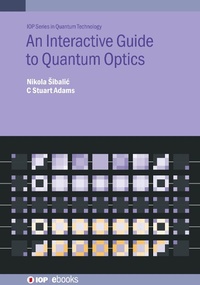
An Interactive Guide to Quantum Optics
Description

Quantum optics is the application of quantum mechanics to light and its interaction with matter. It explores the properties of photons themselves and their use in testing what can seem the counter-intuitive predictions of quantum mechanics. Quantum optics is central to our interpretation of entanglement, teleportation and quantum metrology; and has applications in our understanding the quantum nature of information and how we can formulate, manipulate, and process it using physical systems operating on quantum mechanical principles Embracing the enhanced features of an ebook the authors provide a primer on quantum optics for students and those wanting an introduction to the topic. Whereas standard texts employ complex mathematics and static images, the authors use interactivity to augment understanding via a visual hands-on experience. Forty interactive figures allow exploration of different themes, while multiple representations give a window on quantum dynamics both at microscopic and macroscopic level, connecting understanding across length scales. Historical introduction and examples from modern research set these concepts firmly into both original and contemporary research context. This is an ideal text for final year undergraduate quantum optics students, and new graduate students in AMO physics, and researchers in physics and electrical/optical engineering.
More details
Other editions
Additional editions
Persons
Nikola sibalic studied physics at the University of Belgrade, Serbia and received a PhD from Durham University, UK, before doing postdoctoral research in Denmark and France. Currently he dedicates his days working in the quantum computing industry as product manager and solution architect, and his nights to developing and maintaining an ever growing array of open-source tools for knowledge sharing and (re)use. He relaxes by practising classical mechanics in the form of swing dancing. Find out more at nikolasibalic.github.io.
C Stuart Adams studied physics at the University of Oxford and received a PhD on laser physics from the University of Strathclyde in Glasgow, UK. He completed postdoctoral work in Germany and the United States before starting a research group at Durham University in 1995. He was awarded the Thomson medal in 2014 by the Institute of Physics (IoP) and the Holweck Prize in 2020 by the French Physical Society and IoP for pioneering work in atomic physics and quantum optics. He is co-author of the textbook Optics f2f. Find out more at etotheipiequals.github.io and opticsf2f.github.io/Opticsf2f_CodeBook/ .
Together they co-authored previously Rydberg Physics, IOPP (2018)
Content
-
Introduction
-
Discovery of quantum optics
-
What is Quantum in Quantum Optics?
Part I One quanta
-
One quanta
-
Measurements: projective and non-destructive
-
Fighting environmental noise and imperfections
Part II Two or more quantum
-
Two photons
-
Seeing entanglement: Counting and correlation
-
Strong interactions
Part III Outlook
- Outlook
Appendices
A. Bloch vector
B. Density matrix
C. Rotations
D. The Rabi solution
E. Quantum regression theorem and two-time correlation calculations
