

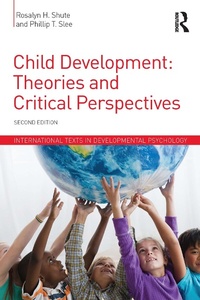
Child Development
Theories and Critical Perspectives
2nd Edition
Published on 15. May 2015
310 pages
978-1-317-66507-6 (ISBN)
Description

Child Development: Theories and Critical Perspectives provides an engaging and perceptive overview of both well-established and recent theories in child and adolescent psychology. This unique summary of traditional scientific perspectives alongside critical post-modern thinking will provide readers with a sense of the historical development of different schools of thought. The authors also place theories of child development in philosophical and cultural contexts, explore links between them, and consider the implications of theory for practice in the light of the latest thinking and developments in implementation and translational science.
Early chapters cover mainstream theories such as those of Piaget, Skinner, Freud, Maccoby and Vygotsky, whilst later chapters present interesting lesser-known theorists such as Sergei Rubinstein, and more recent influential theorists such as Esther Thelen. The book also addresses lifespan perspectives and systems theory, and describes the latest thinking in areas ranging from evolutionary theory and epigenetics, to feminism, the voice of the child and Indigenous theories.
The new edition of Child Development has been extensively revised to include considerable recent advances in the field. As with the previous edition, the book has been written with the student in mind, and includes a number of useful pedagogical features including further reading, discussion questions, activities, and websites of interest.
Child Development: Theories and Critical Perspectives will be essential reading for students on advanced courses in developmental psychology, education, social work and social policy, and the lucid style will also make it accessible to readers with little or no background in psychology.
Early chapters cover mainstream theories such as those of Piaget, Skinner, Freud, Maccoby and Vygotsky, whilst later chapters present interesting lesser-known theorists such as Sergei Rubinstein, and more recent influential theorists such as Esther Thelen. The book also addresses lifespan perspectives and systems theory, and describes the latest thinking in areas ranging from evolutionary theory and epigenetics, to feminism, the voice of the child and Indigenous theories.
The new edition of Child Development has been extensively revised to include considerable recent advances in the field. As with the previous edition, the book has been written with the student in mind, and includes a number of useful pedagogical features including further reading, discussion questions, activities, and websites of interest.
Child Development: Theories and Critical Perspectives will be essential reading for students on advanced courses in developmental psychology, education, social work and social policy, and the lucid style will also make it accessible to readers with little or no background in psychology.
Reviews / Votes
'I whole-heartedly recommend this scholarly book. The authors provide a vibrant and enquiring overview of contemporary debates in developmental psychology, with inspirational coverage of such topics as the voice of the child and the families and communities in which children grow. The book is grounded in the authors' deep understanding of fundamental theories and their willingness to relate these to practice. This book will give generations of students the opportunity to reflect on the meaning of child development in a multi-ethnic, ever-changing social context.' - Helen Cowie, Faculty of Health and Medical Sciences, University of Surrey, UK'The text is strikingly comprehensive - from historical approaches to post-modern interpretations, and with frequent citations from non-Western writing. Adept at linking various theoretical approaches, the authors include a very useful chapter on theoretical integration. A refreshing combination of theory and practice, the authors take a holistic approach, with theory serving as the underpinning for research, teaching and practice. Sophisticated and up-to-date - and highly recommended!' - John D. Hogan, Department of Psychology, St. John's University, USA
'I was pleased to hear that this book, one that I have used for a number of years in my graduate introductory child development course, has been updated and revised. The new edition accurately reflects advances in the integration and inseparability of heredity/environment, brain/behavior, and self/other. I am very much looking forward to using and learning more from it in the coming years'. - Richard Volpe, Department of Applied Psychology & Human Development, University of Toronto, Canada 'I whole-heartedly recommend this scholarly book. The authors provide a vibrant and enquiring overview of contemporary debates in developmental psychology, with inspirational coverage of such topics as the voice of the child and the families and communities in which children grow. The book is grounded in the authors' deep understanding of fundamental theories and their willingness to relate these to practice. This book will give generations of students the opportunity to reflect on the meaning of child development in a multi-ethnic, ever-changing social context.' - Helen Cowie, Faculty of Health and Medical Sciences, University of Surrey, UK
'The text is strikingly comprehensive - from historical approaches to post-modern interpretations, and with frequent citations from non-Western writing. Adept at linking various theoretical approaches, the authors include a very useful chapter on theoretical integration. A refreshing combination of theory and practice, the authors take a holistic approach, with theory serving as the underpinning for research, teaching and practice. Sophisticated and up-to-date - and highly recommended!' - John D. Hogan, Department of Psychology, St. John's University, USA
'I was pleased to hear that this book, one that I have used for a number of years in my graduate introductory child development course, has been updated and revised. The new edition accurately reflects advances in the integration and inseparability of heredity/environment, brain/behavior, and self/other. I am very much looking forward to using and learning more from it in the coming years'. - Richard Volpe, Department of Applied Psychology & Human Development, University of Toronto, Canada
"(...) I enjoyed reading this book. Abstract and complex ideas are described in a clear and uncomplicated style, which makes it a very readable book that is detailed but not burdensome. I particularly liked the short stories, anecdotes, and poems, which clarified some of the more abstract ideas and issues. I wholeheartedly recommend this scholarly book to anyone who wants to have a comprehensive overview and critical discussion of the main theories that have been developed and an accurate picture of contemporary debates in child and adolescent psychology. As such, the book is a very good choice for a (graduate) introductory child development course." - Freek Bucx, The Netherlands Institute for Social Research, Journal of Family Theory & Review
More details
Series
Edition
2nd edition
Language
English
Place of publication
London
United Kingdom
Publishing group
Taylor & Francis Ltd
Target group
College/higher education
Edition type
Revised edition
Product notice
Reflowable
Illustrations
6 s/w Abbildungen, 4 s/w Tabellen, 6 s/w Zeichnungen
4 Tables, black and white; 6 Line drawings, black and white; 6 Illustrations, black and white
File size
2,05 MB
ISBN-13
978-1-317-66507-6 (9781317665076)
Copyright in bibliographic data and cover images is held by Nielsen Book Services Limited or by the publishers or by their respective licensors: all rights reserved.
Schweitzer Classification
Other editions
Additional editions
Book
05/2015
2nd Edition
Routledge
€252.40
Shipment within 3-4 weeks
Book
05/2015
2nd Edition
Routledge
€90.10
Shipment within 3-4 weeks
Persons
Rosalyn H. Shute is an Adjunct Professor in the School of Psychology, Flinders University, Adelaide, Australia, and Federation University, Ballarat, Australia. Her research expertise lies broadly in clinical child psychology and paediatric psychology/child health and wellbeing, and she is an experienced teacher of developmental psychology and clinical child/paediatric psychology.
Phillip T. Slee is a Professor in Human Development in the School of Education at Flinders University, Adelaide, Australia. He is a trained teacher and registered psychologist. His main areas of interest include childhood bullying/aggression, conduct disorders, stress and teacher education, and he has a particular interest in the practical and policy implications of his research.
Phillip T. Slee is a Professor in Human Development in the School of Education at Flinders University, Adelaide, Australia. He is a trained teacher and registered psychologist. His main areas of interest include childhood bullying/aggression, conduct disorders, stress and teacher education, and he has a particular interest in the practical and policy implications of his research.
Content
1. Ways of knowing about development 2. From Darwin to DNA: biologically-based theories of development 3. A rainbow is more than the sum of its colours: beginnings of organicism 4. The child as philosopher 5. From Oedipus to attachment: the Freudian legacy 6. Mechanism: the whole is equal to the sum of its parts 7. Dialecticism: the child developing in a social world 8. The historic event: contextualism 9. Sociocultural influences on development 10. Systems theories 11. Listening to different voices 1: feminism and developmental psychology 12. Listening to different voices 2: the voices of children 13. Towards theoretical integration 14. The theory-practice nexus Appendix 1: Some historical milestone relevant for developmental psychology Appendix 2: Discussion questions, activities and selected websites
