

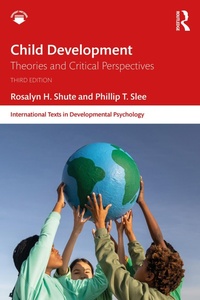
Child Development
Theories and Critical Perspectives
3rd Edition
Published on 3. April 2026
354 pages
978-1-040-54163-0 (ISBN)
Description

Child development: Theories and Critical Perspectives provides a perceptive and engaging overview of theories in child and adolescent psychology, uniquely combining traditional scientific perspectives with critical (postmodern) approaches. This new edition has been extensively revised to incorporate recent advances in the field, featuring a new chapter Theorizing about Children's Digital Worlds that explores contemporary issues including social media, AI, internet addiction and the banning of mobile phones in schools.
The authors skilfully place developmental theories within philosophical and cultural contexts, tracing historical developments across different schools of thought while exploring their interconnections and practical implications. Early chapters cover mainstream theorists such as Piaget, Skinner, Freud, and Vygotsky. Other influential theorists include Maccoby and Thelen, and contemporary thinkers such as Overton and Stetsenko. Significant figures less well-known today, like Dewey and Rubinstein, are also introduced. The text also addresses broader frameworks including lifespan perspectives, systems theory, evolutionary theory, epigenetics, feminist approaches, children's voices, and Indigenous theories. Current controversies such as 'decolonizing' developmental psychology and the role of universities in knowledge production are also discussed.
Written with students in mind, the book includes valuable pedagogical features such as recommended readings, discussion questions, activities, and relevant websites. Essential reading for postgraduate students in developmental psychology, education, social work, and social policy, its lucid style makes complex theoretical concepts accessible to readers at all levels, including those with limited background in psychology.
The authors skilfully place developmental theories within philosophical and cultural contexts, tracing historical developments across different schools of thought while exploring their interconnections and practical implications. Early chapters cover mainstream theorists such as Piaget, Skinner, Freud, and Vygotsky. Other influential theorists include Maccoby and Thelen, and contemporary thinkers such as Overton and Stetsenko. Significant figures less well-known today, like Dewey and Rubinstein, are also introduced. The text also addresses broader frameworks including lifespan perspectives, systems theory, evolutionary theory, epigenetics, feminist approaches, children's voices, and Indigenous theories. Current controversies such as 'decolonizing' developmental psychology and the role of universities in knowledge production are also discussed.
Written with students in mind, the book includes valuable pedagogical features such as recommended readings, discussion questions, activities, and relevant websites. Essential reading for postgraduate students in developmental psychology, education, social work, and social policy, its lucid style makes complex theoretical concepts accessible to readers at all levels, including those with limited background in psychology.
More details
Series
Edition
3rd edition
Language
English
Place of publication
London
United Kingdom
Publishing group
Taylor & Francis Ltd
Target group
College/higher education
Illustrations
3 Tables, black and white; 12 Line drawings, black and white; 1 Halftones, black and white; 13 Illustrations, black and white
File size
192,26 MB
ISBN-13
978-1-040-54163-0 (9781040541630)
Copyright in bibliographic data and cover images is held by Nielsen Book Services Limited or by the publishers or by their respective licensors: all rights reserved.
Schweitzer Classification
Other editions
Additional editions
Book
approx. 04/2026
3rd Edition
Routledge
€213.90
Not yet published
Book
approx. 04/2026
3rd Edition
Routledge
€72.40
Not yet published
Persons
Rosalyn H. Shute, PhD, is an Adjunct Professor of Psychology in the College of Education, Psychology and Social Work, Flinders University, Adelaide, Australia. Her research expertise lies broadly in clinical child psychology and paediatric psychology/child health and wellbeing, and she is an experienced teacher of developmental psychology and clinical child/paediatric psychology.
Phillip T. Slee, PhD, is Emeritus Professor in Human Development in the College of Education, Psychology and Social Work at Flinders University, Adelaide, Australia. He is a trained teacher and registered psychologist. His main areas of interest include childhood bullying/aggression, conduct disorders, stress and teacher education, and he has a particular interest in the practical and policy implications of his research.
Phillip T. Slee, PhD, is Emeritus Professor in Human Development in the College of Education, Psychology and Social Work at Flinders University, Adelaide, Australia. He is a trained teacher and registered psychologist. His main areas of interest include childhood bullying/aggression, conduct disorders, stress and teacher education, and he has a particular interest in the practical and policy implications of his research.
Content
List of figures, tables and boxes Preface 1. The nature of developmental psychology 2. Ways of knowing about children 3. From Darwin to DNA: biologically-based theories of development 4. Mechanism, behaviourism and beyond: the whole is equal to the sum of its parts 5. A rainbow is more than the sum of its colours: beginnings of organicism 6. The child as philosopher: constructivism 7. From Oedipus to attachment: the Freudian legacy 8. Dialecticism: the child developing in a social world 9. The historic event: contextualism 10. Systems theories 11. Culture in development 12. Listening to different voices 1: feminism, developmental psychology, and backlashes 13. Listening to different voices 2: the voices of children 14. Theorizing about the digital world of the child 15. Putting it all together: towards theoretical integration 16. Nothing is as practical as a good theory Appendix Glossary Index
