

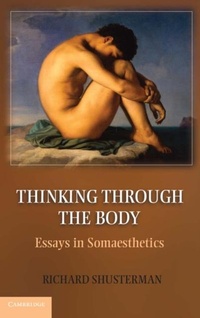
Thinking through the Body
Essays in Somaesthetics
1st Edition
Published on 28. September 2012
978-1-139-53433-8 (ISBN)
Description

This book provides a richly rewarding vision of the burgeoning interdisciplinary field of somaesthetics. Composed of fourteen wide-ranging but finely integrated essays by Richard Shusterman, the originator of the field, Thinking through the Body explains the philosophical foundations of somaesthetics and applies its insights to central issues in ethics, education, cultural politics, consciousness studies, sexuality and the arts. Integrating Western philosophy, cognitive science and somatic methodologies with classical Asian theories of body, mind and action, these essays probe the nature of somatic existence and the role of body consciousness in knowledge, memory and behavior. Deploying somaesthetic perspectives to analyze key aesthetic concepts (such as style and the sublime), he offers detailed studies of embodiment in drama, dance, architecture and photography. The volume also includes somaesthetic exercises for the classroom and explores the ars erotica as an art of living.
Reviews / Votes
'Richard Shusterman's collection takes the first philosophical step in the new millennium, going beyond the action theory that emerged in the 1970s and building a historical pyramid from Socrates to his own conception of somaesthetics: a scholarly monument ranging from muscle memory to vital topics in aesthetics, including ars erotica.' Arthur C. Danto, Columbia University 'History will remember Richard Shusterman for precipitating the somatic turn that the increasingly embodied discipline of philosophy has taken in our own time ... Calling his readers back to a relatively straightforward and practical account of everyday lived experience, he challenges us to reconceive how it is that an educated body consciousness enables us reflexively to structure, theorize, aestheticize, and indeed 'appreciate' the entire human experience in the fullest sense of this term. By fully acknowledging the sentient and purposive body as an aesthetic medium through which a life is lived deliberately, sensitively, and graciously, we are best able to enchant the ordinary and to inspire the everyday.' Roger T. Ames, University of Hawai'i '... powerful ... Bridging analytic and continental philosophical traditions; lived, embodied experience and the cogito; the intellect and the senses; Shusterman moves gracefully from philosopher to practitioner and back again. He shows how philosophy as an embodied art of living can find expression in today's disembodied world, while interpreting and redefining philosophical insights that others have stripped of their somatic implications ... he is hopeful about our bodies - a striking kind of hope, in a Western context of disdain for the 'abnormal,' a radically objectifying visual culture, and environments that serve the physical flourishing of almost no one. Shusterman still believes that a somaesthetic philosophy can speak with and to body practices in the service of a politics of transformation. His creative and diverse essays not only tell but also show us what this might look like.' Cressida J. Heyes, University of Alberta 'The project of Richard Shusterman's philosophical work on the body is an ambitious one: to take philosophy 'in a pragmatic meliorist direction,' as he puts it in Thinking Through the Body, 'reviving the ancient idea of philosophy as an embodied way of life rather than a mere discursive field of abstract theory ... makes a compelling case for the integration of analytic, pragmatic, and practical somaesthetics. ... Shusterman's insights in the realms of philosophy and aesthetics are cogent and interesting, but he doesn't limit himself to the canon. In his essay on muscle memory, he takes more of a therapeutic turn, focusing on how training in somatic awareness can ameliorate the 'somaesthetic pathologies of everyday life.' In Thinking Through the Body, it is his essays on art and culture that hold out the most promise for somaesthetics. ... offers a compelling new lens with which to explore alternate approaches to thinking through embodiment ...' Janet Sarbanes, Los Angeles Review of Books 'This essay collection by Richard Shustermann, the 'originator of the field' of somaesthetics (back cover) is wide-ranging. Not only is somaesthetics itself a fully interdisciplinary academic field, Shustermann also adds a practical dimension and emphasizes its interculturalism in the comparison of eastern and western thinking about body and mind.' Hans J. Rindisbacher, The European LegacyMore details
Language
English
Place of publication
Cambridge
United Kingdom
Publishing group
Cambridge University Press
Target group
Professional and scholarly
College/higher education
File size
2,92 MB
ISBN-13
978-1-139-53433-8 (9781139534338)
Copyright in bibliographic data and cover images is held by Nielsen Book Services Limited or by the publishers or by their respective licensors: all rights reserved.
Schweitzer Classification
Other editions
Additional editions
Book
09/2012
Cambridge University Press
€129.20
Shipment within 15-20 days
Person
Richard Shusterman is the Dorothy F. Schmidt Eminent Scholar in the Humanities and Professor of Philosophy at Florida Atlantic University, where he also directs the Center for Body, Mind, and Culture. He is the author of numerous books, including Body Consciousness: A Philosophy of Mindfulness and Somaesthetics (Cambridge, 2008), Performing Live (2000) and Pragmatist Aesthetics (1992, 2nd edition, 2000, and published in fifteen languages).
Content
Introduction; Part I. Somatic Being, Knowing, and Teaching: 1. Thinking through the body: educating for the humanities; 2. The body as background; 3. Self-knoweldge and its discontents: from Socrates to somaesthetics; 4. Muscle memory and the somaesthetic pathologies of everyday life; 5. Somaesthetics in the philosophy classroom: a practical approach; Part II. Somaesthetics, Aesthetics, and Culture: 6. Somaesthetics and the limits of aesthetics; 7. Somaesthetics and Burke's sublime; 8. Pragmatism and cultural politics: from textualism to somaesthetics; 9. Body consciousness and performance; Part III. The Arts and the Art of Living: 10. Somaesthetics and architecture: a critical option; 11. Photography as performative process; 12. Asian ars erotica and the question of sexual aesthetics; 13. Philosophy as awakened life: everyday aesthetics of embodiment in American transcendentalism and Japanese zen practice; 14. Somatic style.
