

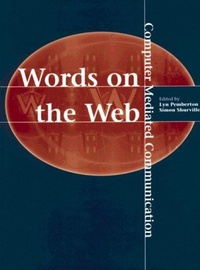
Words on the Web
Computer Mediated Communication
1st Edition
Published on 1. December 2000
130 pages
978-1-84150-867-2 (ISBN)
Description

Recent developments in technology have made this a crucial moment for those people studying language behaviour. This book places the reader at the heart of the investigations into what happens when people use language to communicate via computers.
New communication technologies - video conferencing, email and the World Wide Web - have provided a whole new range of ways to interact with others, and students can now observe the emergence and rapid development of linguistic and social conventions for using these media.
The studies in this volume consider what people say when interacting with others via new technologies, and the ways in which we mould and combine the written, the spoken and the non-verbal in order to express ourselves effectively within the confines of the new media available to us. The breadth of activities covered here is extensive, including:
informal activities such as email and chat-room use
educational uses of CMC, for collaborative learning and language practice
integration of CMC into formal work practice - for instance, in an ambulance dispatch centre.
The scope of the book ranges from Conversation Analysis to Genre Theory and from Social Psychology to Politeness Theory. There is much to contemplate for both designers of new communication as well as those commissioning and buying these technologies for our homes, schools and workplaces.
The collection of work here has been edited to recognise the range of disciplines looking to this field and is of direct interest to any linguist, psychologist or other social scientist working in the study of human communication.
New communication technologies - video conferencing, email and the World Wide Web - have provided a whole new range of ways to interact with others, and students can now observe the emergence and rapid development of linguistic and social conventions for using these media.
The studies in this volume consider what people say when interacting with others via new technologies, and the ways in which we mould and combine the written, the spoken and the non-verbal in order to express ourselves effectively within the confines of the new media available to us. The breadth of activities covered here is extensive, including:
informal activities such as email and chat-room use
educational uses of CMC, for collaborative learning and language practice
integration of CMC into formal work practice - for instance, in an ambulance dispatch centre.
The scope of the book ranges from Conversation Analysis to Genre Theory and from Social Psychology to Politeness Theory. There is much to contemplate for both designers of new communication as well as those commissioning and buying these technologies for our homes, schools and workplaces.
The collection of work here has been edited to recognise the range of disciplines looking to this field and is of direct interest to any linguist, psychologist or other social scientist working in the study of human communication.
More details
Edition
1. Auflage
Language
English
Place of publication
Bristol
United Kingdom
Publishing group
Intellect
Target group
Professional and scholarly
ISBN-13
978-1-84150-867-2 (9781841508672)
Copyright in bibliographic data and cover images is held by Nielsen Book Services Limited or by the publishers or by their respective licensors: all rights reserved.
Schweitzer Classification
Other editions
Additional editions
Book
01/2000
Intellect Books
€49.65
Article not available at the moment
Persons
Dr Lyn Pemberton is Principal Lecturer in the School of Information Management at the University of Brighton, with research interests in Computer-supported collaborative design, multimedia for language learning, and interaction design patterns.
Content
Introduction (1)
Part One - New Media, New Structures
One-way Doors, Teleportation and Writing without Prepositions: an analysis of WWW hypertext links (4)
Knowledge content and narrative structure (13)
Anchors in Context: a corpus analysis of authoring conventions for web pages (25)
Scholarly Email Discussion List Postings: a single new genre of academic communication? (36)
The use of communicative resources in internet video conferencing (44)
The pragmatic of orality in English, Japanese and Korean computer-mediated communication (52)
Part Two - New Media, New Behaviours
Multilingualism on the Net: language attitudes and the use of talkers (63)
maintaining the Virtual Community: us of politeness strategies in an email discussion group (69)
Effects of group identity on discussions in public on-line fora (79)
Literal or Loose Talk: the negotiation of meaning on an internet discussion list (87)
Electric Mail, Communication and Social Identity: a social psychological analysis of computer mediated group interaction (96)
Interaction implications of computer mediation in emergency calls (106)
Bibliography (119)
Part One - New Media, New Structures
One-way Doors, Teleportation and Writing without Prepositions: an analysis of WWW hypertext links (4)
Knowledge content and narrative structure (13)
Anchors in Context: a corpus analysis of authoring conventions for web pages (25)
Scholarly Email Discussion List Postings: a single new genre of academic communication? (36)
The use of communicative resources in internet video conferencing (44)
The pragmatic of orality in English, Japanese and Korean computer-mediated communication (52)
Part Two - New Media, New Behaviours
Multilingualism on the Net: language attitudes and the use of talkers (63)
maintaining the Virtual Community: us of politeness strategies in an email discussion group (69)
Effects of group identity on discussions in public on-line fora (79)
Literal or Loose Talk: the negotiation of meaning on an internet discussion list (87)
Electric Mail, Communication and Social Identity: a social psychological analysis of computer mediated group interaction (96)
Interaction implications of computer mediation in emergency calls (106)
Bibliography (119)
