

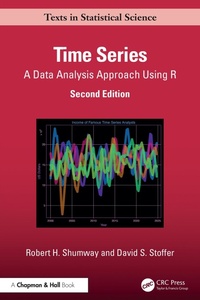
Time Series
A Data Analysis Approach Using R
2nd Edition
Published on 9. February 2026
292 pages
978-1-040-57590-1 (ISBN)
Description

The goals of this new, second edition of this book are to develop the skills and an appreciation for the richness and versatility of modern time series analysis as a tool for analyzing dependent data. An expanded feature of this edition is the inclusion of many nontrivial data sets illustrating the wealth of potential applications to problems in the biological, physical, and social sciences as well as in economics and medicine.
This edition emphasizes a variety of methodological techniques to illustrate solutions to data analysis problems such as discovering natural and anthropogenic climate change, evaluating pain perception experiments using functional magnetic resonance imaging, and the analysis of economic and financial problems.
Key Features:
* Presents a balanced and comprehensive treatment of both time and frequency domain methods with an emphasis on data analysis.
* Detailed R code is included with each numerical example.
* Includes nontrivial data sets.
The book can be used for a one semester/quarter introductory time series course where the prerequisites are an understanding of linear regression, basic calculus-based probability and statistics skills, and math skills at the high-school level. All the numerical examples use the R statistical package without assuming the reader has previously used the software.
Robert H. Shumway was Professor of Statistics, University of California, Davis. He was a Fellow of the American Statistical Association and won the American Statistical Association Award for Outstanding Statistical Application. He was the author of numerous texts and served on editorial boards such as the Journal of Forecasting and the Journal of the American Statistical Association.
David S. Stoffer is Professor Emeritus of Statistics, University of Pittsburgh. He is a Fellow of the American Statistical Association and has won the American Statistical Association Award for Outstanding Statistical Application. He was on the editorial boards of the Journal of Forecasting, the Annals of Statistical Mathematics, and the Journal of Time Series Analysis. He served as a Program Director in the Division of Mathematical Sciences at the National Science Foundation and as an Associate Editor for the Journal of the American Statistical Association and the Journal of Business & Economic Statistics. The authors have also published the more advanced Time Series Analysis and Its Application: With R Examples, Fifth Edition.
This edition emphasizes a variety of methodological techniques to illustrate solutions to data analysis problems such as discovering natural and anthropogenic climate change, evaluating pain perception experiments using functional magnetic resonance imaging, and the analysis of economic and financial problems.
Key Features:
* Presents a balanced and comprehensive treatment of both time and frequency domain methods with an emphasis on data analysis.
* Detailed R code is included with each numerical example.
* Includes nontrivial data sets.
The book can be used for a one semester/quarter introductory time series course where the prerequisites are an understanding of linear regression, basic calculus-based probability and statistics skills, and math skills at the high-school level. All the numerical examples use the R statistical package without assuming the reader has previously used the software.
Robert H. Shumway was Professor of Statistics, University of California, Davis. He was a Fellow of the American Statistical Association and won the American Statistical Association Award for Outstanding Statistical Application. He was the author of numerous texts and served on editorial boards such as the Journal of Forecasting and the Journal of the American Statistical Association.
David S. Stoffer is Professor Emeritus of Statistics, University of Pittsburgh. He is a Fellow of the American Statistical Association and has won the American Statistical Association Award for Outstanding Statistical Application. He was on the editorial boards of the Journal of Forecasting, the Annals of Statistical Mathematics, and the Journal of Time Series Analysis. He served as a Program Director in the Division of Mathematical Sciences at the National Science Foundation and as an Associate Editor for the Journal of the American Statistical Association and the Journal of Business & Economic Statistics. The authors have also published the more advanced Time Series Analysis and Its Application: With R Examples, Fifth Edition.
More details
Series
Edition
2nd edition
Language
English
Place of publication
London
United Kingdom
Publishing group
Taylor & Francis Ltd
Target group
College/higher education
Illustrations
5 Tables, black and white; 105 Line drawings, color; 3 Line drawings, black and white; 1 Halftones, color; 106 Illustrations, color; 3 Illustrations, black and white
File size
20,12 MB
ISBN-13
978-1-040-57590-1 (9781040575901)
Copyright in bibliographic data and cover images is held by Nielsen Book Services Limited or by the publishers or by their respective licensors: all rights reserved.
Schweitzer Classification
Other editions
Additional editions
Book
approx. 02/2026
2nd Edition
CRC Press
€89.50
Not yet published
Book
approx. 02/2026
2nd Edition
CRC Press
€235.50
Not yet published
Persons
Robert H. Shumway was Professor of Statistics, University of California, Davis. He was a Fellow of the American Statistical Association and won the American Statistical Association Award for Outstanding Statistical Application. He was the author of numerous texts and served on editorial boards such as the Journal of Forecasting and the Journal of the American Statistical Association.
David S. Stoffer is Professor Emeritus of Statistics, University of Pittsburgh. He is a Fellow of the American Statistical Association and has won the American Statistical Association Award for Outstanding Statistical Application. He was on the editorial boards of the Journal of Forecasting, the Annals of Statistical Mathematics, and the Journal of Time Series Analysis. He served as a Program Director in the Division of Mathematical Sciences at the National Science Foundation and as an Associate Editor for the Journal of the American Statistical Association and the Journal of Business & Economic Statistics. The authors have also published the more advanced Time Series Analysis and Its Application: With R Examples, Fifth Edition
David S. Stoffer is Professor Emeritus of Statistics, University of Pittsburgh. He is a Fellow of the American Statistical Association and has won the American Statistical Association Award for Outstanding Statistical Application. He was on the editorial boards of the Journal of Forecasting, the Annals of Statistical Mathematics, and the Journal of Time Series Analysis. He served as a Program Director in the Division of Mathematical Sciences at the National Science Foundation and as an Associate Editor for the Journal of the American Statistical Association and the Journal of Business & Economic Statistics. The authors have also published the more advanced Time Series Analysis and Its Application: With R Examples, Fifth Edition
Content
Preface 1 Time Series Elements 2 Correlation and Stationary Time Series 3 Time Series Regression and EDA 4 ARMA Models 5 ARIMA Models 6 Spectral Analysis and Filtering 7 Spectral Estimation 8 Additional Topics* Appendix A Probability and Statistics Primer Appendix B Complex Number Primer Hints for Selected Exercises References Index
