

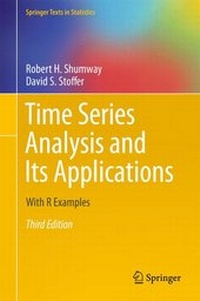
Time Series Analysis and Its Applications
Description

Time Series Analysis and Its Applications presents a balanced and comprehensive treatment of both time and frequency domain methods with accompanying theory. Numerous examples using nontrivial data illustrate solutions to problems such as discovering natural and anthropogenic climate change, evaluating pain perception experiments using functional magnetic resonance imaging, and monitoring a nuclear test ban treaty. The book is designed to be useful as a text for graduate level students in the physical, biological and social sciences and as a graduate level text in statistics. Some parts may also serve as an undergraduate introductory course. Theory and methodology are separated to allow presentations on different levels. In addition to coverage of classical methods of time series regression, ARIMA models, spectral analysis and state-space models, the text includes modern developments including categorical time series analysis, multivariate spectral methods, long memory series, nonlinear models, resampling techniques, GARCH models, stochastic volatility, wavelets and Markov chain Monte Carlo integration methods. The third edition includes a new section on testing for unit roots and the material on state-space modeling, ARMAX models, and regression with autocorrelated errors has been expanded.
Also new to this edition is the enhanced use of the freeware statistical package R. In particular, R code is now included in the text for nearly all of the numerical examples. Data sets and additional R scripts are now provided in one file that may be downloaded via the World Wide Web. This R supplement is a small compressed file that can be loaded easily into R making all the data sets and scripts available to the user with one simple command. The website for the text includes the code used in each example so that the reader may simply copy-and-paste code directly into R. Appendix R, which is new to this edition, provides a reference for the data sets and our R scripts that are used throughout the text. In addition, Appendix R includes a tutorial on basic R commands as well as an R time series tutorial.Reviews / Votes
From the reviews of the third edition:
"This is the third edition of a textbook first published in 2000. The text is intended as a course text for a time series analysis class at the graduate level. . the appendix includes everything that is necessary to understand the mathematics of time series analysis. As such, there is no way to describe the whole philosophy of the last half century to time series models better than this book." (Wolfgang Polasek, International Statistical Review, Vol. 81 (2), 2014)
"The book is organised in 7 chapters and 4 appendices. . the book is a valuable resource for students at undergraduate and graduate levels and researchers. The R code for almost all the numerical examples, and the appendices with tutorials containing basic R and R time series commands, are helpful for a better understanding of the theoretical concepts by bringing the theory into a more practical context." (Irina Ioana Mohorianu, zbMATH, Vol. 1276, 2014)More details
Other editions
Additional editions
Persons
David S. Stoffer is Professor of Statistics at the University of Pittsburgh. He is a Fellow of the American Statistical Association. He has made seminal contributions to the analysis of categorical time series and won the 1989 American Statistical Association Award for Outstanding Statistical Application in a joint paper analyzing categorical time series arising in infant sleep-state cycling. He is currently a Departmental Editor of the Journal of Forecasting and an Associate Editor of the Annals of Statistical Mathematics. He has served as a Program Director in the Division of Mathematical Sciences at the National Science Foundation and as an Associate Editor for the Journal of the American Statistical Association.
