

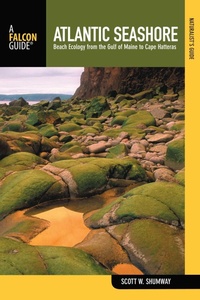
Naturalist's Guide to the Atlantic Seashore
Beach Ecology From The Gulf Of Maine To Cape Hatteras
Published on 3. October 2023
240 pages
978-1-4930-8293-3 (ISBN)
Description

From the North Carolina's Outer Banks to Maine's rocky coast, this comprehensive guidebook covers the ecology, wildlife, plants and ocean creatures in full-color photographs and vivid detail. No other book includes all of the plants, animals, and terrain along this stretch of coastline, making this a must-have for anyone who lives or recreates near the Atlantic.
The diverse habitats of the seashore, from the Rocky Shores to Sandy Beaches, Estuaries, Tidal Flats, Salt Marshes, Seagrass Meadows, and the Open Ocean are explored in detail in this user-friendly guide and natural history. The easy-to-use layout, comprehensive index, water-resistant cover and guaranteed binding make this a beautiful volume of natural history and biodiversity.
Scott W. Shumway is a professor of biology at Wheaton College. He lives in Westborough, Massachusetts.
The diverse habitats of the seashore, from the Rocky Shores to Sandy Beaches, Estuaries, Tidal Flats, Salt Marshes, Seagrass Meadows, and the Open Ocean are explored in detail in this user-friendly guide and natural history. The easy-to-use layout, comprehensive index, water-resistant cover and guaranteed binding make this a beautiful volume of natural history and biodiversity.
Scott W. Shumway is a professor of biology at Wheaton College. He lives in Westborough, Massachusetts.
Reviews / Votes
Most field guides are designed to simplify the identification of plants or animals. Shumway (Wheaton College) takes a different tack, forgoing any exhaustive or systematic list of organisms and instead presenting an overall view of all the elements and processes that shape and define the many ecosystems found along the Atlantic coast. The book is organized and color coded by habitat types (e.g., rocky shores, salt marshes, tidal flats, sand dunes), allowing discussion of a wide range of topics that include geologic history, introduced species, past and present human impacts, and the adaptations of the myriad species occurring in these areas. Numerous sidebars provide additional detail, and the book is liberally illustrated with color photographs. Shumway has done an excellent job of seamlessly integrating these subjects, making this both an enjoyable read and an essential companion for exploring the seashore. Summing Up: Highly recommended. General, undergraduate, and graduate collections. -- G. C Jensen, University of Washington "This book is a naturalist's guide to the diverse beach ecosystems stretching from the Gulf of Maine to Cape Hatteras in North Carolina. The author states that the book's goal is to provide an introduction to the natural histories of the major habitat types found along the east coast and give an overview of the species and natural processes ''you can actually observe when you go to the beach.'' After the introduction the book is split into sections by the major habitats ranging from ''Rocky shores'' to ''Seagrass meadows,'' each full of color photographs and engaging text." * Ecology * "This guide to coastal ecosystems of the Atlantic Coast is different from many other publications called "guides..." [I]t provides much useful information about the overall ecology of the different coastal environments and on the ecology, reproduction, and behavior of the organisms. The primary goal of the book, as explained by the author, is to describe how coastal environments function and to discuss the roles played by various species in these environments. And this he does very well." * Quarterly Review Of Biology *More details
Series
Language
English
Place of publication
New York
United States
Publishing group
Globe Pequot Press
File size
26,29 MB
ISBN-13
978-1-4930-8293-3 (9781493082933)
Copyright in bibliographic data and cover images is held by Nielsen Book Services Limited or by the publishers or by their respective licensors: all rights reserved.
Schweitzer Classification
Other editions
Additional editions
Scott Shumway
Naturalist's Guide to the Atlantic Seashore
Book
04/2008
Falcon Guides
€31.00
Shipment within 10-20 days
Person
Scott Shumway is a professor of biology at Wheaton College and has been studying the ecosystems of the Atlantic Coast for decades.
Content
- The Naturalist's Guide to the Atlantic Seashore
- CONTENTS
- Acknowledgments
- About the Author
- Preface
- Map
- Introduction
- The Coastline: Where the Ocean Meets the Land
- Food Chains and the Forgotten Plankton
- Rocky Shores
- Sandy Beaches
- Sand Dunes
- Estuaries
- Salt Marshes
- Tidal Flats
- Seagrass Meadows
- The Open Ocean
- The Beach in Winter
- Afterword
- References
- Index
